

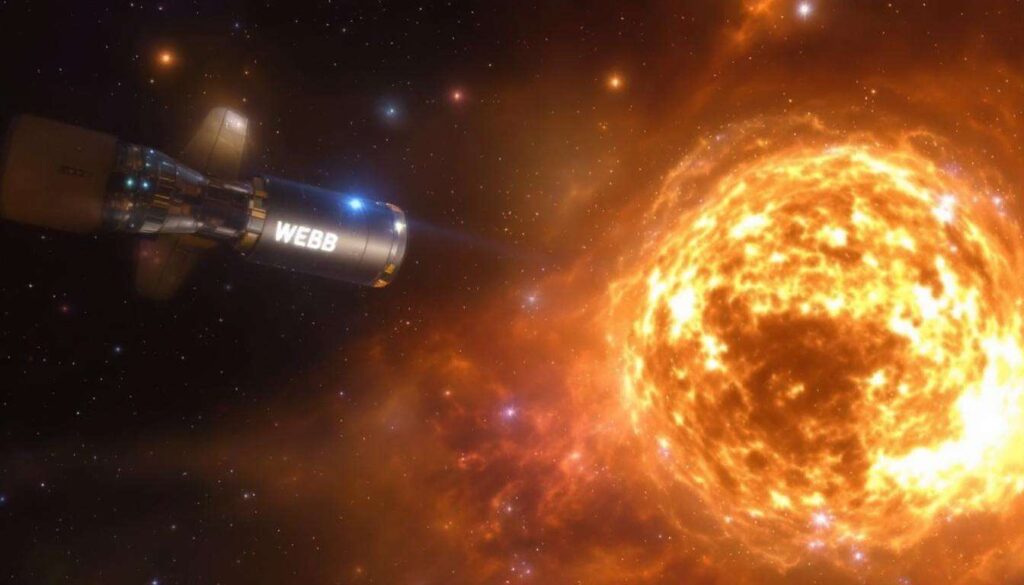
Gaze into the deepest recesses of time and space. The James Webb Space Telescope (JWST) is doing just that, potentially capturing an image of one of the universe’s most sought-after events: the explosive death of a first-generation star. This observation, if confirmed, is not merely another astronomical photograph; it represents a direct glimpse into the cosmic dawn, a period when the very first points of light pierced the primordial darkness. The data gathered by Webb’s advanced instruments could rewrite our understanding of how the universe evolved from a simple state of hydrogen and helium into the complex, element-rich cosmos we see today. This is a story of cosmic archaeology, using light from a cataclysm that occurred over 13 billion years ago to unearth the secrets of our origins.
Major discovery: the role of the Webb telescope
The power of infrared vision
The James Webb Space Telescope is uniquely equipped for this kind of discovery due to its unparalleled sensitivity to infrared light. As the universe expands, light from distant objects is stretched to longer, redder wavelengths in a phenomenon known as redshift. Light from the earliest stars, which was originally emitted in visible and ultraviolet wavelengths, has been stretched so much over its 13-billion-year journey that it now arrives at our solar system as infrared light. Webb’s massive primary mirror and sophisticated instruments, like the Near-Infrared Camera (NIRCam), are designed specifically to capture this faint, ancient glow, allowing it to see further back in time than any previous observatory. It effectively parts the cosmic curtains that have hidden the universe’s infancy from view.
A serendipitous find
This potential first supernova was not the result of a direct search but a fortunate discovery within a broader observational program. The candidate was identified in data from the GLASS-JWST Early Release Science Program, which aims to study distant galaxy clusters. One of the program’s goals is to use these massive clusters as “gravitational lenses,” where their immense gravity bends and magnifies the light from even more distant objects behind them. It was in the background of one of these lensed fields that astronomers noticed a new point of light that wasn’t there in previous images taken by the Hubble Space Telescope. This transient object, which brightened and then faded over time, exhibited the classic signature of a supernova.
Data confirmation process
Identifying a candidate is only the first step in a rigorous scientific process. To confirm that this object is indeed a supernova from a first-generation star, astronomers must conduct extensive follow-up observations and analysis. This involves:
- Spectroscopy: Using Webb’s Near-Infrared Spectrograph (NIRSpec) to break the object’s light into its constituent colors. This will reveal the chemical elements present in the explosion and provide a precise measurement of its distance, or redshift.
- Light curve analysis: Carefully monitoring the object’s brightness over time. The way a supernova brightens and fades, its “light curve,” provides crucial clues about the mass and type of star that exploded.
- Peer review: The findings must be submitted to scientific journals where other experts in the field will scrutinize the data, methodology, and conclusions before they are formally accepted by the scientific community.
This painstaking verification is essential to rule out other possibilities and solidify the importance of the discovery. The initial data is compelling, but the scientific process demands certainty before any final declarations can be made.
Webb’s ability to peer into the infrared universe is precisely what allows it to hunt for the explosive deaths of these primordial stellar giants.
The exploration of the universe’s first stars
Population III stars: the cosmic pioneers
The first stars to form in the universe, known as Population III stars, were unlike anything that exists today. Forged from the pristine hydrogen and helium created in the Big Bang, they were entirely devoid of heavier elements, which astronomers collectively call “metals.” Theoretical models predict these stars were behemoths, potentially hundreds of times more massive than our sun. Due to their immense mass, they burned through their nuclear fuel with incredible speed, living for only a few million years before dying in spectacular supernova explosions. These were the true pioneers of the cosmos, setting the stage for everything that followed.
The search for the first light
For decades, observing these first stars has been a primary goal of cosmology. Their formation marks the end of the “cosmic dark ages,” a period after the Big Bang when the universe was filled with a neutral gas and contained no sources of light. The ignition of Population III stars represents the “cosmic dawn,” the moment the universe first lit up. Finding direct evidence of these stars or their explosive deaths is akin to finding the first chapter in the story of cosmic evolution. It would provide the first observational confirmation of our theories about how structure began to form in the early universe.
How supernovae seeded the universe
The death of Population III stars was as important as their life. The supernova explosions that ended their brief existence were the universe’s first factories for heavy elements. Everything heavier than hydrogen and helium, including the oxygen we breathe, the carbon in our bodies, and the iron in our blood, was forged in the hearts of stars and dispersed into space through these cataclysmic events.
| Element | Origin | Cosmic Significance |
|---|---|---|
| Carbon, Oxygen | Stellar Fusion | Fundamental building blocks of life |
| Silicon, Iron | Supernova Nucleosynthesis | Core components of rocky planets |
| Gold, Uranium | Extreme Supernova Conditions | Traces of the most violent cosmic events |
These first supernovae seeded the interstellar medium with the raw materials necessary for the next generation of stars (Population II) and, eventually, planets and life. Finding one of these events is therefore not just about seeing an old explosion; it’s about witnessing the birth of chemical complexity in the universe.
The monumental significance of finding such an event is matched only by the challenge of confirming its unique properties.
The unique characteristics of the observed supernova
A distant and ancient event
The supernova candidate, located in a galaxy designated GLASS-z13, is exceptionally distant. Initial estimates place its redshift at approximately z = 13, meaning the light from this explosion has been traveling for over 13.4 billion years to reach us. We are seeing an event that took place when the universe was only about 300 to 400 million years old, a mere 3% of its current age. This places it firmly in the era when the first stars and galaxies were thought to be forming, making it a prime candidate for a Population III supernova.
Spectral analysis and composition
While full spectroscopic data is still being gathered, initial photometric data (measurements of light in different color filters) provides tantalizing clues. The light from the event appears to be extremely blue, which is consistent with the explosion of a very hot, massive star. Most importantly, a confirmed spectrum would be expected to show a profound lack of heavy elements. A modern supernova spectrum is rich with lines corresponding to elements like iron, silicon, and oxygen. The spectrum of a Population III supernova, by contrast, should be dominated by hydrogen and helium, providing a “clean” chemical fingerprint that would be unmistakable proof of its primordial origin.
Distinguishing from other cosmic phenomena
Astronomers must be cautious and rule out other possibilities before confirming the supernova hypothesis. A number of other energetic cosmic events can mimic a supernova’s appearance, especially at such extreme distances.
- Active Galactic Nucleus (AGN): The flaring of a supermassive black hole at the center of a distant galaxy could cause a sudden brightening. However, these flares typically have a different light curve and spectral signature than a supernova.
- Gamma-Ray Burst (GRB): The “afterglow” of a GRB can resemble a supernova, but these events are usually accompanied by a burst of high-energy gamma rays, which was not detected in this case.
- Tidal Disruption Event (TDE): This occurs when a star is torn apart by a black hole. While rare, it is another source of a transient bright light that must be considered and ruled out through detailed analysis of the light curve.
The current data, particularly the way the object faded, leans heavily toward the supernova explanation, but only more data can provide the final verdict.
The immense distance and the faintness of the signal make gathering this definitive data an extraordinary technical feat.
The challenges of interpreting data
The faintness of the signal
Observing an event from over 13 billion light-years away presents an immense challenge. The light from the supernova candidate is incredibly faint, having spread out over a vast distance and been absorbed by intervening material. Even with Webb’s giant 6.5-meter mirror, collecting enough photons to perform a detailed analysis requires long exposure times. Every piece of data is precious, and scientists must carefully account for instrumental noise and background light from foreground objects to extract the weak signal from this ancient explosion.
Cosmic dust and gas interference
The light’s long journey to Earth was not through empty space. It had to travel through the host galaxy of the supernova itself, as well as countless other galaxies and clouds of intergalactic gas along the line of sight. Dust and gas can absorb and scatter light, altering its color and dimming its brightness. Astronomers must create sophisticated models to correct for these effects, a process that introduces its own uncertainties. Accurately determining the intrinsic properties of the supernova depends on accurately subtracting the impact of this cosmic fog.
The need for theoretical models
Since we have never directly observed a Population III star, our understanding of them is based entirely on complex theoretical models and computer simulations. These models predict their mass, lifespan, and the characteristics of their supernova explosions. When astronomers analyze the data from the Webb telescope, they are comparing it against these theoretical predictions. A strong match would provide powerful validation for the models. However, if the data deviates from expectations, it could mean either the object is not a Population III supernova or that our theories about the first stars need to be revised. This interplay between observation and theory is at the heart of scientific progress.
Overcoming these challenges is crucial, as the confirmation of this event would have profound consequences for our understanding of the cosmos.
Implications for modern astronomy
Validating theories of early star formation
For decades, the existence of massive, metal-free Population III stars has been a cornerstone of cosmological theory, yet it has remained unproven by direct observation. Confirming this supernova would provide the first empirical evidence that these stellar giants truly existed. It would validate the fundamental predictions of models describing how the first structures formed out of the primordial gas of the early universe. This single observation would transform a key theoretical concept into an observed reality, providing a solid foundation for our understanding of cosmic origins.
Understanding chemical enrichment
Witnessing a first-generation supernova in action is like watching the starting gun fire for cosmic chemical evolution. By analyzing the composition of the material ejected in the explosion, scientists can directly measure the yields of the first heavy elements. This data will allow them to refine models of nucleosynthesis—the process of element creation inside stars. It will help answer fundamental questions, such as: how efficiently did the first stars produce elements like carbon and oxygen ? And how were these elements distributed into the intergalactic medium to fuel the next generation of star formation ? It’s a direct look at the process that ultimately made planets and people possible.
A new window into the cosmic dawn
This discovery, if confirmed, marks the beginning of a new era in astronomy: observational stellar archaeology. The Webb telescope is not just finding one object; it is opening a new window into the cosmic dawn. Astronomers can now move from speculating about the first stars to actively hunting for them and studying their properties. Each new discovery of a primordial supernova will be another piece of the puzzle, helping us map out the history of the universe’s first billion years with unprecedented detail. We can begin to answer questions about how quickly the first galaxies formed and how the universe was reionized by the light of these first stars.
This landmark observation is not an endpoint but a starting point for a whole new field of study, one that will be a central focus for Webb’s future operations.
Future projects and explorations of the Webb telescope
Follow-up observations
The immediate priority for the scientific community is to conduct intensive follow-up observations of the GLASS-z13 supernova candidate. This will involve dedicating more of Webb’s valuable observation time to obtain a high-quality spectrum with the NIRSpec instrument. A detailed spectrum is the key to unlocking the object’s secrets. It will provide a definitive redshift, confirming its immense distance, and allow for a precise measurement of its chemical composition. If the spectrum shows the telltale absence of metals, it will serve as the smoking gun evidence for a Population III star explosion.
Searching for more ‘first explosions’
This discovery is likely the tip of the iceberg. Astronomers now know what to look for, and the Webb telescope will continue to survey other deep fields and gravitationally lensed clusters to hunt for more of these transient events. By building a sample of primordial supernovae, scientists can study their diversity. Were all Population III stars massive, or did they come in a range of sizes ? Did they all explode in the same way ? Finding more examples will move the field from a single case study to a statistical analysis, providing a much richer understanding of the universe’s first stellar generation.
Beyond supernovae: first galaxies and black holes
The quest to understand the cosmic dawn extends beyond supernovae. The same deep-field observations that find these explosions are also designed to achieve other groundbreaking goals. Webb’s mission includes:
- Identifying the first galaxies: Finding and studying the small, faint protogalaxies that were the building blocks of massive galaxies like our own Milky Way.
- Investigating cosmic reionization: Mapping how the light from the first stars and galaxies burned through the neutral hydrogen fog that filled the early universe.
- Seeding supermassive black holes: Searching for clues about how the supermassive black holes found at the center of nearly every large galaxy today first formed. The remnants of Population III stars are one leading candidate for the “seeds” from which these monsters grew.
The Webb telescope is a time machine, and its journey into the past has only just begun.
Acknowledge the monumental potential of this discovery. The James Webb Space Telescope has provided a candidate for the most distant supernova ever seen, possibly heralding the death of one of the universe’s first stars. Understand that this observation opens a direct window into the cosmic dawn, offering a chance to test long-held theories of star formation and chemical enrichment. Follow the rigorous process of scientific confirmation that is now underway, as it will ultimately determine the true nature of this ancient light. Recognize that this is just the beginning of a new era of cosmic exploration, promising to reveal the story of our universe’s origins in stunning detail.