

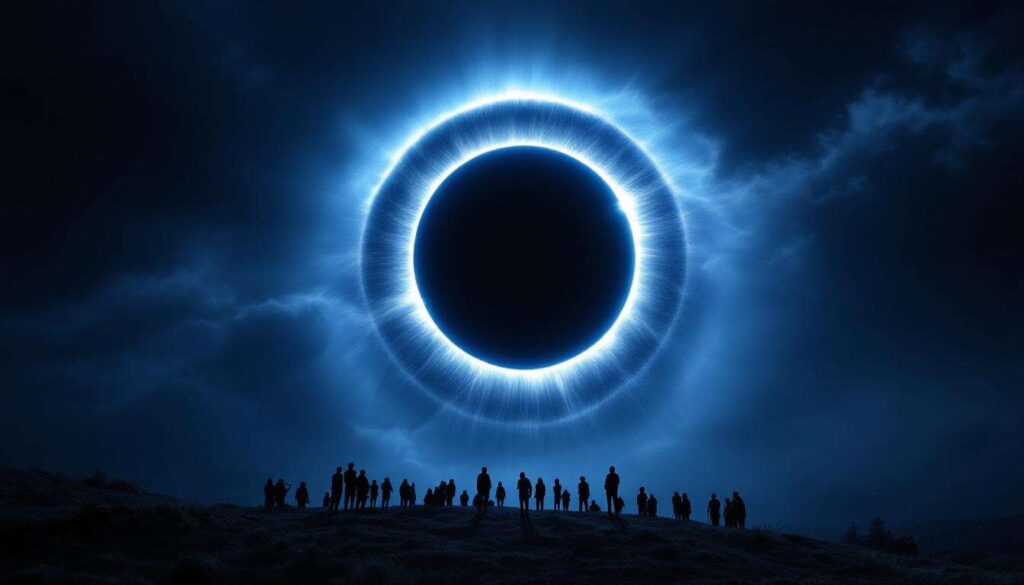
A colossal shadow will soon sweep across the planet, plunging bustling cities and serene landscapes into an eerie, midday twilight. For a few breathtaking minutes, the sun will vanish from the sky, blotted out by the moon in a perfect, rare alignment. This is not a scene from science fiction but a preview of a real celestial event of historic proportions, an astronomical spectacle that promises to be the longest and most widely viewed total solar eclipse for a generation. Observers are already marking their calendars for what many are calling the true eclipse of the century, an event that will offer an unparalleled glimpse into the hidden mysteries of our solar system.
Date of the eclipse
Pinpointing the event
The celestial appointment that has astronomers and sky-gazers buzzing is set for August 12, 2045. This specific date marks the moment when the moon’s umbra, or its darkest, innermost shadow, will trace a path across the surface of the Earth. Falling on a Saturday, the timing of the event is particularly fortuitous, allowing millions of people across its path to witness the spectacle without the constraints of a typical workday. Planning for this event is already underway, as the path of totality will cross densely populated areas, making it one of the most accessible major eclipses in modern history.
Global timeline and visibility
The eclipse will begin its journey over the Pacific Ocean before making landfall in the United States. The shadow will enter Northern California in the morning and race southeastward across the country, exiting over the coast of Florida by early afternoon. For those in the direct path, the experience will be profound, but a partial eclipse will be visible to a much wider audience, encompassing all of North America, Central America, and a large portion of South America. It is crucial for observers to know their local times for the start of the partial phase, the beginning of totality, the maximum eclipse, and the end of all phases to fully appreciate the unfolding drama in the sky.
This long-awaited date provides a clear target for communities, scientists, and tourists to prepare for the influx of visitors and the unique logistical challenges that accompany an event of this magnitude. As we move closer to 2045, understanding the precise timing will be key to a successful viewing experience.
Exceptional duration of the event
Breaking records
What sets the August 12, 2045, eclipse apart is its extraordinary duration. At its point of greatest eclipse, located over the Atlantic Ocean just off the coast of Florida, totality will last for a stunning 6 minutes and 6 seconds. This is significantly longer than most total solar eclipses, which typically last for only two to three minutes. For comparison, the widely watched “Great American Eclipse” of 2017 featured a maximum totality of about 2 minutes and 40 seconds. The 2045 event will offer more than double that time in darkness, providing an extended opportunity for both scientific observation and personal awe.
The science behind the length
The remarkable duration is not a random occurrence but the result of a near-perfect cosmic alignment. Several factors contribute to this extended period of totality:
- The moon’s position: The moon will be near its perigee, the point in its orbit where it is closest to Earth. This makes its apparent size in the sky larger, allowing it to cover the sun more completely and for a longer time.
- The Earth’s position: The Earth will be near its aphelion, the point in its orbit where it is farthest from the sun. This makes the sun’s apparent size in the sky slightly smaller.
- The eclipse path: The path of the moon’s shadow will cross the Earth near the equator, where the rotational speed of the planet is highest. This allows the Earth’s surface to “keep up” with the shadow more effectively, prolonging the experience for observers on the ground.
This combination of an apparently large moon and a slightly smaller sun is the ideal recipe for a long-lasting total solar eclipse.
Totality duration comparison
To put the 2045 eclipse in perspective, it is helpful to compare its duration of totality with other notable eclipses of the 21st century. As the table below illustrates, its length is truly exceptional and approaches the theoretical maximum duration possible from Earth’s surface.
| Eclipse Event | Maximum Totality Duration |
| Great American Eclipse (August 21, 2017) | 2 minutes, 40 seconds |
| Great North American Eclipse (April 8, 2024) | 4 minutes, 28 seconds |
| Eclipse of the Century (August 12, 2045) | 6 minutes, 6 seconds |
| Theoretical Maximum on Earth | 7 minutes, 32 seconds |
This extended time in shadow not only enhances the viewing experience but also provides a critical window for scientists to conduct complex experiments that are impossible under normal conditions. This brings us to the profound astronomical importance of the event.
Astronomical significance
A rare celestial alignment
A total solar eclipse occurs during a specific alignment known as syzygy, when the sun, moon, and Earth line up perfectly in that order. While a new moon occurs monthly, the moon’s orbit is tilted by about five degrees relative to Earth’s orbit around the sun. Because of this tilt, the moon’s shadow usually passes above or below our planet. Only when the new moon crosses the plane of Earth’s orbit does its shadow fall upon the surface, creating a solar eclipse. A total eclipse is even rarer, requiring the observer to be located within the narrow path of the umbra. The 2045 event is a textbook example of this precise cosmic geometry.
The sun’s corona revealed
Perhaps the most significant scientific gift of a total solar eclipse is the rare view it provides of the sun’s corona. This is the sun’s outer atmosphere, a region of superheated plasma that extends millions of miles into space. Normally, the corona is completely invisible, drowned out by the intense brightness of the sun’s photosphere. During totality, the moon acts as a natural coronagraph, blocking the main disk of the sun and allowing the ethereal, pearly-white tendrils of the corona to shine forth. Scientists will use these precious six minutes to study its structure, temperature, and magnetic fields, which are key to understanding solar flares and coronal mass ejections that can impact Earth.
Testing theories of relativity
Historically, total solar eclipses have served as crucial natural experiments. The 1919 eclipse provided the first observational proof of Albert Einstein’s theory of general relativity, by showing that the sun’s immense gravity could bend the light from distant stars. While this theory is now well-established, modern astronomers continue to use eclipses to refine our understanding of gravity and the fundamental laws of physics. Each eclipse offers a chance to conduct new tests and gather data with increasingly sensitive instruments.
The unique scientific opportunities presented by this eclipse are matched only by the logistical challenge of being in the right place at the right time to witness it. This makes choosing a viewing location a critical part of the preparation.
Best locations to observe
The path of totality
The path of totality for the 2045 eclipse will be a spectacle in itself, stretching coast-to-coast across the United States. The approximately 140-mile-wide path will begin in Northern California, travel southeast through Nevada, Utah, Colorado, Kansas, Oklahoma, Arkansas, Mississippi, and Alabama, before crossing over a large portion of Florida. It will then continue over the Bahamas and the Caribbean before ending over South America. This trajectory makes it one of the most accessible eclipses for the American population in over a century, passing directly over or near numerous major metropolitan areas.
Prime viewing spots
While any location within the path of totality will offer a stunning show, some spots may offer better prospects based on historical weather data and local infrastructure. Potential observers should consider:
- The Intermountain West: States like Nevada, Utah, and Colorado are known for their high altitudes and typically clear, dry summer skies, making them statistically excellent choices for avoiding cloud cover.
- The Florida Peninsula: The point of longest duration on land will occur in Florida. While the state is prone to summer afternoon thunderstorms, a morning or early afternoon eclipse time may precede the daily weather patterns.
- Cruise ship expeditions: For those wishing to guarantee clear skies, many cruise lines will likely offer special eclipse-chasing voyages in the Atlantic and Caribbean, allowing them to move to the most promising locations based on real-time weather forecasts.
Urban centers in the dark
Unlike many eclipses that pass over remote areas, the 2045 event will plunge several major American cities into darkness. Residents and visitors in cities such as Reno, Salt Lake City, Colorado Springs, Tulsa, Little Rock, and Orlando will be able to experience totality without traveling far. This urban accessibility will create unique opportunities for massive public viewing events but also presents challenges for traffic and resource management. It is advisable for anyone planning to be in these areas to prepare for large crowds and make arrangements well in advance.
Once a location is chosen, the next step is to ensure you have the right knowledge and equipment to watch the event safely and effectively.
Tips for optimal viewing
Eye safety first
The single most important rule for observing a solar eclipse is to never look directly at the sun without proper eye protection. Staring at the sun, even for a few seconds, can cause permanent eye damage or blindness. The only safe way to view the partial phases of the eclipse is through specially designed solar viewers or eclipse glasses that meet the ISO 12312-2 international safety standard. Regular sunglasses, no matter how dark, are not safe for solar viewing. The only time it is safe to look at the eclipse without protection is during the brief period of totality, when the sun’s face is completely blocked. As soon as the sun begins to reappear, certified eye protection must be used again.
Essential equipment
Beyond basic eye protection, a few other items can enhance the viewing experience. A simple pinhole projector, which can be made from two pieces of cardboard, is an excellent and safe way to watch the partial phases indirectly. For those with cameras, telescopes, or binoculars, these instruments must be fitted with a certified solar filter that covers the front aperture. Attempting to use a standard telescope or camera to view the sun will not only destroy the equipment but also cause immediate and severe eye injury. During totality, these filters can be removed to view the corona, but they must be put back in place before the sun reemerges.
Planning your trip
The 2017 and 2024 eclipses demonstrated that millions of people will travel to be within the path of totality. This mass movement of people can lead to enormous traffic jams, sold-out hotels, and strained local resources. Advice for 2045 is clear: plan far in advance. Book accommodations a year or more ahead of time. Plan to arrive at your viewing location at least a day early and consider staying a day late to avoid the worst of the post-eclipse traffic. Have a full tank of gas and bring plenty of water, food, and other essentials, as local stores may be overwhelmed.
The immense effort to witness this event speaks to its profound effect on both our scientific understanding and our shared human culture.
Cultural and scientific impact
Historical perspectives
Throughout history, eclipses have been powerful and often feared events. Many ancient cultures interpreted the sudden darkening of the sun as a terrifying omen, a sign of angry gods, or a celestial dragon devouring the sun. These events were recorded in ancient texts and rock carvings, providing some of our earliest astronomical data. Over time, as scientific understanding grew, fear turned to fascination. Eclipses became predictable, transforming from omens of doom into celebrated celestial events that demonstrated the power of human intellect and the clockwork precision of the cosmos.
Modern scientific endeavors
The 2045 eclipse will be a major scientific event, with researchers from around the world converging on the path of totality. Armed with advanced spectrometers, high-resolution cameras, and other sophisticated instruments, they will undertake a wide range of studies. Key research areas will include mapping the magnetic field of the corona, analyzing the chemical composition of the solar atmosphere, and observing the behavior of the Earth’s ionosphere as it responds to the sudden cutoff of solar radiation. Citizen science projects will also likely play a large role, allowing amateurs to contribute valuable data.
A unifying global event
Beyond the science, a total solar eclipse is a deeply human experience. It is a moment that can foster a profound sense of connection to the cosmos and to each other. People from all walks of life and from all over the world will gather to share in a moment of collective wonder. For over six minutes, those in the path of totality will stand together in an otherworldly twilight, united by the shared spectacle of the sun’s hidden glory. This communal experience serves as a powerful reminder of our place in the universe and the beauty that can be found when we look up.
The eclipse of August 12, 2045, promises to be a defining celestial event for a generation. With its extraordinary duration of over six minutes of totality and a path crossing the heart of the United States, it offers an unparalleled opportunity for scientific discovery and public engagement. From the high deserts of the west to the sunny shores of Florida, millions will have the chance to witness the sun’s magnificent corona. For those who prepare properly, prioritizing eye safety and planning logistics well in advance, it will be a truly unforgettable experience, a brief and beautiful dance of the sun and moon.