

Visitors from beyond our solar system have long been a staple of science fiction, but they are now a concrete reality for astronomers. These interstellar wanderers, messengers from other stars, carry with them the chemical blueprints of their distant birthplaces. The latest of these cosmic travelers to capture scientific attention, a comet designated 3I/ATLAS, is proving to be particularly enigmatic. Its behavior defies simple explanations, showcasing a complex dance of gas and dust that provides an unprecedented look into the nature of objects formed in entirely different stellar nurseries.
Discovery of the interstellar comet 3I/ATLAS
The ATLAS survey’s watchful eyes
The discovery of this interstellar object is a testament to the power of modern astronomical surveys. The Asteroid Terrestrial-impact Last Alert System, or ATLAS, is a robotic survey and early warning system designed to detect near-Earth objects. Comprising several telescopes, it scans the entire observable sky every few nights. It was during one of these routine scans that an faint, unfamiliar object was flagged by the system’s automated software, setting in motion a chain of follow-up observations that would confirm its extraordinary origin.
Confirmation of an interstellar trajectory
Upon initial detection, astronomers around the world turned their instruments toward the newcomer. By precisely measuring its position over several days and weeks, they were able to calculate its orbit. The data was unequivocal: the object was moving far too fast to be gravitationally bound to our sun. Its trajectory was a sharp hyperbola, a clear indication that it had entered our solar system from interstellar space and would, after a brief visit, return to the void between the stars. This confirmation made it only the third such interstellar object ever detected.
A name from beyond
The naming of celestial objects follows strict conventions set by the International Astronomical Union (IAU). For interstellar objects, the designation begins with an ‘I’. Comet 3I/ATLAS was therefore officially named as the third interstellar object confirmed. The ‘ATLAS’ part of its name credits the survey that first discovered it. This simple name belies the profound significance of the object, a pristine sample from another solar system delivered to our cosmic doorstep.
The confirmation of its origin was just the beginning. Scientists soon realized that the comet’s physical properties were just as remarkable as its journey through space.
The unique characteristics of comet 3I/ATLAS
A primordial composition
Analysis of the light reflecting off 3I/ATLAS revealed a composition rich in volatile ices, such as carbon monoxide and carbon dioxide. This suggests it formed in a very cold region, far from its parent star. Unlike many comets in our own solar system, which have been repeatedly heated by the sun, 3I/ATLAS appears to be a remarkably pristine relic. Its chemical makeup offers a snapshot of the raw materials present in its home system during its formation, billions of years ago.
A visitor in a hurry
The comet’s high velocity is a key characteristic. As it approached the sun, it was traveling at a speed that could not be achieved by any object originating from our own Oort cloud. This high speed is a direct consequence of its journey from another star’s gravitational influence. Comparing it to its interstellar predecessors reveals distinct differences in their nature and journey.
| Object Name | Designation | Type | Estimated Velocity (relative to Sun) |
|---|---|---|---|
| ‘Oumuamua | 1I/2017 U1 | Asteroid-like, ambiguous | 26.3 km/s |
| Borisov | 2I/Borisov | Comet | 32.2 km/s |
| ATLAS | 3I/ATLAS | Comet | Approximately 30 km/s |
These unique compositional and orbital characteristics directly influence the comet’s activity as it nears the sun, leading to some truly bizarre and unexpected behavior.
The phenomenon of wobbling jets
The engine of a comet
As a comet approaches the sun, solar radiation heats its surface, causing frozen gases to turn directly into vapor in a process called sublimation. This outgassing erupts from the nucleus in powerful streams known as jets. These jets carry dust and gas away from the comet, forming the characteristic coma and tail. The strength and location of these jets depend on the comet’s surface composition and its rotation.
An unstable rotation
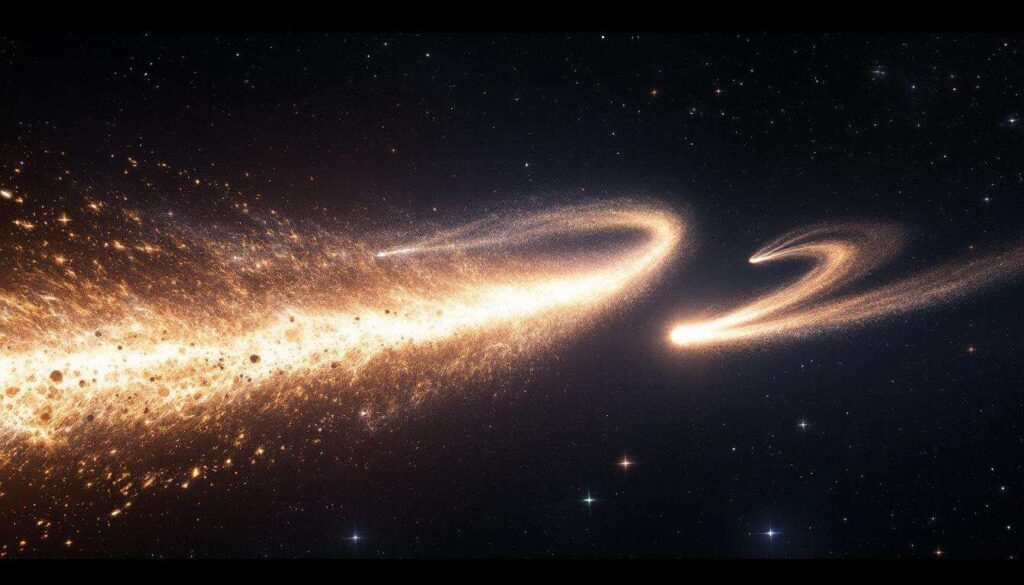
Observations of 3I/ATLAS revealed that its jets were not firing in a stable, predictable pattern. Instead, they appeared to be wobbling. This strange behavior is thought to be caused by a combination of factors:
- An irregularly shaped nucleus, meaning sunlight heats different areas unevenly.
- A complex rotation, where the comet may be tumbling end-over-end rather than spinning smoothly on a single axis.
- The jets themselves acting like thrusters, pushing on the nucleus and causing its rotation to change over time.
This creates a feedback loop where the outgassing alters the rotation, which in turn alters the outgassing. It’s a dynamic and chaotic process that astronomers are still working to model accurately.
Capturing the dance
Telescopes like the Hubble Space Telescope have been instrumental in observing this phenomenon. By taking a series of images over time, scientists can create time-lapse videos that show the jets sputtering and changing direction. This is not just a visual curiosity; it provides critical information about the internal structure and physical properties of the cometary nucleus, something that is impossible to see directly from such a great distance.
This outgassing and the material it expels are responsible for another of the comet’s visual oddities: its highly unusual tail structure.
The sun-facing anti-tail: a rare occurrence
Understanding cometary tails
Typically, a comet displays two main tails. The ion tail is composed of lightweight, ionized gas that is pushed directly away from the sun by the solar wind, always pointing anti-sunward. The dust tail is made of heavier dust particles that are less affected by the solar wind and more by the comet’s own orbital motion. They tend to curve along the comet’s path. An ‘anti-tail’, however, is a different beast altogether.
An illusion of perspective
An anti-tail is largely an optical illusion. It occurs when Earth passes through the orbital plane of a comet. From our vantage point, we are looking at the comet’s dust trail edge-on. The larger dust particles, which were ejected from the comet much earlier and are lagging far behind in its orbit, appear to form a spike pointing towards the sun. It’s not a separate tail, but rather a specific view of the broad, fan-shaped dust trail.
A truly sunward feature
What makes the anti-tail of 3I/ATLAS so remarkable is that it is not merely an illusion of geometry. Detailed analysis shows that this feature is composed of larger dust grains, perhaps millimeter-sized, that were ejected from the comet at very low speeds. Because of their size and slow ejection, they are barely affected by the sun’s radiation pressure and remain very close to the comet’s orbit. As the comet swings around the sun, this trail of debris can, for a time, appear to point directly at the sun. This is an extremely rare configuration that tells scientists about the specific size and ejection velocity of the dust coming off this interstellar visitor.
Observing such rare phenomena in an object from another star system has profound consequences for our understanding of how comets and planetary systems form across the galaxy.
Implications for the study of interstellar comets
Windows into other solar systems
Each interstellar object is a physical sample from a distant star system. By studying the composition of 3I/ATLAS, we learn about the chemical environment where it formed. The high abundance of certain volatile ices, for instance, can inform models of protoplanetary disks around other stars. It helps answer a fundamental question: is the chemistry that formed our solar system common or rare in the Milky Way ?
Testing models of comet formation
The bizarre behavior of 3I/ATLAS, from its wobbling jets to its unique anti-tail, challenges existing models of cometary physics. These models were developed based on comets from our own solar system. An object like 3I/ATLAS provides a crucial out-of-sample test. If our models can’t explain its behavior, they need to be revised and improved, ultimately leading to a more robust understanding of how all comets work, regardless of their origin.
A galactic census of building blocks
As we detect more interstellar objects, we can begin to build a statistical census of their properties.
- Are most interstellar visitors rocky like ‘Oumuamua or icy like Borisov and ATLAS ?
- Do they show a wide diversity of compositions, or are they broadly similar ?
- Does their composition correlate with their star of origin’s type or location in the galaxy ?
Answering these questions will paint a much clearer picture of planet formation across the galaxy.
The study of 3I/ATLAS is just one data point, but it’s a vital one that highlights the need for even more powerful tools to find and characterize these fleeting visitors.
Future perspectives on comet observation
The next generation of sky surveys
The discovery of 3I/ATLAS would have been nearly impossible just a few decades ago. The future is even brighter. The upcoming Vera C. Rubin Observatory is expected to revolutionize this field. With its enormous mirror and camera, it will survey the sky with unprecedented depth and speed. Astronomers estimate that it could discover dozens of interstellar objects every year, transforming them from rare curiosities into a population of objects that can be studied systematically.
Rapid response and characterization
Finding these objects is only the first step. The key will be to characterize them quickly before they speed out of the solar system forever. This requires a global network of telescopes that can be rapidly deployed to conduct follow-up observations. Spectrographs will analyze their chemical makeup, while powerful imaging systems will track their activity and rotation. This coordinated effort will be essential to extract the maximum scientific value from each brief visit.
The dream of a rendezvous mission
While challenging, the ultimate goal for many planetary scientists is to send a spacecraft to rendezvous with an interstellar object. Projects like the European Space Agency’s ‘Comet Interceptor’ are being designed for this very purpose. The mission would wait in a stable location in space for a suitable interstellar target to be discovered. Once a target is identified, the spacecraft would be sent on a trajectory to fly by the object, studying it up close with a suite of advanced instruments. Such a mission would provide a level of detail that is simply unattainable from Earth.
The study of comet 3I/ATLAS has provided a tantalizing glimpse into the universe beyond our sun’s influence. Its wobbling jets and rare sun-facing anti-tail are not just cosmic oddities; they are crucial clues about the diverse processes that shape planetary systems across our galaxy. Each new interstellar visitor like this one pushes the boundaries of our knowledge, reminding us that our solar system is just one small part of a much larger and more complex cosmic neighborhood.