



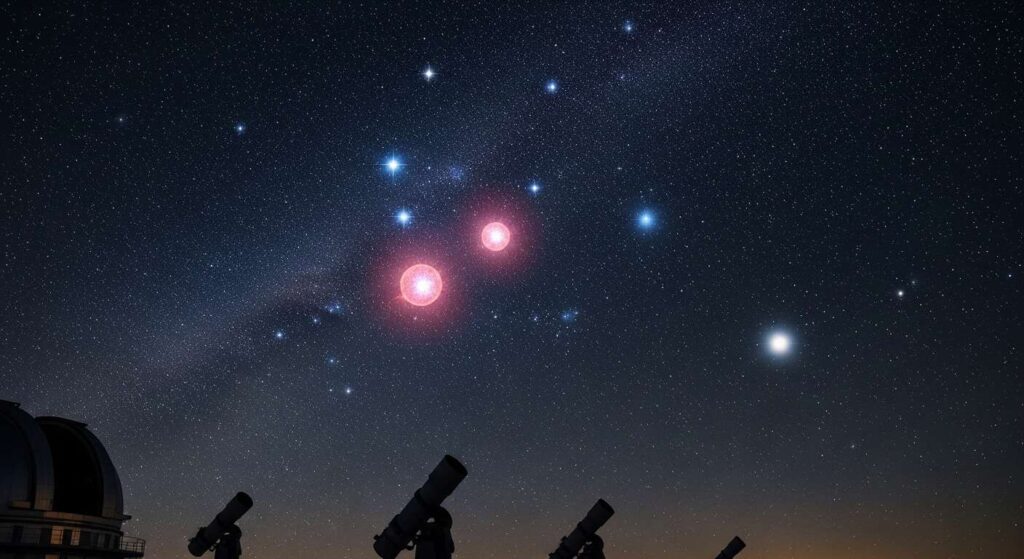
In the vast stellar nursery of the Taurus cloud, a recent astronomical survey has unveiled two remarkable celestial systems, each centered on an ultracool dwarf star. The findings, which include both a planetary-mass object and a low-mass stellar companion, provide critical new data points that challenge and refine existing theories of how stars and planets form. This discovery pushes the boundaries of observation, demonstrating the increasing power of ground-based telescopes to peer into the dimmest corners of our galactic neighborhood and uncover the diverse architectures of stellar systems.
Discovery of exoplanets around ultracool dwarfs
A groundbreaking find
Astronomers have confirmed the existence of two new companions orbiting a pair of ultracool dwarfs located in the Taurus star-forming region. The first system, 2M0437, features a planetary-mass companion, while the second, GM Cha, is orbited by a small stellar companion, or brown dwarf. These discoveries are significant because they represent some of the widest-orbit companions ever found around such low-mass host stars. The sheer distance between these objects and their parent stars raises fundamental questions about their formation history.
The significance of ultracool dwarfs
Ultracool dwarfs are stars at the very bottom of the main sequence, with masses less than a tenth of our sun’s. They are the most numerous type of star in the Milky Way, yet their faintness and low temperatures make them, and any potential planets, incredibly difficult to study. Finding companions around them is a technical triumph and offers a crucial window into the most common type of stellar environment in the galaxy. Each detection provides a valuable test case for theories that attempt to explain how planetary and binary systems come into being.
Details of the discovered systems
The two systems present intriguing, yet distinct, configurations that contribute to our understanding of cosmic diversity. Their properties highlight the different outcomes possible in the chaotic environments of stellar nurseries. The key characteristics include:
- The 2M0437 system: This involves an ultracool dwarf host with a companion estimated to be several times the mass of Jupiter. The separation between the two is approximately 100 astronomical units (AU), which is more than three times the distance between Neptune and our sun.
- The GM Cha system: This system consists of an ultracool dwarf orbited by a much more massive companion, likely a brown dwarf or a very low-mass star. Their separation is even more extreme, measured in hundreds of AU, placing them in a category of very wide binary systems.
These initial findings about the companions orbiting 2M0437 and GM Cha are based on their specific physical properties, which were painstakingly measured by the research team.
Characteristics of the ultracool dwarfs in Taurus
Profile of 2MASS J04372171+2651014 (2M0437)
The star known as 2M0437 is a young M-type dwarf, a class of stars significantly cooler and dimmer than our sun. Located about 400 light-years away, it is part of the Taurus stellar association, with an estimated age of just two to five million years. Its youth is a critical factor, as any companion object is still radiating the heat from its formation, making it brighter in infrared light and thus easier to detect. Its companion, 2M0437 b, has a mass that places it squarely in the planetary regime, though it is much more massive than any planet in our own solar system.
Profile of GM Cha
GM Cha is another member of the young stellar population in the southern part of the Taurus-Auriga region. Like 2M0437, it is an ultracool dwarf with a very low mass. Its companion, however, is substantially more massive, tipping the scales into the brown dwarf or low-mass star category. A brown dwarf is a “failed star,” an object more massive than a planet but lacking the sufficient mass to ignite sustained nuclear fusion in its core. The wide separation in the GM Cha system makes it a prime example of a loosely bound binary pair.
Comparative analysis
A side-by-side comparison of the two systems reveals both similarities in their youth and location, but stark differences in their architecture. These variations provide crucial clues for theorists modeling the formation of such systems.
| Property | 2M0437 System | GM Cha System |
|---|---|---|
| Host Star Type | M-type Ultracool Dwarf | M-type Ultracool Dwarf |
| System Age | 2-5 million years | 1-3 million years |
| Companion Type | Planetary-mass object | Brown dwarf / Low-mass star |
| Companion Mass | 3-5 Jupiter masses | 15-30 Jupiter masses |
| Orbital Separation | ~100 AU | ~350 AU |
The ability to resolve and characterize these faint objects at such great distances is a testament to the sophisticated observation methods employed by modern astronomy.
Observation techniques used by astronomers
The power of direct imaging
Both companions were discovered using a technique called direct imaging. Unlike more common, indirect methods that detect a planet’s effect on its star (like transits or radial velocity), direct imaging involves capturing actual photons of light from the companion itself. This is exceptionally challenging because the light from the host star is millions or billions of times brighter than its companion. Astronomers use a coronagraph, a device that blocks the star’s overwhelming glare, allowing the faint light from the nearby object to be seen.
Leveraging adaptive optics
These observations would have been impossible without the use of adaptive optics (AO) systems on large ground-based telescopes. The Earth’s atmosphere blurs and distorts starlight, smearing out the fine details needed to separate a faint companion from its bright host. AO systems counteract this effect by using a deformable mirror that changes its shape hundreds of times per second to correct for atmospheric turbulence in real time. This technology sharpens the view, effectively giving the telescope vision as clear as if it were in space.
Multi-wavelength observations
To confirm that the detected objects were true, gravitationally bound companions and not just unrelated background stars, the team conducted follow-up observations over time and across different wavelengths. Key instruments and facilities included:
- The Subaru Telescope in Hawaii, equipped with its state-of-the-art AO system and infrared camera.
- The Keck Observatory, also in Hawaii, which was used to obtain spectra of the objects to analyze their atmospheric composition and confirm their nature.
- Archival data from other telescopes, which helped establish the common motion of the stars and their companions across the sky, proving they were moving together as a system.
These meticulous techniques provided the robust evidence needed to announce the discovery, a result with profound consequences for our understanding of how such systems are built.
Implications for understanding stellar systems
Challenging formation theories
The existence of such massive companions on extremely wide orbits poses a significant puzzle for dominant planet formation theories. The leading model, core accretion, suggests that planets form from the slow buildup of dust and gas in a protoplanetary disk close to the star. This process is thought to be too slow and inefficient to form giant planets at distances of 100 AU or more. The alternative model, gravitational instability, where a massive disk rapidly fragments under its own gravity to form clumps, might better explain these wide-orbit giants, but it too has its limitations.
Insights into binary and planetary systems
These discoveries add to a growing body of evidence that the formation of stars and planets is deeply interconnected. The GM Cha system, in particular, blurs the line between a planetary system and a binary star system. It suggests that the same underlying physical processes might be responsible for forming both giant planets and stellar companions, with the final outcome depending on the initial conditions in the collapsing cloud of gas and dust. These systems serve as crucial benchmarks for testing the full spectrum of formation outcomes.
The role of stellar youth
The fact that these systems were found in the young Taurus region is no coincidence. Young planets and brown dwarfs are still intensely hot from the energy released during their formation. This residual heat makes them glow brightly in infrared wavelengths, rendering them detectable with current technology. As they age, they cool and fade, becoming much harder to see. Targeting young stellar associations like Taurus is therefore a key strategy for direct imaging surveys aiming to build a census of wide-orbit companions.
The choice to focus on the Taurus cloud was strategic, leveraging its unique properties as a celestial laboratory for studying the early stages of stellar and planetary evolution.
The importance of the Taurus region for astronomy
A stellar nursery close to home
The Taurus molecular cloud is one of the nearest large star-forming regions to Earth, located approximately 430 light-years away. Its relative proximity makes it an ideal target for detailed study, as telescopes can resolve finer details than in more distant stellar nurseries. It is a sprawling, filamentary complex of gas and dust that is actively giving birth to new, low-mass stars like 2M0437 and GM Cha. Its youth, with an average age of only one to three million years, provides a snapshot of star and planet formation in its earliest phases.
A rich hunting ground for exoplanets
Because of its age and proximity, Taurus has become a prime hunting ground for astronomers searching for young, newly formed exoplanets via direct imaging. The region’s stars are predominantly low-mass, reflecting the most common type of star in the galaxy. Studying the planetary systems in Taurus helps astronomers understand the initial conditions and architectures of the most typical solar systems in the universe. Previous surveys have already uncovered a wealth of protoplanetary disks and a handful of directly imaged planets in this region.
Previous discoveries in Taurus
The Taurus region has a long history of yielding groundbreaking discoveries that have shaped our understanding of astrophysics. These include:
- The first clear images of protoplanetary disks, the dusty, gaseous cradles where planets are born.
- The detection of some of the youngest known protostars, still deeply embedded in their natal clouds.
- The identification of other wide-orbit planetary-mass companions, which helped establish that such systems, while rare, are a possible outcome of the formation process.
The latest findings from 2M0437 and GM Cha build upon this legacy, promising that future investigations in Taurus and similar regions will continue to yield transformative results.
Future perspectives in astrophysics research
Upcoming observational campaigns
The detailed characterization of these newly discovered companions is just beginning. Future observations with next-generation facilities will provide unprecedented insights. The James Webb Space Telescope (JWST) is uniquely suited to analyze the atmospheric composition of these objects, searching for molecules like water, methane, and carbon monoxide. On the ground, a new class of extremely large telescopes (ELTs) with mirrors 30 meters or more in diameter will be able to image even fainter, smaller planets around these stars, pushing direct imaging capabilities to new frontiers.
Refining formation models
Every new data point from systems like 2M0437 and GM Cha provides a critical test for theoretical models. The properties of these companions, their masses, and their wide orbits will force theorists to revise and refine their simulations. By comparing the observed population of companions with the predictions from models of core accretion and gravitational instability, scientists can better constrain which physical processes dominate in different environments and around stars of different masses.
The search for habitable worlds
While the companions discovered here are giant, gaseous worlds and not candidates for life, studying their formation is a vital step in the broader quest to understand the prevalence of habitable planets. Ultracool dwarfs are the most common stars, and they are known to host rocky, Earth-sized planets, such as those in the famous TRAPPIST-1 system. By understanding how giant planets form in the outer reaches of these systems, we gain a more complete picture of their architectural possibilities, including the potential for smaller, rocky worlds to exist in stable orbits closer to the star.
The discovery of these two systems in Taurus provides a clear demonstration of astronomical progress. By combining powerful observational techniques with strategic survey targets, researchers have uncovered new worlds that challenge our theories of formation. These findings underscore the dynamic and often surprising nature of the cosmos and set the stage for future telescopes to explore the full diversity of planetary and stellar systems across our galaxy.