

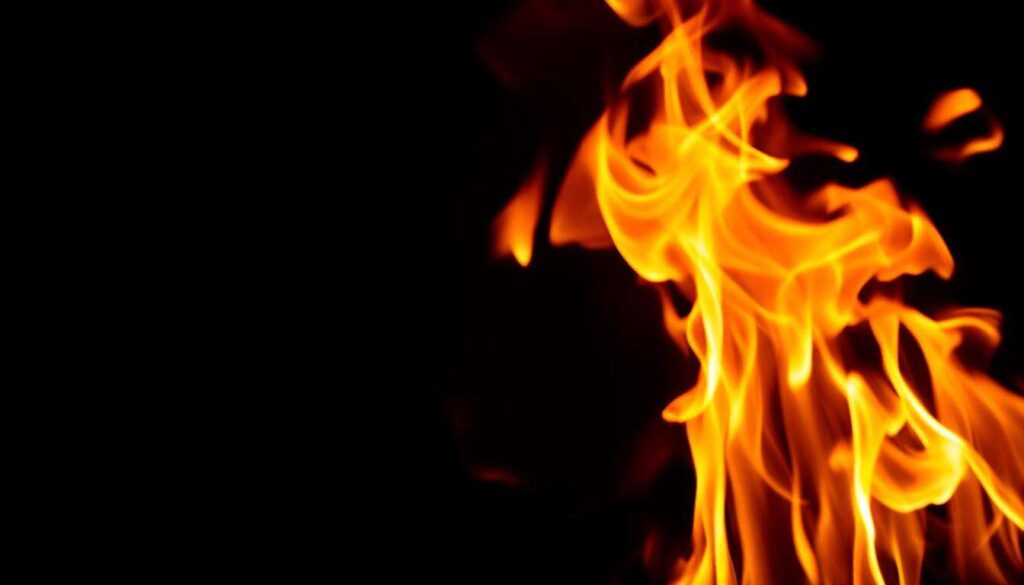
Fire is one of humanity’s oldest companions, a source of warmth, light, and power. Yet, for all its familiarity, its fundamental nature is often misunderstood. We see it, feel it, and use it daily, but what exactly is this flickering, dancing phenomenon ? It is not a substance in itself, like wood or water. Instead, fire is a process, a visible and often violent event where matter is rapidly transformed. A physicist sees fire not as an element, but as a complex interplay of chemistry and physics, a rapid, self-sustaining exothermic reaction that has captivated and propelled our species for millennia.
The Nature of Fire: a Complex Chemical Reaction
Beyond the Flames: an Exothermic Event
At its core, fire is the visible effect of combustion, a specific type of chemical reaction. This reaction is exothermic, meaning it releases more energy than it consumes to get started. The energy is released primarily in the form of heat and light, which we perceive as the flame. The process involves a substance reacting rapidly with an oxidizing agent, most commonly oxygen from the air. During this reaction, chemical bonds in the fuel are broken, and new, more stable bonds are formed in the products, such as carbon dioxide and water. The excess energy from forming these new, stronger bonds is what we experience as the fire’s intense heat and brilliant light. It’s not magic; it’s chemistry in action.
The Products of Combustion
What a fire leaves behind is just as important as what it consumes. The specific byproducts depend entirely on the fuel and the amount of oxygen available. A clean, efficient fire with plenty of oxygen will primarily produce carbon dioxide (CO2) and water (H2O). However, most real-world fires are not perfectly efficient. Incomplete combustion, caused by an insufficient oxygen supply, leads to the creation of more harmful substances. These can include:
- Carbon monoxide (CO): a colorless, odorless, and highly toxic gas.
- Soot: fine black particles of unburnt carbon that constitute smoke.
- Various hydrocarbons: a range of organic compounds, many of which can be hazardous to health and the environment.
Therefore, the smoke from a fire is a complex aerosol containing solid particles, liquid droplets, and a cocktail of gases, making it often more dangerous than the flames themselves. Understanding this chemical transformation is the first step, but for the reaction to even begin, a specific set of ingredients must be present.
The Essential Elements for Igniting Fire
The Classic Fire Triangle
For centuries, the concept of the “fire triangle” has been used to explain the necessary components for ignition. It’s a simple yet powerful model illustrating that three things are required for most fires to start and be sustained: heat, fuel, and an oxidizing agent (usually oxygen). If you remove any one of these three elements, the fire cannot exist. Firefighters use this principle every day; they apply water to remove heat, use foam to cut off the oxygen supply, or create firebreaks to remove fuel from a wildfire’s path. It is the fundamental basis for fire suppression.
From Triangle to Tetrahedron
While the fire triangle is an excellent model, modern fire science has expanded it into the “fire tetrahedron.” The fourth element added is the sustaining chemical chain reaction. Combustion is not a single event but a series of reactions where the products of one step help propagate the next. The heat and reactive molecules, known as free radicals, produced during combustion feed back into the process, igniting more fuel and sustaining the fire. This chain reaction is the element that makes a fire self-perpetuating. Certain fire extinguishers, like those using Halon or its replacements, are designed specifically to interrupt this chemical chain reaction, effectively stopping the fire even if fuel, heat, and oxygen are still present. This more complete model helps explain the intricate physics that govern how a fire grows and spreads.
The Physics of Fire: understanding Combustion
How Heat Spreads
Once a fire is ignited, physics dictates how it moves and grows. The transfer of heat is the engine that drives a fire’s spread, and it occurs through three primary mechanisms. Understanding these is critical for predicting fire behavior and for designing fire-resistant materials and buildings. The three modes of heat transfer are conduction, convection, and radiation. Each plays a distinct role in how a fire propagates through different materials and environments.
| Mechanism | Description | Example in a Fire |
|---|---|---|
| Conduction | Heat transfer through direct molecular contact. | A metal poker heating up when one end is in the fire. |
| Convection | Heat transfer through the movement of fluids (liquids or gases). | Hot smoke and gases rising from a fire, heating the ceiling of a room. |
| Radiation | Heat transfer through electromagnetic waves, primarily infrared. | Feeling the heat of a bonfire from several feet away, without touching it or being in the path of the smoke. |
The Stages of a Fire
A fire in an enclosed space, like a room, typically evolves through distinct stages governed by the availability of fuel and oxygen. It begins with ignition, where the fire tetrahedron is completed. This is followed by the growth stage, where the fire consumes fuel near the source and the convection of hot gases begins to form a hot layer at the ceiling. If enough fuel and oxygen are present, the fire can reach flashover, a critical point where all combustible surfaces in the room ignite almost simultaneously due to intense radiant heat. Following this is the fully developed stage, where all available fuel is burning. Finally, as the fuel or oxygen is depleted, the fire enters the decay stage, gradually extinguishing itself. The physics of heat transfer and fluid dynamics at each stage are incredibly complex, and can sometimes lead to the formation of a surprising state of matter.
The Role of Plasma in the Fire Phenomenon
Is Fire Actually Plasma ?
A common question in physics is whether the flames we see are actually plasma. Plasma is often called the fourth state of matter, after solid, liquid, and gas. It is a superheated gas in which electrons have been stripped from their atoms, creating an ionized gas of charged particles. While this sounds like a fitting description for the intense environment of a fire, the answer is nuanced. Most common fires, like a candle flame or a wood fire, are not hot enough to cause significant ionization. The light they produce comes from incandescent soot particles glowing hot, much like the filament in an old light bulb. They are essentially just hot, reacting gas.
When Fire Becomes Plasma
However, under certain conditions, a fire can indeed contain or become plasma. For a significant portion of the flame to be considered plasma, it needs to reach extremely high temperatures, typically several thousand degrees Celsius. This level of heat is enough to ionize a substantial number of the gas molecules.
- Industrial torches: Welding and cutting torches can create flames hot enough to be considered plasma.
- Lightning strikes: The channel of a lightning strike is a clear example of natural plasma.
- The Sun: Our sun is a giant ball of plasma sustained by nuclear fusion.
So, while your campfire is technically an incandescent gas, the underlying physics connects it to the same principles that govern the stars. This understanding of fire’s physical state is not merely academic; it has direct consequences for how we manage and control this powerful force.
Practical Applications and Challenges in Fire Control
Harnessing Combustion for Technology
The controlled application of combustion is a cornerstone of modern civilization. The principles of fire physics are central to a vast array of technologies. The internal combustion engine, for example, is a marvel of controlled explosions, converting the chemical energy of fuel into mechanical work with remarkable efficiency. Power plants burn fossil fuels or biomass in carefully managed boilers to produce steam that drives turbines, generating electricity for millions. Even rocket propulsion is a highly sophisticated application of combustion, where the precise mixing of fuel and oxidizer generates immense thrust. In all these cases, a deep understanding of thermodynamics, fluid dynamics, and chemical kinetics is essential for maximizing efficiency and ensuring safety.
The Science of Fire Suppression
Conversely, the same physical principles are used to fight unwanted fires. Fire suppression is a science dedicated to breaking the fire tetrahedron. Firefighters choose their tools based on the type of fire and the mechanism they need to disrupt.
| Class | Fuel Type | Primary Suppression Mechanism |
|---|---|---|
| Class A | Ordinary combustibles (wood, paper) | Cooling (Water removes heat) |
| Class B | Flammable liquids (gasoline, oil) | Smothering (Foam or powder separates fuel from oxygen) |
| Class C | Electrical equipment | Smothering/Chain Reaction Interruption (Non-conductive agents like CO2) |
| Class D | Combustible metals (magnesium) | Smothering (Specialized dry powders) |
Wildland firefighting adds another layer of complexity, where factors like wind, topography, and humidity must be modeled to predict and control the fire’s spread. Ultimately, while controlling an active fire is a critical skill, preventing it from starting is an even greater challenge.
Fire and Safety: preventing Fires
Understanding Common Fire Hazards
Preventing fires begins with recognizing potential hazards in our daily environment. Most residential fires are not caused by malicious acts but by accidents, negligence, or faulty equipment. A firm grasp of what can start a fire is the first line of defense. Some of the most prevalent causes include:
- Unattended cooking: This remains the leading cause of home fires.
- Heating equipment: Furnaces, space heaters, and fireplaces can ignite nearby combustible materials if not properly maintained or used.
- Faulty electrical systems: Overloaded circuits, damaged wiring, and malfunctioning appliances pose a significant risk.
- Smoking materials: Improperly discarded cigarettes are a frequent cause of fires in homes and wildlands.
- Candles: An open flame is an inherent risk and should never be left unattended.
Recognizing these risks is crucial, but it must be paired with proactive measures to mitigate them.
The Principles of Proactive Fire Prevention
Effective fire safety is built on a foundation of simple, consistent practices. It’s about creating an environment where the fire tetrahedron is unlikely to be completed accidentally. This involves a two-pronged approach: reducing ignition sources and maintaining safety systems. Keeping flammable materials away from heat sources, regularly inspecting electrical cords for wear, and enforcing a strict “no smoking in bed” rule are basic yet powerful preventive actions. Equally important is ensuring that safety equipment is functional. This means testing smoke alarms monthly and replacing their batteries annually, having the correct type of fire extinguisher accessible and knowing how to use it, and establishing and practicing a family escape plan. These steps transform abstract knowledge of fire physics into life-saving habits.
Fire is not a thing, but a dynamic event driven by the laws of chemistry and physics. It is a rapid oxidation process requiring fuel, an oxidizer, heat, and a self-sustaining chain reaction. Its energy spreads through conduction, convection, and radiation, and in its most intense forms, it can even create plasma. Understanding these core principles is not just an academic exercise; it is fundamental to harnessing fire’s immense power for technology and to implementing the safety measures that protect our lives and property from its destructive potential.