


The silent, vast expanse of interstellar space has once again sent an emissary to our solar system. For only the third time in recorded history, astronomers have confirmed the presence of an object from beyond our sun’s gravitational embrace. But this visitor, designated 3I/ATLAS, is unlike its predecessors. It is not a silent, tumbling rock or a simple outgassing comet. This mysterious traveler is active, erupting with violent plumes of ice and gas, a phenomenon that is forcing a profound reevaluation of what kinds of worlds wander the galaxy. In a stunning series of observations, this object has flared to life, revealing the presence of ice volcanoes on a body traversing the cold, dark void between stars.
Mysterious interstellar visitors: who are they ?
Defining a traveler between stars
An interstellar object is, by definition, a celestial body that is not gravitationally bound to our sun. While the billions of asteroids and comets in our solar system follow elliptical or near-circular orbits, these visitors trace a distinct path: a hyperbolic trajectory. This open-ended path proves they have come from another star system, accelerated to immense speeds over millions of years, and are only passing through ours on their journey back into the galactic wilderness. Their velocity is simply too high for the sun’s gravity to capture them into a permanent orbit. Identifying these objects requires meticulous tracking of their speed and direction to confirm they are not one of our own.
A brief history of our previous guests
Before 3I/ATLAS, humanity had knowingly encountered only two such interstellar travelers. Each was unique and deepened the mystery of what lies beyond our cosmic neighborhood. The first, 1I/’Oumuamua, was a bizarre, elongated object that showed no cometary outgassing, yet accelerated slightly as it left, a behavior that still sparks debate. The second, 2I/Borisov, was more familiar, behaving much like a typical comet from our own solar system, with a visible coma and tail. Their differences highlight how little we know about the populations of objects that inhabit the galaxy.
| Object | Discovery | Key Characteristic | Observed Activity |
|---|---|---|---|
| 1I/’Oumuamua | 2017 | Highly elongated, reddish color | No visible outgassing, but showed non-gravitational acceleration |
| 2I/Borisov | 2019 | Resembled a typical solar system comet | Clear cometary activity (coma and tail) |
| 3I/ATLAS | Recent | Appears comet-like but with unusual composition | Sudden, powerful cryovolcanic eruptions |
The arrival of a third visitor was anticipated, but its dynamic and explosive nature was not. This discovery has shifted the focus from merely identifying these objects to understanding the complex processes that can occur on them.
The discovery of 3I ATLAS: a stakes for astronomy
The vigilant eyes of automated surveys
The detection of faint, fast-moving objects like 3I/ATLAS is a monumental task, made possible by automated sky surveys. Systems like the Asteroid Terrestrial-impact Last Alert System (ATLAS), after which the object is partly named, scan the entire observable sky every night. Their primary mission is to detect near-earth asteroids that could pose a threat, but in doing so, they create an unprecedented catalog of the moving sky. It was one of these automated systems that first flagged a faint point of light moving too fast and on the wrong trajectory to be a local resident. This initial alert triggered an immediate response from the global astronomical community.
A race against time
Once an object is identified as potentially interstellar, the clock starts ticking. It is a one-shot opportunity for observation. Unlike a planet or a local comet, 3I/ATLAS will not be coming back. Astronomers around the world rapidly coordinated their efforts, turning major ground-based and space telescopes toward the object to gather as much data as possible before it faded into the distance. The initial data confirmed its interstellar origin and provided preliminary estimates of its size and composition, but it was the subsequent, sustained monitoring that revealed its truly astonishing secret.
The initial classification suggested a large, dark cometary nucleus. However, what these continuous observations captured next went far beyond the behavior of a simple comet warming in the sun’s glow.
Ice volcanoes: a surprising phenomenon
Understanding cryovolcanism
While volcanoes on earth spew molten rock, cryovolcanism is a starkly different process found in the frigid outer reaches of the solar system, on moons like Enceladus and Triton. Instead of magma, these “ice volcanoes” erupt volatile materials. The process is driven by internal heat, which causes subsurface pockets of frozen substances to sublimate or melt, building up immense pressure until they burst through the icy crust. Key elements of this process include:
- A source of internal heat: This can be from the decay of radioactive elements within the object’s core or from tidal forces exerted by a nearby massive planet.
- A subsurface reservoir: A layer or pocket of volatile ices, such as water, ammonia, methane, or nitrogen.
- A fractured crust: Fissures or weak points in the surface ice that allow the pressurized materials to escape.
The result is a spectacular plume of ice crystals and gas that can shoot hundreds of kilometers into space.
Witnessing eruptions on an interstellar object
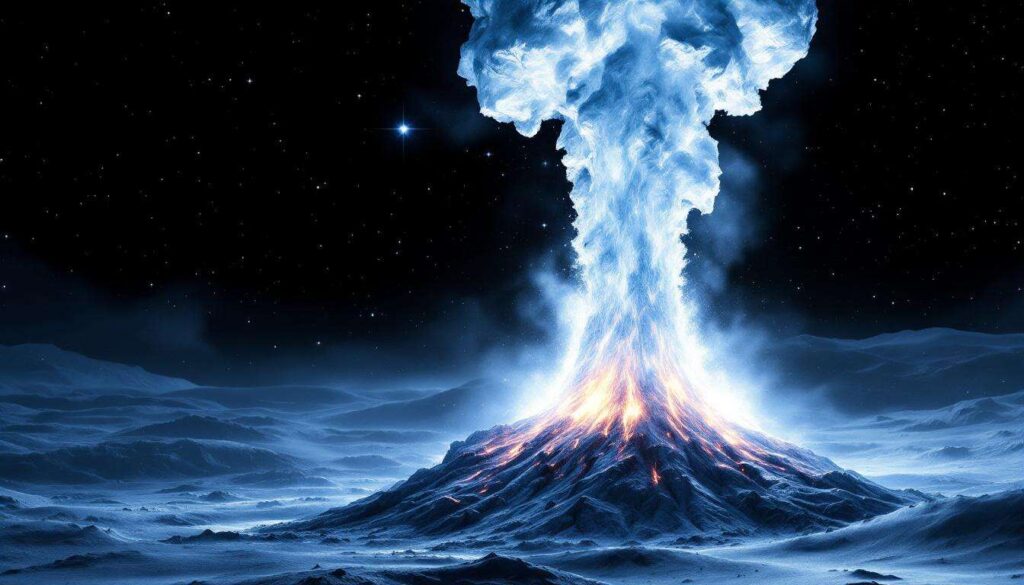
No one expected to see this phenomenon on a lone object traveling through interstellar space. Astronomers monitoring 3I/ATLAS were stunned when the object suddenly and dramatically increased in brightness by a factor of more than one hundred. This was not the gentle, continuous outgassing of a comet. Spectroscopic analysis confirmed the flash was caused by a massive, directed plume of water ice and ammonia, erupting from a specific point on its surface. It was, in effect, a volcanic eruption in the deep cold. This was the first time cryovolcanism had ever been directly observed on an interstellar visitor, a discovery that opens a new chapter in planetary science.
This active geology, occurring on a body far from the warming influence of any star for potentially millions of years, raises profound questions about the object’s origin and internal mechanics.
The scientific implications of eruptions on 3I ATLAS
A window into another solar system
The material being ejected from 3I/ATLAS is a pristine sample of the building blocks from its home star system. By analyzing the light from these plumes, scientists can determine their chemical composition with remarkable precision. The presence of specific isotopes or ratios of molecules like ammonia to water can provide a chemical fingerprint of its birthplace. This allows us to, for the first time, directly study the chemistry of a planet-forming disk around another star. It is a form of galactic archaeology, using a wandering object to learn about a distant, unseen solar system.
The mystery of the internal engine
Perhaps the most pressing question is: what is powering these eruptions ? For a relatively small body traveling alone in space, maintaining enough internal heat to drive volcanism is a major puzzle. Scientists are exploring several hypotheses. One possibility is that 3I/ATLAS is a fragment of a much larger, Pluto-sized world that had a hot core due to radioactive decay. Another theory suggests that it may have been recently ejected from its home system after a close encounter with a giant planet, and the tidal forces from that event superheated its interior. Solving this mystery will be key to understanding the evolution of such bodies.
The discovery of this internal activity and its associated chemistry has massive implications, and to probe them further, astronomers are relying on our most advanced observational tools.
Observation technologies: a leap into the unknown
The power of spectroscopy
The primary tool for understanding the eruptions of 3I/ATLAS is spectroscopy. When the plumes erupt, sunlight reflects off the gas and ice particles. Telescopes collect this light and pass it through a spectrograph, which acts like a high-tech prism, splitting the light into its constituent colors or wavelengths. Chemical elements and molecules absorb and emit light at specific, known wavelengths, creating a unique “barcode” in the spectrum. By reading this barcode, astronomers can identify the presence of water, ammonia, carbon compounds, and potentially even complex organic molecules, giving them a complete inventory of the erupted material.
Space telescopes join the hunt
While ground-based observatories made the initial detection, space telescopes like the James Webb Space Telescope (JWST) are providing an unparalleled view. Operating outside earth’s distorting atmosphere, JWST can perform highly sensitive infrared spectroscopy. This is crucial because many key molecules, including water and organics, have their strongest spectral signatures in the infrared. The data from JWST is providing a much clearer picture of the plume’s temperature, density, and chemical complexity than would otherwise be possible. It is a perfect demonstration of how different observatories must work in concert to solve a cosmic mystery.
This global, multi-platform campaign is gathering data at a furious pace, allowing scientists to not only study the present but also to plan for what comes next.
Future perspectives: what will 3I ATLAS reveal to us ?
A continuing journey
The observation campaign for 3I/ATLAS is far from over. Astronomers will continue to track it as it moves into the outer solar system and back toward interstellar space. A key question is how its activity will change as it gets farther from the sun. Will the eruptions cease as the surface cools, or is the internal heat source strong enough to sustain them indefinitely ? The long-term behavior of 3I/ATLAS will provide crucial constraints on theories about what powers its cryovolcanoes. Every new observation is another piece of a puzzle that could redefine our understanding of small, icy worlds.
Informing the next generation of missions
The discovery of an active interstellar object has energized discussions about future space missions. Scientists are now designing concepts for “rapid intercept” spacecraft that could be launched on short notice to fly by a future interstellar visitor. The data from 3I/ATLAS is critical for designing such a mission: knowing what instruments would be most valuable, what materials to expect, and what orbital mechanics are required for a rendezvous. Witnessing active geology on 3I/ATLAS makes the scientific case for such a mission more compelling than ever before.
This interstellar visitor is more than just a scientific curiosity. It is a messenger from the stars, carrying with it clues about the formation of other solar systems and the potential for a galaxy rich in diverse and dynamic worlds. The discovery of its fiery, icy heart has opened a new frontier in the exploration of the cosmos.
The detection of 3I/ATLAS marks a pivotal moment in astronomy. The confirmation of a third interstellar visitor was significant, but the observation of its active cryovolcanism is revolutionary. This object serves as a direct probe of a distant solar system’s chemistry and challenges our models of how planetary bodies evolve. As we continue to monitor its journey and analyze the composition of its plumes, 3I/ATLAS is not just teaching us about the worlds beyond our own; it is driving the development of new technologies and missions that will shape the future of space exploration.