

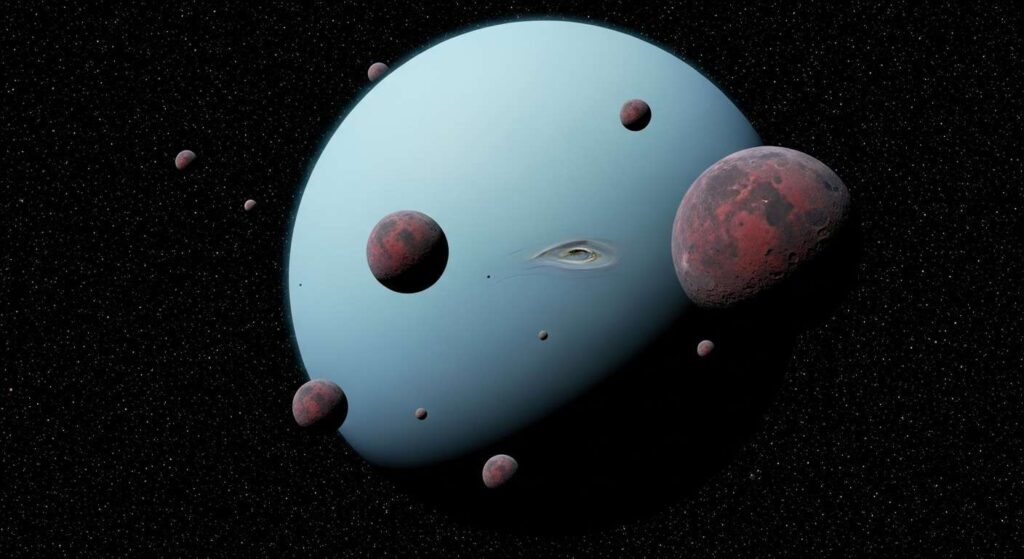
Examine the distant, ice-blue world of Uranus, where recent findings are compelling a dramatic reassessment of its satellite system. For decades, the planet’s small inner moons were presumed to be chunks of water ice, akin to their counterparts around Saturn. New analysis of archival data reveals a starkly different reality: these diminutive worlds are surprisingly dark, red, and almost devoid of water, challenging long-held theories about how such systems form and evolve in the frigid depths of the outer solar system.
Physical characteristics of Uranus’s small moons
Size and orbital proximity
The small moons of Uranus form a tightly packed system, orbiting closer to the planet than its larger, more famous satellites like Titania and Oberon. This group includes nine confirmed small moons: Puck, Mab, Juliet, Portia, Rosalind, Cupid, Belinda, Desdemona, and Cressida. They are all relatively tiny, with Puck being the largest at approximately 162 kilometers in diameter. The others are significantly smaller, some measuring less than 20 kilometers across. Their proximity to Uranus places them within its complex ring system, suggesting a deep, interconnected relationship between the rings and these moons. This clustering is so dense that astronomers believe the orbits are inherently unstable, hinting that collisions may have occurred over the system’s history and could happen again.
Surface properties and albedo
One of the most striking features of these moons is their remarkably low albedo, or reflectivity. They are some of the darkest objects known in the solar system, reflecting very little sunlight. This contrasts sharply with the bright, icy moons found around Saturn, which are known for their high albedo. The surfaces of Uranus’s small moons are more comparable to the dark, carbonaceous asteroids found in the outer asteroid belt. This low reflectivity suggests that their surfaces are not dominated by clean water ice but by a much darker material. The table below compares the albedo of several Uranian small moons to other objects in the solar system for context.
| Celestial Body | Type | Geometric Albedo |
|---|---|---|
| Puck (Uranus Moon) | Small Moon | ~0.08 |
| Enceladus (Saturn Moon) | Icy Moon | ~0.99 |
| Earth’s Moon | Rocky Moon | ~0.12 |
| Charcoal | Reference Material | ~0.04 |
This data clearly illustrates just how unusually dark these objects are. Their surfaces absorb the vast majority of the sunlight that reaches them, a physical characteristic that provides crucial clues about their makeup.
These dark surfaces are not just a curiosity; they are a direct window into the material composition of these tiny worlds, a composition that has turned out to be quite unexpected.
Chemical composition and water-poor nature
Spectroscopic evidence
Analysis of reflected light, or spectroscopy, is the primary tool astronomers use to determine the chemical makeup of distant objects. When scientists re-examined data from the Voyager 2 spacecraft, the only probe to have visited Uranus, they found something astonishing. The spectral signature of water ice, which was expected to be prominent, was either extremely weak or completely absent on these small moons. Instead, the spectra indicated the presence of a dark, reddish material. This discovery was a major departure from the prevailing models, which assumed that any object forming in the cold outer solar system would be rich in water ice. The lack of a strong water-ice signal suggests that the surface is dominated by other compounds, forcing a complete rethinking of what these moons are made of.
The water-ice anomaly
The near-absence of water ice is a profound puzzle. In the Uranian system, temperatures are low enough for water to exist as a hard, rock-like solid. Therefore, its scarcity on the surface is not due to evaporation. Several hypotheses have been proposed to explain this anomaly:
- A non-icy core: It is possible the moons are not icy bodies with a dark coating but are fundamentally rocky or carbonaceous objects throughout.
- Surface processing: An external process might have altered the surface, either by removing the ice or by burying it under a layer of dark material.
- A unique formation history: The moons may have formed from material that was inherently poor in water, a scenario that would have significant implications for our understanding of the protoplanetary disk around Uranus.
This water-poor nature is a fundamental discovery. It separates these moons from many of their neighbors in the outer solar system and directly informs the investigation into their mysterious coloration.
The fact that these moons are both dark and lacking in water strongly suggests their color comes from the very material that has replaced the ice on their surfaces.
Possible origin of the dark and red hues
Irradiation of carbonaceous materials
The leading theory for the dark and reddish color of Uranus’s small moons involves the intense radiation environment around the planet. Uranus has a powerful magnetic field that traps high-energy particles. It is hypothesized that the moons are composed of a mix of rock and carbon-rich organic compounds. Over billions of years, the relentless bombardment by charged particles would have processed these surface materials. This process, known as space weathering or irradiation, can break down complex molecules and darken surfaces, often leaving behind a reddish, carbonaceous residue. This would effectively cook the surface, creating a dark crust that masks any underlying ice and gives the moons their characteristic hue. This is similar to processes observed on some asteroids and comets, suggesting a potential link in their composition.
Contamination from external sources
Another possibility is that the dark material is not native to the moons themselves but is instead a coating of dust from an external source. The dark, narrow rings of Uranus are thought to be composed of similar carbonaceous material. It is plausible that dust particles from these rings, or from micrometeoroid impacts on the rings, have gradually accumulated on the surfaces of the nearby moons over eons. This would create a thin, dark veneer that dictates their appearance. This theory is supported by the fact that the moons are embedded within the ring system, making such a transfer of material highly likely. The moons could be acting as celestial dust mops, sweeping up dark particles as they orbit. This process could also explain why the smaller moons, with their weaker gravity, appear to be just as dark as the larger ones like Puck, as a surface coating would affect all of them similarly.
The interaction between these moons and their environment doesn’t stop at a simple exchange of dust; it appears to have a measurable effect on the giant planet itself.
Impact of the small moons on Uranus’s atmosphere
The “ring rain” phenomenon
The close relationship between Uranus’s rings, its small moons, and the planet’s atmosphere manifests in a phenomenon sometimes called “ring rain”. Material from the rings and moons is constantly being dislodged by micrometeoroid impacts and interactions with the planet’s magnetosphere. These tiny particles, rich in the same dark, carbonaceous material that colors the moons, are drawn inward by Uranus’s immense gravity. As they fall toward the planet, they enter its upper atmosphere. This influx of external material has been proposed as a potential explanation for some of the observed depletions of certain gases in Uranus’s stratosphere. The particles vaporize upon entry, seeding the atmosphere with elements that are not native to it.
Atmospheric composition changes
Observational data has shown that Uranus’s atmosphere has some peculiar chemical properties, such as a lower-than-expected amount of ammonia at certain altitudes. The constant infall of material from its dark moons and rings could be a contributing factor. The dark, water-poor dust would introduce carbon and other elements into the upper atmosphere, potentially triggering chemical reactions that alter its composition. While this effect is likely subtle, it demonstrates a dynamic and interconnected system where the smallest members play a role in shaping the characteristics of the giant planet they orbit. Studying this interaction provides a unique laboratory for understanding planetary atmospheres and how they are influenced by their local environment. This is a critical link between the planet and its satellite system.
Understanding these intricate local dynamics is not just about Uranus; it provides a valuable piece of a much larger puzzle concerning the origins of planetary systems everywhere.
Importance for studying the solar system’s formation
Clues to satellite system evolution
The unusual characteristics of Uranus’s small moons provide a crucial test for models of satellite formation. The traditional model suggests moons form from a circumplanetary disk of gas and ice, which should result in bright, icy bodies. The dark, water-poor nature of these moons challenges that view. It suggests an alternative origin story: perhaps they are not original bodies but are instead the remnants of a larger moon that was shattered by a massive impact long ago. The resulting debris, stripped of its icy mantle, could have re-formed into the dark, rocky objects we see today. Another theory is that they are captured objects, similar to Kuiper Belt Objects (KBOs), which are also known for their dark, reddish surfaces. If they are captured KBOs, their composition could tell us about the material present in the outer solar system during the era of planetary migration.
A window into the primordial solar system
Because of their small size, these moons have not undergone significant geological processing like larger worlds. Their surfaces are ancient, preserving a record of the conditions in the early solar system. Their composition could reflect the building blocks that were available in the Uranus region when the planets were forming. If they are indeed rich in carbonaceous material, it supports models suggesting that organic compounds were common in the outer solar nebula. By studying them, we can gain insight into the distribution of water, rock, and organics across the solar system, which is fundamental to understanding how planets, and potentially life, came to be. They are, in essence, pristine relics from a bygone era.
The tantalizing questions raised by these distant, dark worlds have made the Uranian system a high-priority target for future exploration.
Planned space mission to explore Uranus’s moons
The Uranus Orbiter and Probe mission
In light of these discoveries and the many remaining mysteries, the scientific community has designated a mission to Uranus as a top priority. The proposed Uranus Orbiter and Probe (UOP) is a flagship-class mission concept designed for an in-depth study of the entire Uranian system. The orbiter would spend several years circling the planet, allowing for repeated, close-up observations of its rings, atmosphere, magnetosphere, and, crucially, its moons. Equipped with modern spectrometers, cameras, and other instruments, it would be able to map the surface composition of the small moons in unprecedented detail, finally confirming the nature of their dark material and searching for any hidden water ice.
Key scientific objectives
A primary goal of any future mission would be to solve the puzzle of the small moons’ origin and composition. The key objectives related to these bodies would include:
- Determining their bulk composition to distinguish between a rocky nature and an icy core with a dark crust.
- Mapping their surface features to understand their geological and impact history.
- Analyzing their relationship with the rings to confirm whether the moons are a source of, or are coated by, ring material.
- Measuring their densities with high precision to constrain models of their internal structure.
Such a mission would represent a monumental leap in our understanding of ice giant systems, which are now known to be one of the most common types of planets in the galaxy. The small, dark moons of Uranus may be the key to unlocking their secrets.
Re-examine the distant ice giant. Recognize that its small moons are not merely inert balls of ice but complex, dark, and water-poor worlds. These enigmatic bodies challenge our theories of planetary formation and hold vital clues to the chaotic history of our own solar system. Their secrets, currently locked away in the dim sunlight of the outer planets, await the arrival of a new generation of explorers to be fully revealed.