

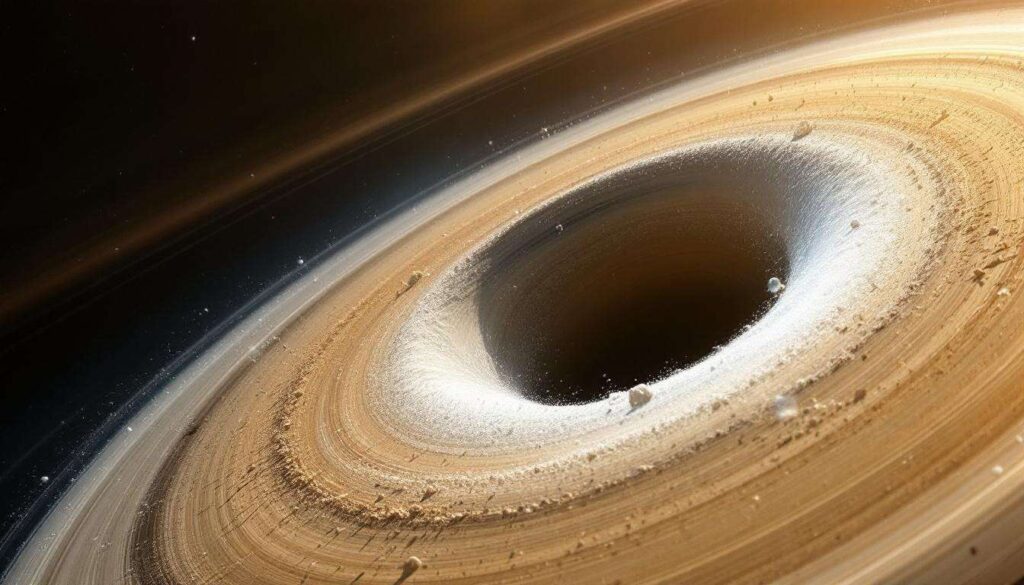
Saturn, the jewel of our solar system, owes its majestic appearance to the vast system of rings that encircle it. Often perceived as a static, serene feature, this celestial halo is in fact a dynamic and chaotic environment, a colossal doughnut of ice and dust whose origins continue to fuel scientific debate. Understanding this intricate structure reveals a story of cosmic violence, delicate gravitational ballets, and the ephemeral nature of planetary features. These are not solid bands but a collection of countless individual particles, each in its own orbit, forming one of the most breathtaking sights in the cosmos.
Formation of Saturn’s rings
The leading theories
The origin of Saturn’s magnificent ring system has long been a subject of intense scientific inquiry. Two primary hypotheses have dominated the discussion for decades. The first suggests that the rings are primordial, composed of leftover material from the nebular cloud that formed Saturn and its moons over 4.5 billion years ago. According to this model, this material was within a specific distance from the planet where the gravitational pull was too strong for it to coalesce into a large moon. The second, more recent theory posits a far more violent and recent origin: the catastrophic destruction of a large icy moon, or perhaps a captured comet, that strayed too close to Saturn and was ripped apart by its immense tidal forces.
Evidence from Cassini
Data from NASA’s Cassini mission, which studied Saturn for over a decade before its dramatic plunge into the planet’s atmosphere in 2017, has provided compelling evidence that strongly favors the shattered moon theory. One of the key findings relates to the mass of the rings. Cassini’s measurements revealed that the rings are less massive than previously thought, suggesting they have not had billions of years to accumulate interplanetary dust, which would have made them both heavier and darker. Furthermore, the spacecraft discovered a phenomenon known as ring rain, where ring material is continuously being pulled into Saturn’s upper atmosphere. This steady loss of mass implies the rings are a temporary feature and could not have survived since the dawn of the solar system. These findings point to the rings being a relatively young phenomenon, perhaps only 10 to 100 million years old.
A violent past
The scenario of a celestial body’s destruction paints a dramatic picture of Saturn’s past. Scientists theorize that an icy moon, possibly as large as Mimas, experienced a significant orbital disruption. This could have been caused by a gravitational tug-of-war with other moons or by being knocked off course by a passing object. As this ill-fated body drifted closer to Saturn, it crossed a critical threshold known as the Roche limit. The process of its demise would have unfolded in steps:
- The moon’s orbit becomes unstable and spirals inward toward Saturn.
- It crosses the Roche limit, where Saturn’s tidal forces overcome the moon’s own gravitational cohesion.
- The moon is stretched and then violently torn apart into countless fragments.
- Over millions of years, these fragments collide and spread out, settling into a thin, wide disk around the planet’s equator.
This debris, composed almost entirely of the moon’s pristine ice, formed the bright, shimmering rings we observe today.
Now that we have explored the violent origins of this cosmic structure, it is essential to understand what exactly these rings are made of.
Components of the rings
An icy composition
An analysis of the light reflected from the rings reveals their composition with remarkable clarity. They are made of an overwhelming majority of water ice, estimated to be about 99.9% pure in some sections. The remaining fraction consists of contaminants, including rocky material, dust, and possibly organic compounds, which are responsible for the subtle variations in color seen across the ring system. The individual particles that make up this grand structure are incredibly diverse in size. They range from microscopic dust grains smaller than a speck of flour to massive boulders the size of a house or a bus. This vast range in particle size contributes to the rings’ complex appearance and behavior.
Structure and divisions
From Earth, Saturn’s rings may appear as a few solid bands, but they are in fact an immensely complex system composed of thousands of individual rings and gaps. They are broadly categorized into several main groups, each designated by a letter. The A, B, and C rings are the main, brightest rings that are most easily observed. Surrounding them are the fainter and more tenuous D, E, F, and G rings. Separating these rings are prominent gaps. The most famous of these is the Cassini Division, a 2,980-mile-wide (4,800 km) gap that separates the A and B rings. These gaps are not entirely empty but are regions with a significantly lower density of particles, often cleared by the gravitational influence of Saturn’s many moons.
A comparative look at ring particles
The different ring sections exhibit distinct characteristics in terms of their density, brightness, and particle composition. These differences offer clues about their formation and ongoing evolution. The B ring, for instance, is the most massive and optically thick, containing a dense concentration of particles that effectively blocks starlight from passing through.
| Ring Section | Typical Particle Size | Composition Notes |
|---|---|---|
| C Ring | Meters | Darker and more “polluted” with non-icy material. |
| B Ring | Centimeters to meters | Brightest and most massive, composed of very pure water ice. |
| A Ring | Centimeters to meters | Less dense than the B ring, containing the Encke and Keeler gaps. |
| F Ring | Micrometers to meters | A narrow, complex ring shepherded by moons Pandora and Prometheus. |
The sheer quantity of these ice and rock particles culminates in a structure of immense scale, a true giant of cosmic dust.
A giant of cosmic dust
Unfathomable dimensions
The scale of Saturn’s ring system is difficult to comprehend. The main rings stretch across a vast expanse of space, with the outer edge of the A ring located about 85,000 miles (137,000 km) from the planet’s center. Yet, for all their breathtaking width, the rings are astonishingly thin. In most places, their vertical thickness is estimated to be no more than 30 feet (10 meters). This extreme thinness is one of their most remarkable features. To put it in perspective, if you were to build a scale model of the rings with a sheet of standard office paper, the model would need to be over half a mile wide. This incredible aspect ratio is a direct result of the physics of orbiting particles, which inevitably settle into the flattest possible configuration over time.
The faint and extended rings
Beyond the main, bright rings lies an even larger and more tenuous system. The most colossal of these is the Phoebe ring, discovered in 2009. This gigantic ring is tilted 27 degrees relative to the main rings and is so diffuse that it is nearly invisible. It extends from about 3.7 million to 10.1 million miles (6 million to 16.2 million km) from Saturn, making it by far the largest planetary ring in the solar system. Scientists believe this ring is composed of dust kicked up from Saturn’s distant, retrograde moon Phoebe. Another significant faint ring is the E ring, which is associated with the geologically active moon Enceladus. This moon continuously spews plumes of ice crystals from cryovolcanoes at its south pole, and this material directly feeds and sustains the E ring.
Mass and density
Despite their vast size, the total mass of the rings is surprisingly low. Current estimates place their combined mass at around 1.5 x 10^19 kilograms, which is about half the mass of Saturn’s moon Mimas. This relatively low mass is another key piece of evidence supporting the theory of their recent formation. If the rings were as old as the solar system, they would have swept up a great deal more interplanetary dust and debris from passing comets and asteroids, making them significantly more massive and much darker than their current brilliant, icy state. The density of particles varies dramatically across the rings, from the nearly opaque B ring to the almost transparent C and D rings.
These colossal yet delicate structures do not float randomly in space; their existence and stability are dictated by their precise placement within Saturn’s gravitational domain.
The unique position of the rings
The Roche limit
The location of Saturn’s main rings is no coincidence. They lie almost entirely within the planet’s Roche limit, a critical theoretical boundary. The Roche limit is the distance from a celestial body at which the tidal forces of that body are stronger than the self-gravity holding a smaller body, like a moon or comet, together. Inside this limit, any large object held together primarily by gravity will be torn to pieces. This is the fundamental reason why the ring material could not accrete to form a moon. The constant gravitational pull of Saturn keeps the particles dispersed in a wide, flat disk rather than allowing them to clump together. The existence of the rings is a direct and visible demonstration of this powerful gravitational principle at work.
The role of shepherd moons
The intricate structure of the rings, with their sharp edges and well-defined gaps, is maintained by the gravitational influence of numerous small moons. These are known as “shepherd moons” because they orbit near the edges of rings or within gaps, gravitationally herding the ring particles and keeping them in line. A classic example is the F ring, a narrow and clumpy band of material that is confined by the orbits of two small moons, Prometheus and Pandora. One orbits just inside the ring, and the other just outside. Their combined gravitational tugs prevent the ring particles from spreading out, creating the F ring’s uniquely defined, and sometimes braided, appearance. Similarly, the moon Pan orbits within the Encke Gap in the A ring, acting like a cosmic snowplow to keep its path clear.
Orbital resonance
In addition to shepherd moons, the large-scale structure of the rings is sculpted by a phenomenon called orbital resonance. This occurs when two orbiting bodies exert a regular, periodic gravitational influence on each other because their orbital periods are related by a ratio of two small integers. The most prominent example in Saturn’s rings is the Cassini Division. Particles in this region would orbit Saturn exactly twice for every single orbit of the moon Mimas. This 2:1 resonance means that Mimas gives these particles a repeated gravitational kick in the same spot of their orbit, destabilizing their paths and eventually flinging them out of the area. This process has cleared out the Cassini Division over millions of years, creating the largest and most famous gap in the rings.
The intricate dance between moons and ring particles not only shapes the rings but also creates a direct connection between the ring system and the planet itself.
The impact of the rings on Saturn
Ring rain phenomenon
One of the most surprising discoveries of the Cassini mission was the revelation that the rings are actively raining down on the planet. This “ring rain” consists of a constant shower of water and other particles being pulled from the inner edge of the rings along Saturn’s magnetic field lines and into its upper atmosphere. The influx is substantial, with estimates suggesting that an amount of water equivalent to an Olympic-sized swimming pool is draining from the rings onto Saturn every half hour. This process is driven by a combination of micrometeoroid impacts on the rings, which kick up charged dust and ice, and the subsequent interaction of these charged particles with the planet’s powerful magnetic field.
Altering the atmosphere
This steady downpour of material from the rings has a measurable effect on Saturn’s atmosphere. The water ice particles fall into the planet’s ionosphere, where they react with other molecules and alter the local chemistry. Observations have shown that this influx can reduce the density of electrons in certain regions of the ionosphere, effectively quenching the atmospheric “glow” that would otherwise be present. This discovery fundamentally changed our understanding of planet-ring interactions, revealing them to be a deeply interconnected system rather than two separate entities. The rings are not just orbiting Saturn; they are an active part of its atmospheric and magnetic environment.
A temporary feature
The measured rate of ring rain has profound implications for the long-term future of the rings. The current rate of mass loss is so significant that scientists now believe the entire ring system could disappear in as little as 100 million years, and perhaps no more than 300 million years. In the context of the solar system’s 4.5-billion-year history, this is a remarkably short lifespan. This finding reinforces the theory that the rings are a recent addition and suggests that humanity is witnessing them during a particularly spectacular, yet fleeting, epoch. We are fortunate observers of a transient cosmic spectacle, one that may not have been visible in the distant past and will not be visible in the distant future.
While missions like Cassini have answered many questions about the rings’ influence on Saturn, they have also unveiled a new set of profound puzzles.
Unresolved mysteries
The question of age
While the evidence from Cassini strongly points to the rings being young, the debate is not entirely closed. Some scientists are still exploring models that could allow for ancient rings. For example, it’s possible that the rings are part of a continuous cycle of destruction and reformation, with moons being periodically destroyed and their debris replenishing a much older ring system. The precise origin event also remains a mystery. Was it one of Saturn’s own moons that was destroyed, or was it a large comet or Kuiper Belt object that was captured and then torn apart ? Pinpointing the exact timing and cause of the rings’ formation is a key goal for future research.
The spokes of the B ring
One of the most baffling features of the rings are the “spokes,” which are transient, wedge-shaped patterns that appear to rotate along with the B ring. These features, which can be larger than Earth, appear dark in back-scattered light and bright in forward-scattered light. They seem to appear and disappear seasonally, tied to Saturn’s 29-year orbit around the sun. The leading theory is that the spokes are composed of microscopic dust particles that are levitated above the main ring plane by electrostatic forces. These forces are thought to be generated by the interaction of sunlight with the rings and Saturn’s magnetic field, but the exact mechanism remains elusive and is not fully understood.
The origin of color variations
Although the rings are composed almost entirely of water ice, they exhibit subtle but distinct variations in color. Some areas appear slightly reddish, while others are a cleaner bluish-gray. These color differences are thought to be caused by minute amounts of non-icy contaminants. The nature of these “pollutants” and their origin are still a matter of scientific investigation.
- Reddish hues: These could be caused by complex organic compounds, known as tholins, which are formed when simple organic molecules are exposed to ultraviolet radiation.
- Bluish/gray hues: These likely indicate regions of purer water ice, perhaps recently exposed by collisions or other dynamic processes.
Determining whether these contaminants came from micrometeoroid impacts or from material originating from Saturn’s moons is crucial for understanding the history and evolution of the ring system.
Saturn’s rings are far more than a beautiful, static ornament. They represent a dynamic laboratory of astrophysics, a testament to a violent cosmic history, and a fleeting feature on a geological timescale. This giant doughnut of icy debris, sculpted by gravity and intertwined with its parent planet, continues to challenge our understanding of planetary systems. Its ongoing disappearance reminds us that the solar system is not a fixed museum piece but a constantly evolving environment, with wonders that may exist only for a brief, shining moment in time.