



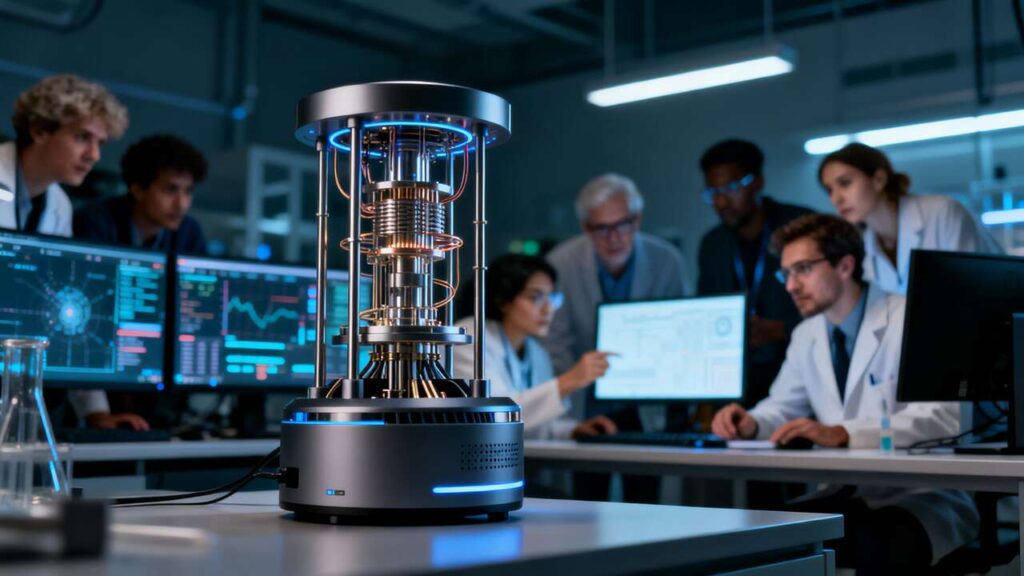
Quantum computing promises to revolutionize fields from medicine to finance, wielding computational power unimaginable with today’s supercomputers. Yet, this futuristic technology is currently grappling with a fundamental obstacle that threatens to stall its progress indefinitely. While scientists have successfully built small-scale quantum processors, scaling them into the powerful, fault-tolerant machines of tomorrow hinges on solving a single, pervasive problem that lies at the very heart of quantum mechanics. Until this critical vulnerability is overcome, the true potential of the quantum age will remain just beyond our reach.
What is quantum computing ?
The basics of quantum mechanics
At its core, quantum computing harnesses the strange and counterintuitive principles of quantum mechanics. Unlike classical computers that use bits to represent information as either a 0 or a 1, quantum computers use quantum bits, or qubits. A qubit can exist not just as a 0 or a 1, but in a superposition of both states simultaneously. This ability to hold multiple values at once is one of the primary sources of a quantum computer’s power. Furthermore, qubits can be linked together through a phenomenon called entanglement. When two qubits are entangled, the state of one instantly influences the state of the other, no matter how far apart they are. This interconnectedness allows quantum computers to perform complex calculations in parallel, exploring a vast number of possibilities at the same time.
How does it differ from classical computing ?
The fundamental difference between classical and quantum computing lies in how they process information. A classical computer tackles problems sequentially, one calculation at a time. A quantum computer, by leveraging superposition and entanglement, can explore many potential solutions at once, making it exponentially faster for certain types of problems. This distinction is not just about speed; it is a completely different paradigm for computation.
| Feature | Classical Computing | Quantum Computing |
|---|---|---|
| Basic Unit | Bit | Qubit (Quantum Bit) |
| Possible States | 0 or 1 | 0, 1, or a superposition of both |
| Core Principle | Boolean algebra and classical physics | Superposition and entanglement |
| Problem Solving | Sequential processing | Massive parallel processing |
This theoretical power, however, runs into immense practical hurdles in the physical world, presenting engineers and physicists with a set of formidable obstacles.
Major technical challenges
Qubit stability
The very properties that make qubits so powerful also make them incredibly fragile. A qubit’s quantum state is delicate and can be easily disturbed by the slightest interaction with its environment. This instability, known as decoherence, causes the qubit to lose its quantum properties and collapse into a classical state of 0 or 1, destroying the computation. Factors that can disrupt a qubit include:
- Thermal fluctuations
- Electromagnetic fields
- Vibrations in the hardware
- Even the act of measuring the qubit
Maintaining a qubit in its quantum state long enough to perform a useful calculation is one of the primary challenges in the field.
Error correction
Given the inherent fragility of qubits, errors are rampant in quantum computations. Classical computers have robust error correction mechanisms, but these do not translate directly to the quantum world. Quantum error correction (QEC) is far more complex because you cannot simply copy a qubit to create redundancy, as the act of measuring or copying it would destroy its quantum state. Instead, QEC protocols must use entanglement to distribute the information of a single logical qubit across many physical qubits. This means that a single, perfect, fault-tolerant qubit might require thousands of noisy physical qubits to protect it from errors, a massive overhead that complicates the scaling of these machines.
Scalability issues
Building a quantum computer with a handful of qubits has been achieved, but scaling up to the thousands or millions of high-quality qubits needed for practical applications is another monumental task. As the number of qubits increases, so does the complexity of the system required to control them and keep them from interfering with each other. The physical space, cooling requirements, and control wiring become exponentially more challenging to manage. Increasing the number of qubits while simultaneously maintaining their stability and connectivity is a central engineering problem that researchers are actively working to solve.
While stability, scalability, and error correction are all significant, they are largely symptoms of a single, more fundamental phenomenon that must be addressed.
The importance of decoherence
Defining quantum decoherence
Quantum decoherence is the process by which a quantum system loses its quantum behavior due to interaction with its environment. Essentially, it is the enemy of quantum computation. A qubit in a perfect superposition is like a spinning coin, capable of landing on heads or tails. Decoherence is the “noise” from the outside world—like a gust of wind or a vibration—that forces the coin to fall and land on one side. Once this happens, the qubit has lost its “quantumness” and behaves just like a classical bit, rendering it useless for quantum calculation. This process is unavoidable and happens incredibly quickly.
The race against time
The duration for which a qubit can maintain its quantum state before succumbing to decoherence is known as its coherence time. This window is the effective time limit for performing quantum operations. If a computation takes longer than the coherence time of its qubits, the information will be lost before the calculation is complete. Researchers are in a constant race to extend these coherence times while simultaneously making quantum operations faster. The quality of a quantum computer is often judged by this crucial metric.
| Qubit Type | Typical Coherence Time | Primary Challenge |
|---|---|---|
| Superconducting | Tens to hundreds of microseconds | Sensitivity to electromagnetic noise |
| Trapped Ions | Seconds to minutes | Slow gate operation speeds |
| Photonic | Very long (theoretically) | Difficulty in creating qubit interactions |
| Silicon Quantum Dots | Milliseconds | Manufacturing variability |
Why it’s the central problem
Decoherence is not just one challenge among many; it is the central problem from which most others arise. Qubit instability is a direct result of decoherence. The need for complex quantum error correction is driven by the high error rates caused by decoherence. Scalability is made harder because larger systems are more susceptible to environmental noise, accelerating decoherence. Taming decoherence is the key that could unlock progress on all other fronts. Without a solution to this issue, building a large-scale, fault-tolerant quantum computer remains an impossibility.
This critical problem has spurred a global race among scientists and engineers to devise and implement viable strategies to protect fragile quantum information.
Solutions considered by researchers
Improving qubit hardware
A primary line of attack is to build better, more resilient qubits. This involves both refining existing qubit technologies and exploring new ones. For superconducting qubits, researchers are experimenting with new materials and circuit designs to reduce their sensitivity to noise. For trapped ions, they are developing more sophisticated electromagnetic traps to hold the ions more securely. The goal is to create a physical qubit that is inherently more isolated from its environment, thereby extending its natural coherence time before complex error correction is even applied.
Advanced error correction codes
While hardware improvements are crucial, no qubit will ever be perfect. Therefore, a parallel effort is focused on creating smarter software and algorithms to deal with the inevitable errors. Researchers are developing more efficient quantum error correction codes that can protect quantum information with less overhead. Some of these approaches include:
- Surface codes: A popular QEC scheme that arranges qubits in a 2D lattice, known for its high tolerance to errors but requiring a large number of physical qubits.
- Low-density parity-check (LDPC) codes: A class of codes that promises to be more efficient, potentially reducing the number of physical qubits needed for each logical qubit.
- Dynamical decoupling: A technique that involves applying a sequence of control pulses to the qubits to effectively average out environmental noise and extend coherence.
Environmental isolation
To give qubits a fighting chance, they must be shielded from the outside world as much as possible. This has led to the development of some of the most controlled environments on Earth. Quantum processors are often housed inside large, multi-layered dilution refrigerators that cool them to temperatures colder than deep space, typically around 15 millikelvins. This extreme cold minimizes thermal vibrations. The systems are also placed in vacuum chambers to remove air particles and shielded by layers of special metals to block out stray electromagnetic radiation. Every wire and connection is meticulously designed to prevent noise from leaking into the system.
If researchers succeed in combining these solutions to overcome the decoherence barrier, the impact across various sectors could be transformative.
Potential impact on industries
Medicine and materials science
One of the most promising applications of quantum computing is in simulating molecules and chemical reactions. Classical computers struggle to accurately model complex molecules due to their quantum nature. A fault-tolerant quantum computer could simulate the behavior of a new drug molecule within the human body or help design a novel catalyst for a more efficient industrial process. This could dramatically accelerate drug discovery, leading to new treatments for diseases like Alzheimer’s, and enable the creation of new materials with desirable properties, such as high-temperature superconductors.
Finance and optimization
The financial world is built on complex models for risk analysis, portfolio optimization, and pricing derivatives. Quantum computers could solve optimization problems that are currently intractable for even the most powerful supercomputers. This could lead to more accurate financial modeling and more efficient allocation of resources. The same capability applies to logistics, such as optimizing shipping routes for a global delivery company or designing more efficient power grids.
| Problem | Classical Computer Time | Quantum Computer Time (Theoretical) |
|---|---|---|
| Factoring a 2048-bit number | Billions of years | Hours or days |
| Optimizing a complex portfolio | Weeks | Minutes |
| Simulating a simple protein | Years | Seconds |
Artificial intelligence
Quantum machine learning is an emerging field that could enhance artificial intelligence. Quantum algorithms have the potential to speed up key machine learning tasks, such as pattern recognition and classification. By processing vast datasets in new ways, quantum computers could help train more powerful and efficient AI models. This could lead to breakthroughs in areas like natural language processing, computer vision, and the development of truly intelligent systems.
While these applications paint a picture of a revolutionary future, the path to achieving them is incremental and filled with milestones yet to be reached.
The future of quantum computing
The noisy intermediate-scale quantum (NISQ) era
We are currently in what has been termed the NISQ era. Today’s quantum computers have dozens to hundreds of qubits, making them too large to be perfectly simulated by classical computers, but they are also too “noisy” and prone to errors to run sophisticated algorithms like Shor’s algorithm for factoring. During this phase, researchers are focused on finding practical applications for these imperfect machines. The goal is to demonstrate a “quantum advantage” where a NISQ computer can solve a useful problem that is beyond the reach of any classical computer, even without full fault tolerance.
The path to fault-tolerant quantum computers
The ultimate goal is to build a fault-tolerant quantum computer, a machine with enough high-quality, error-corrected qubits to solve the most impactful problems. Reaching this milestone will require significant progress across multiple fronts. Key steps on this journey include:
- Achieving a physical qubit error rate below the threshold required for error correction to work effectively.
- Demonstrating a single, high-fidelity logical qubit that is more robust than its underlying physical qubits.
- Scaling the architecture to interconnect thousands or millions of logical qubits.
- Developing a full software stack, including compilers and operating systems, to manage these complex machines.
A collaborative global effort
The immense challenges of building a quantum computer mean that no single company, university, or country is likely to succeed alone. Progress in the field is driven by a vibrant and collaborative global ecosystem. Open-source software projects, academic-industry partnerships, and international research consortia are all essential for sharing knowledge, validating results, and pushing the boundaries of what is possible. This collective effort is accelerating the pace of innovation and bringing the quantum future closer to reality.
The journey toward powerful quantum computing is a marathon, not a sprint. Its immense potential is fundamentally tethered to solving the critical challenge of decoherence. Through persistent innovation in hardware, sophisticated error correction, and extreme environmental isolation, researchers are steadily chipping away at this barrier. Overcoming it remains the central quest, and its resolution will ultimately determine when and how this technology reshapes our world, unlocking computational power for industries from medicine to artificial intelligence.