



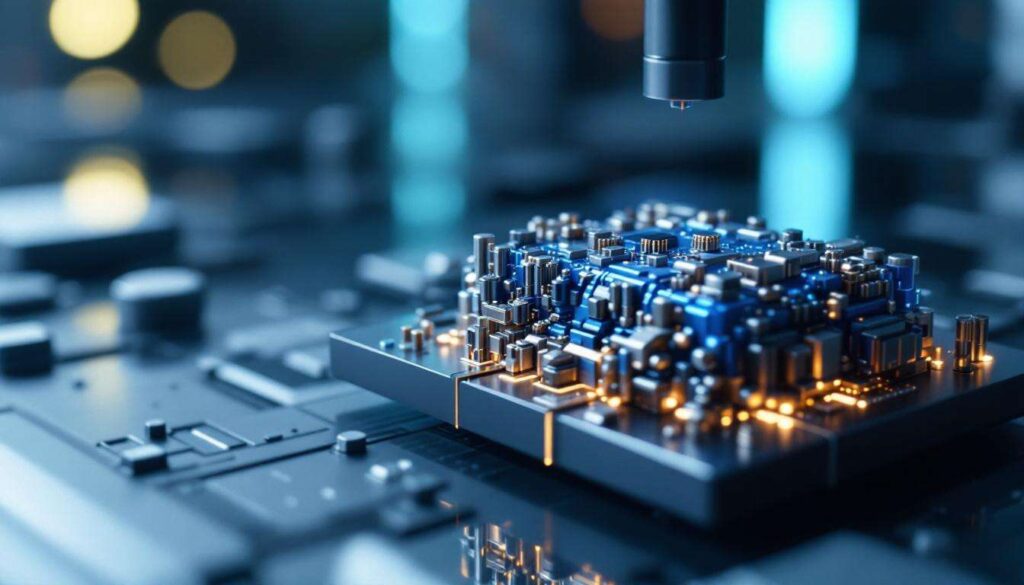
In a development that could redefine the landscape of high-performance computing, researchers have unveiled a pivotal breakthrough in quantum technology. A team of scientists has successfully engineered a critical quantum computing component at a scale previously thought unattainable, shrinking it to a size one hundred times smaller than the diameter of a human hair. This achievement addresses one of the most significant hurdles in the field: the immense physical size and complexity of current quantum hardware.
Revolution in Quantum Computing: a Major Leap Forward
Defining the Quantum Realm
Unlike classical computers that store information in bits as either a 0 or a 1, quantum computers use quantum bits, or qubits. Thanks to the principles of quantum mechanics, a qubit can exist as a 0, a 1, or both simultaneously in a state known as superposition. This, combined with another quantum phenomenon called entanglement, allows quantum computers to process a vast number of calculations in parallel. The potential processing power is staggering, promising to solve complex problems that are currently intractable for even the most powerful classical supercomputers.
The Significance of This Breakthrough
The recent announcement is not merely an incremental improvement; it represents a fundamental shift in how quantum devices can be constructed. For years, the path to building a powerful, fault-tolerant quantum computer has been blocked by the challenge of scaling. Current prototypes often require large, specialized laboratory environments with equipment occupying entire rooms to control just a handful of qubits. By demonstrating the ability to create an essential component on a microscopic scale, researchers have opened a viable pathway toward integrating thousands, or even millions, of qubits onto a single chip, a necessary step for creating commercially useful quantum machines.
This leap forward is primarily rooted in a single, game-changing achievement: a drastic reduction in the physical size of the core components that manipulate and read qubits.
Unprecedented Miniaturization: 100 Times Smaller Than a Hair
The Innovation at its Core
The heart of this innovation is a newly designed quantum control device. While previous iterations of similar components were measured in millimeters, this new device has dimensions on the nanometer scale, coming in at less than a single micron. To put this into perspective, a human hair is typically 70 to 100 microns in diameter. This new device is, therefore, dramatically smaller and more compact than anything that has come before it. The implications for density are enormous; where once a single component stood, hundreds could now fit. This is the key to building processors with a high qubit count.
| Feature | Previous Generation Technology | New Breakthrough Device |
|---|---|---|
| Component Size | Several millimeters (mm) | Less than 1 micron (µm) |
| Relative Scale | Visible to the naked eye | 100x smaller than a human hair |
| Potential Density | Low | Extremely high |
How This Was Achieved
This feat of engineering was made possible by leveraging advanced semiconductor manufacturing techniques, similar to those used to create modern classical computer chips. The process involved several key steps:
- Advanced Lithography: Using cutting-edge photolithography to etch incredibly precise patterns onto a silicon wafer.
- Novel Materials: Incorporating new superconducting materials that maintain their quantum properties even at these reduced dimensions.
- Integrated Design: A complete redesign of the device architecture to ensure that control wiring and the qubit itself could be co-fabricated in a compact, three-dimensional structure.
Achieving this level of precision at such a small scale was not without its own set of immense technical hurdles that needed to be overcome.
The Technological Challenges Behind This Achievement
Combating Quantum Decoherence
One of the greatest enemies of a quantum computer is a phenomenon known as decoherence. This is the process by which a qubit loses its quantum properties due to interactions with its environment, such as tiny fluctuations in temperature or electromagnetic fields. As devices get smaller, they often become more susceptible to this environmental “noise”. The research team tackled this by developing innovative shielding techniques integrated directly into the chip’s structure. This design isolates the qubit, preserving its delicate quantum state for a longer period, which is crucial for performing complex calculations.
Manufacturing at the Nanoscale
Building anything with nanometer precision is an extraordinary challenge. At this scale, even the smallest imperfection can render a device useless. The team had to refine existing fabrication processes to achieve unprecedented levels of quality control. They developed new methods for depositing atomic layers of material and for etching circuits without introducing defects. This required a deep synergy between quantum physicists and semiconductor engineers, pushing the boundaries of what is possible in modern fabrication facilities. The success of their method proves that it is possible to manufacture quantum hardware with the same reliability and precision as classical processors.
With these technical barriers broken, the focus can now shift more concretely toward the tangible benefits this technology will bring to various sectors.
Practical Applications and Impacted Industries
Accelerating Scientific Discovery
The ability to build powerful quantum computers could revolutionize fields like medicine and materials science. For example, designing a new drug molecule involves simulating its interaction with proteins in the body, a task that is incredibly complex for classical computers. A quantum computer could perform these simulations with high accuracy, drastically shortening the development time for new pharmaceuticals. Similarly, it could be used to design new materials with specific properties, such as more efficient catalysts for green energy or novel superconductors that work at room temperature.
Transforming Finance and Data Security
The financial industry stands to gain immensely from quantum computing. Its power could be harnessed for:
- Optimizing investment portfolios by analyzing a massive number of variables in real-time.
- Pricing complex financial derivatives with much greater speed and accuracy.
- Improving machine learning models for fraud detection and risk assessment.
However, this power also poses a threat. A sufficiently powerful quantum computer could break many of the encryption algorithms that currently protect sensitive data online. This breakthrough accelerates the need for the development and adoption of new, “quantum-resistant” cryptography standards.
| Complex Problem | Classical Supercomputer Time | Projected Quantum Computer Time |
|---|---|---|
| Drug Molecule Simulation | Years to decades | Hours to days |
| Breaking RSA-2048 Encryption | Billions of years | Several hours |
| Large-Scale Logistics Optimization | Days to weeks (approximate) | Minutes (optimal) |
This glimpse into potential applications underscores the transformative nature of the technology, but the journey from this single component to a fully functional quantum machine is still long.
Future Prospects and Challenges for Quantum Computing
The Path to a Scalable Machine
This miniaturization is a critical piece of the puzzle, but it is not the final one. The next major step is scalability. Researchers must now demonstrate that they can manufacture these tiny components with a high yield and integrate them into a larger, cohesive architecture. The challenge will be to connect hundreds or thousands of these devices, allowing qubits to interact with each other through entanglement while remaining isolated from environmental noise. This involves creating complex, multi-layered chips with intricate quantum wiring, a field of engineering that is still in its infancy.
Remaining Hurdles to Overcome
Beyond scaling, the field of quantum computing still faces significant obstacles. Quantum error correction is a major area of research. Qubits are inherently fragile, and errors in calculations are common. Developing efficient algorithms to detect and correct these errors without destroying the quantum information is essential for building a fault-tolerant machine. Furthermore, creating user-friendly software and programming languages that can harness the unique power of quantum processors remains a work in progress. Bridging the gap between quantum hardware and practical application will require continued innovation across multiple disciplines.
This breakthrough has significantly brightened the outlook for quantum computing, transforming a theoretical possibility into a tangible engineering goal. The successful miniaturization of a key quantum device marks a definitive turning point, moving the field from the realm of pure science toward practical, world-changing technology. While substantial challenges in scaling, error correction, and software development remain, the path forward is now clearer than ever. The ability to manufacture quantum components with the precision of the semiconductor industry paves the way for processors powerful enough to tackle some of humanity’s most complex problems.