



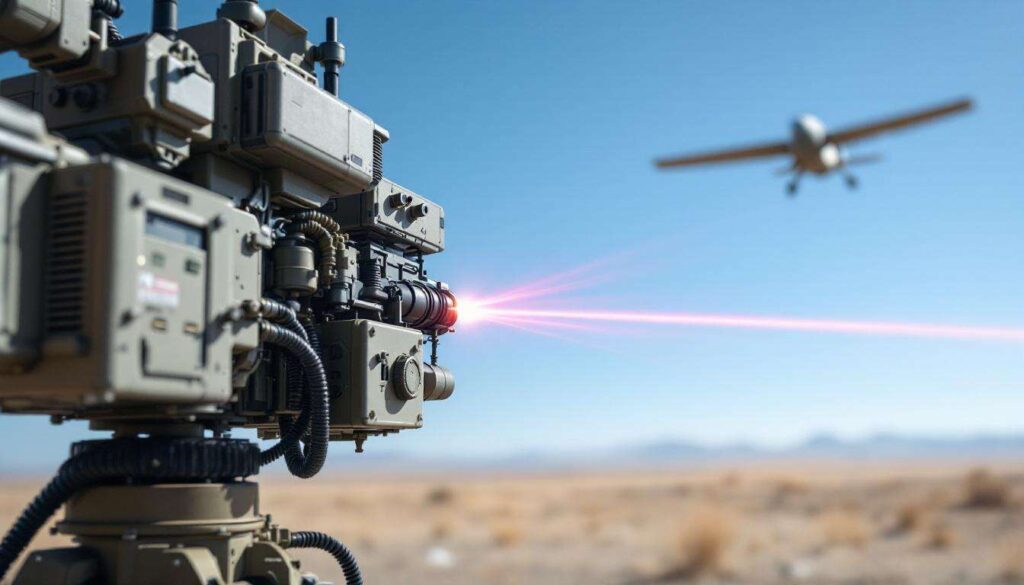
The modern battlefield is being reshaped by a persistent, low-cost threat that swarms from the sky. Small, commercially available drones, once tools for hobbyists and filmmakers, have been weaponized with startling effectiveness, creating a tactical dilemma for the world’s most advanced militaries. Traditional air defense systems, designed to intercept jets and missiles, are proving both economically and logistically unsustainable against these new adversaries. In response, a technology once relegated to science fiction is now a battlefield reality, promising to neutralize these threats for mere cents on the dollar. The world’s first operational 100-kilowatt class combat laser is ready, heralding a profound shift in defensive warfare.
Drones: a growing threat on the battlefield
The proliferation of unmanned aerial vehicles
The rise of unmanned aerial vehicles (UAVs), or drones, represents a fundamental change in asymmetric warfare. State and non-state actors alike can now deploy swarms of inexpensive yet lethal drones for a fraction of the cost of conventional military hardware. These systems are used for a variety of missions, including: intelligence, surveillance, and reconnaissance (ISR) to locate and track troop movements; artillery spotting to guide strikes with precision; and direct attacks as loitering munitions or “kamikaze” drones. Their small size and low radar cross-section make them incredibly difficult to detect and track, allowing them to penetrate sophisticated air defense networks.
The challenge of traditional air defense
Conventional air defense systems are poorly suited to counter the drone swarm threat. A single interceptor missile, such as a Stinger or an AMRAAM, can cost hundreds of thousands, if not millions, of dollars. Using such an asset to destroy a drone that may have been built for a few thousand dollars is a losing economic proposition. Firing multiple interceptors to counter a swarm can deplete a priceless and limited stock of munitions, leaving high-value assets vulnerable to more traditional threats like cruise missiles or fighter jets. This unsustainable cost exchange is forcing military planners to seek more efficient solutions.
| System | Unit Cost (Approximate) | Target Type |
|---|---|---|
| Commercial Quadcopter (Modified) | $500 – $5,000 | Personnel, Light Vehicles |
| AIM-9X Sidewinder Missile | $400,000+ | Aircraft, Drones |
| Patriot PAC-3 Missile | $3,000,000+ | Ballistic Missiles, Aircraft |
The stark economic disparity highlighted by these figures has driven the urgent development of alternative defensive technologies. This search has led military scientists back to a long-pursued but historically elusive goal: directed energy weapons.
Laser technology: from dream to reality
A concept from science fiction
For decades, the idea of a high-energy laser weapon has been a staple of military fiction and futuristic speculation. The concept is simple: project a concentrated beam of light to burn through a target at immense speed. However, translating this concept into a reliable, field-ready weapon system presented enormous technical challenges. Early prototypes were massive, required immense power, and were too fragile for the rigors of combat. The dream of a practical “ray gun” remained tantalizingly out of reach, limited by fundamental physics and engineering constraints.
Overcoming the technical hurdles
Recent breakthroughs in several key areas have finally made combat lasers a viable reality. The primary obstacles that engineers had to overcome were not insignificant, but persistent innovation has yielded effective solutions. These critical advancements include:
- Solid-state fiber lasers: Moving away from bulky and hazardous chemical lasers, modern systems use highly efficient and scalable fiber optic technology to generate the laser beam.
- Power and thermal management: Developing compact and robust power systems capable of generating the megawatts of electricity needed, along with sophisticated cooling systems to dissipate the immense waste heat produced during operation.
- Beam control and targeting: Creating advanced optics and software that can keep the laser beam focused on a small, fast-moving target over several kilometers, compensating for atmospheric turbulence and distortion in real time.
Solving these complex problems has paved the way for the development of powerful and mobile systems, culminating in the creation of a new class of weapon.
The 100 kW combat laser: a technological feat
Introducing the system
The newly unveiled 100 kW combat laser represents the pinnacle of this technological development. Mounted on a tactical vehicle, such as a heavy truck, the system combines a high-energy laser module with a sophisticated radar and electro-optical targeting system. This integration allows it to operate as a self-contained unit, capable of detecting, tracking, and engaging multiple targets autonomously. It is designed for point defense, protecting critical infrastructure, forward operating bases, and naval vessels from a range of aerial threats.
How it works: precision and speed
The engagement process is a marvel of modern engineering. Once the radar detects an incoming threat, the electro-optical targeting system locks on and provides a precise aim point. The laser is then fired, sending a powerful, invisible beam of infrared light toward the target. The beam travels at the speed of light, meaning there is no lead time required for the shot. The intense energy is focused on a small spot on the drone’s surface, rapidly heating it until the material melts or vaporizes, causing a catastrophic structural failure. Alternatively, the beam can be aimed at sensitive electronics or explosive payloads to disable the drone without destroying it completely.
Key specifications and capabilities
While exact performance details are often classified, the general capabilities of a 100 kW class system are well understood. It is a game-changer for short-range air defense.
| Specification | Performance Metric |
|---|---|
| Power Output | 100 kilowatts |
| Effective Range | Several kilometers, depending on atmospheric conditions |
| Target Set | Drones (Class 1-3), rockets, artillery, mortars (RAM) |
| Engagement Speed | Speed of light |
| Magazine Depth | Virtually unlimited (requires only electrical power) |
The combination of these capabilities addresses the core weaknesses of traditional air defense, particularly when it comes to cost and logistics.
Efficiency and cost: why choose laser ?
The cost-per-shot advantage
The most compelling argument for laser weapons is their incredibly low operational cost. While the initial procurement and development cost of the system is high, the cost of firing a single shot is estimated to be only a few dollars—the price of the diesel or electricity required to power the system for a few seconds. This fundamentally alters the economic equation of air defense, making it possible to engage even the cheapest of threats without hesitation. The financial advantage is staggering when compared to conventional kinetic interceptors.
Logistical simplicity and a deep magazine
Beyond cost, lasers offer a profound logistical advantage. A missile-based system is constrained by the number of interceptors it can carry. Once fired, it must be reloaded, a process that can be slow and dangerous in a combat zone. A laser weapon, by contrast, has a virtually unlimited magazine. As long as it has fuel for its generator, it can continue firing. This “deep magazine” ensures a persistent defensive capability against saturation attacks, where an enemy attempts to overwhelm defenses by launching a massive number of projectiles simultaneously.
Limitations and vulnerabilities
Despite their advantages, laser weapons are not a silver bullet. Their performance can be significantly degraded by adverse weather conditions. Rain, fog, dust, and smoke can scatter the laser beam, reducing its effective range and power on target. This makes them less reliable than missiles in certain environments. Furthermore, they are line-of-sight weapons, meaning they cannot engage targets behind hills or other obstacles. Countermeasures, such as reflective or ablative coatings on drones, are also being developed to reduce their effectiveness.
These limitations mean that lasers are not a replacement for all other systems but rather a powerful new component within a broader defensive strategy.
Towards a new era of military defense
Redefining layered air defense
The introduction of combat lasers will lead to a restructuring of air defense doctrine. They will form a new, highly effective inner layer in a multi-layered defense architecture. Long-range threats like ballistic missiles and high-altitude aircraft will still be handled by traditional interceptor missiles. Mid-range threats will be covered by systems like the Patriot. But for the close-in fight against swarms of drones, rockets, and mortars, lasers will provide a cost-effective and deep-magazine shield that has been missing from the arsenal. This layered approach ensures that the right tool is used for the right threat.
The future of directed energy
The 100 kW system is just the beginning. Research is already underway to develop more powerful megawatt-class lasers capable of engaging more resilient targets like cruise missiles and even hypersonic vehicles. Efforts are also focused on shrinking the systems for deployment on a wider range of platforms, including fighter jets and smaller ground vehicles. As the technology matures, directed energy will likely become a ubiquitous element of military power, fundamentally changing the dynamics of both offense and defense.
The imminent fielding of these weapons raises important questions about their impact on global security and strategic stability.
Imminent deployment: what are the geopolitical implications ?
Shifting the balance of power
The nations that first master and deploy effective laser defenses will gain a significant military advantage. This technology could effectively neutralize the drone and rocket arsenals that have been used by smaller nations and non-state groups to challenge larger military powers. It could render entire strategies based on saturation attacks obsolete, potentially re-establishing a degree of dominance for technologically advanced states. This shift could alter regional power balances and change how nations project force.
An arms race in directed energy ?
The deployment of a revolutionary weapon system almost invariably triggers a race to acquire or counter it. It is highly likely that the fielding of combat lasers will spur a new arms race in directed energy. Adversaries will rush to develop their own laser systems while simultaneously investing in countermeasures. This could lead to a rapid and potentially destabilizing cycle of innovation, with new offensive capabilities being developed to overcome the latest defensive systems. The strategic landscape could become far more complex as a result.
Ethical and legal considerations
Like any new weapon, directed energy systems raise new questions for international law and the rules of engagement. While lasers are primarily designed for anti-materiel use, the risk of misuse or accidental engagement of personnel exists. Debates will emerge regarding their classification under the laws of armed conflict. Policymakers and military leaders will need to establish clear doctrines for their use to ensure they are employed responsibly and ethically on a future battlefield where the line between combatant and civilian can be increasingly blurred.
The arrival of the 100 kW combat laser marks a pivotal moment in military history. It offers a revolutionary solution to the growing threat of low-cost aerial swarms, rewriting the economic and logistical rules of air defense. This technological leap from science fiction to reality provides an incredibly efficient defensive shield, but it also signals the dawn of a new era of directed energy warfare. The strategic implications of this shift, from regional power dynamics to a potential new arms race, will unfold in the years to come, reshaping security calculations across the globe.