

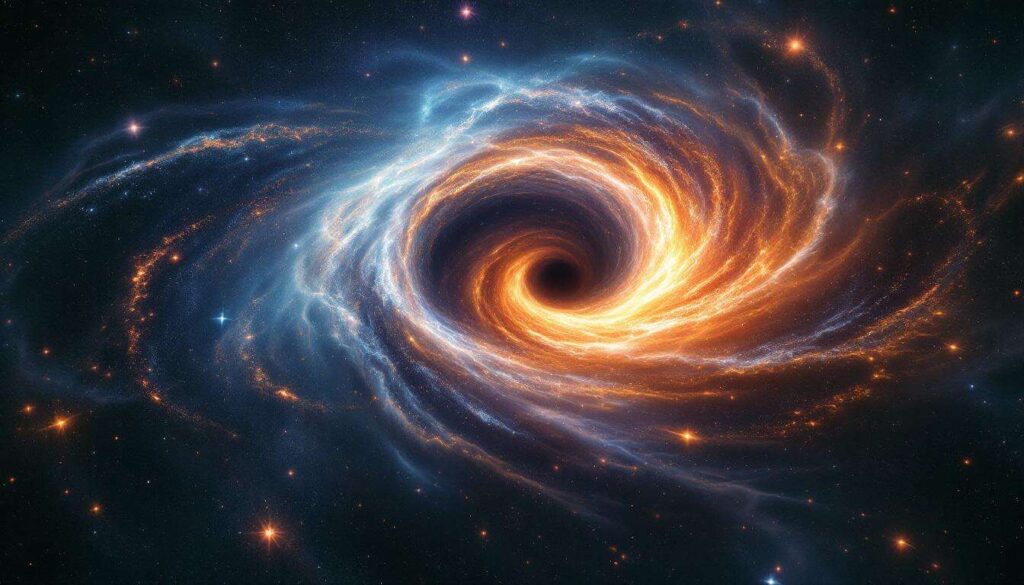
In an unprecedented glimpse into the cosmic dawn, astronomers using the James Webb Space Telescope have uncovered a supermassive black hole lurking at the heart of an enigmatic galaxy. The discovery, made by peering through thick veils of cosmic dust, challenges long-held theories about how these gravitational behemoths form and grow. The host galaxy, nicknamed ‘Jekyll and Hyde’ for its starkly contrasting characteristics, provides a unique laboratory for studying the intricate relationship between a galaxy and its central monster, offering a new piece to the puzzle of the early universe.
Discovery of a supermassive black hole by the James Webb telescope
A breakthrough observation
The detection was made possible by the unparalleled infrared capabilities of the James Webb Space Telescope (JWST). Previous observatories, including the Hubble Space Telescope, were blinded by the dense cocoon of dust and gas enveloping the galaxy’s core. JWST’s Mid-Infrared Instrument (MIRI) and Near-Infrared Spectrograph (NIRSpec) were able to pierce this obscurity, capturing the faint glow of matter being heated as it spirals into the black hole. This active galactic nucleus, or AGN, had remained completely hidden until now, a ghost in the cosmic machine that only Webb could reveal.
Pinpointing the cosmic giant
Scientists confirmed the object’s nature by analyzing the light emitted from the galaxy’s center. The spectrum of this light showed tell-tale signs of a supermassive black hole actively feeding on surrounding material. By measuring the velocity of gas swirling around the core, the team was able to estimate its mass. The data pointed to an object millions of times more massive than our sun, a truly colossal entity existing when the universe was less than a billion years old. This finding provides concrete evidence of massive black holes in the very early stages of cosmic history.
| Object | Estimated Mass (Solar Masses) | Location |
|---|---|---|
| Newly Discovered Black Hole (ZS7) | ~50 million | Early Universe |
| Sagittarius A* | ~4 million | Milky Way Center |
| M87* | ~6.5 billion | Virgo Galaxy Cluster |
The sheer size of this black hole, found so deep in cosmic history, forces a re-evaluation of its origins. This remarkable finding sets the stage for a closer examination of its strange and compelling galactic home.
Characteristics of the ‘Jekyll and Hyde’ galaxy
A galaxy of dual personality
The host galaxy, officially designated ZS7, has earned its ‘Jekyll and Hyde’ moniker due to its bizarre, bifurcated nature. One region of the galaxy is a brilliant hub of star formation, blazing with the light of young, massive stars. In stark contrast, the other region appears much quieter, with star birth seemingly suppressed. This duality is highly unusual and suggests powerful forces are at play. Researchers are investigating whether the immense energy being blasted out by the feeding black hole is responsible for quenching star formation in its vicinity, creating the ‘Hyde’ aspect of the galaxy.
The dust-shrouded core
At the heart of ZS7 lies its defining feature: an extreme concentration of interstellar dust. This is not uncommon in young, star-forming galaxies, but the density in ZS7 is exceptional. This dust acts like a thick fog, absorbing visible and ultraviolet light and making the galactic core invisible to most telescopes. It is this very feature that made the central black hole so difficult to find and simultaneously underscores the necessity of infrared observatories like Webb for studying the early universe. The dust itself is a product of earlier generations of stars, providing raw material for new stars and planets while hiding the galaxy’s most energetic processes.
Redshift and cosmic distance
The light from ZS7 has traveled for over 13 billion years to reach us, meaning we are seeing the galaxy as it was when the universe was in its infancy. Its high redshift, a measure of how much its light has been stretched by the expansion of the universe, confirms its immense distance. Discovering such a well-developed supermassive black hole at this early epoch is a significant finding. It provides a crucial data point for understanding the timeline of cosmic evolution, pushing the boundaries of when and how quickly such massive objects could assemble after the Big Bang.
Unveiling such a complex object from the dawn of time was only possible due to the specific and revolutionary technology aboard the telescope.
Role of the James Webb telescope in modern astronomy
Seeing the invisible
The James Webb Space Telescope represents a paradigm shift in observational astronomy, primarily because it is optimized to see the universe in infrared light. This part of the electromagnetic spectrum is crucial for two main reasons. First, the expansion of the universe stretches the light from distant objects, shifting it towards longer, redder wavelengths. Second, infrared light can penetrate the dense clouds of cosmic dust that obscure many of the most interesting regions of space, such as the birthplaces of stars and the centers of galaxies. Webb’s ability to capture this infrared universe is what allowed it to find the black hole in ZS7 where others could not.
A leap in sensitivity and resolution
Beyond its infrared vision, JWST’s power comes from its sheer scale and precision. Its 6.5-meter primary mirror gives it unprecedented light-collecting ability, allowing it to see objects that are fainter and farther away than ever before. This sensitivity is paired with a suite of state-of-the-art instruments capable of both stunning imaging and detailed spectroscopy, which is the science of breaking light down into its constituent colors to determine an object’s properties.
| Telescope | Primary Mirror Diameter | Primary Wavelength Range |
|---|---|---|
| Hubble Space Telescope | 2.4 meters | Ultraviolet, Visible, Near-Infrared |
| James Webb Space Telescope | 6.5 meters | Near-Infrared, Mid-Infrared |
Answering foundational questions
Webb was designed to tackle some of the most fundamental questions in astrophysics. Its mission goals are broad and ambitious, aiming to rewrite textbooks on cosmic history. Key research areas include:
- The First Light: Searching for the very first stars and galaxies that formed after the Big Bang.
- Galaxy Assembly: Observing how galaxies evolve over billions of years.
- Stellar Nurseries: Peering into dusty clouds to witness the birth of stars and planetary systems.
- Worlds Beyond: Characterizing the atmospheres of planets orbiting other stars, searching for signs of habitability.
The discovery in ZS7 is a perfect example of Webb fulfilling its promise, directly impacting our understanding of how the universe’s largest structures came to be.
Implications of the discovery for black hole research
The ‘heavy seed’ model debate
The existence of such a massive black hole so early in cosmic history provides compelling evidence for the ‘heavy seed’ model of black hole formation. For decades, astronomers have debated how the first supermassive black holes grew so quickly. The traditional ‘light seed’ model posits that they started from the remnants of massive stars and grew slowly over time by merging and accreting gas. However, this new discovery suggests there may not have been enough time for that process. The alternative, the heavy seed model, proposes that some black holes formed from the direct collapse of immense clouds of primordial gas, giving them a massive head start. This find in ZS7 strongly favors the latter scenario.
Rethinking galactic evolution
This discovery also challenges our understanding of the relationship between black holes and their host galaxies. In the nearby universe, there is a well-established correlation between the mass of a galaxy’s central bulge and the mass of its supermassive black hole. The black hole in ZS7, however, appears to be significantly oversized for its host galaxy compared to this local standard. This suggests that in the early universe, the black hole-to-galaxy mass ratio was different, and perhaps black holes grew first and their host galaxies caught up later, a reversal of the commonly accepted sequence.
Such a potentially disruptive finding has not gone unnoticed, prompting widespread discussion and analysis across the astronomical field.
Reactions from the scientific community
Confirmation and excitement
The astronomical community has responded with a wave of excitement. For many, this is exactly the kind of groundbreaking discovery that JWST was built for. Leading astrophysicists not involved in the study have lauded the work as a landmark achievement, confirming that a population of heavily obscured, early supermassive black holes has been waiting to be found. The finding validates theoretical models that predicted their existence and opens a new frontier for observational cosmology. It is seen as a testament to the telescope’s transformative power and the ingenuity of the scientific team.
A call for more data
While the initial results are compelling, the finding has also been met with the healthy skepticism that defines the scientific process. Researchers are calling for follow-up observations to confirm the black hole’s mass and to better understand the dynamics of its host galaxy. The primary question is whether ZS7 is a rare anomaly or a representative of a large, previously hidden population of early galaxies. A single data point, however spectacular, is not enough to rewrite the textbooks. The community eagerly awaits the discovery of more such objects to build a robust statistical sample.
New questions arise
Every great discovery in science tends to raise more questions than it answers, and this is no exception. The ‘Jekyll and Hyde’ nature of the galaxy is a deep puzzle. What is the precise mechanism by which the black hole is suppressing star formation in half of the galaxy ? How did such a massive, dust-rich galaxy form so quickly ? And if ‘heavy seeds’ are the dominant formation mechanism, where are their smaller counterparts ? These new questions will guide the next wave of research, pushing the limits of both theory and observation.
These new avenues of inquiry set a clear path for what astronomers will be looking for next with this powerful new eye on the cosmos.
Future research prospects with James Webb
A census of the early universe
Armed with this initial success, astronomers will now launch targeted surveys to hunt for more dust-obscured quasars in the early universe. The primary goal is to conduct a census to determine just how common these objects are. By analyzing deep field images and spectroscopic data from large patches of the sky, teams hope to identify dozens of similar objects. This will allow them to understand the demographics of the first supermassive black holes and their role in shaping the first galaxies, moving from a single case study to a comprehensive picture of cosmic dawn.
Spectroscopic deep dives
Future observations will involve using JWST’s powerful spectrographs to perform deep dives on ZS7 and any similar objects that are found. Spectroscopy allows astronomers to dissect the light from these galaxies, providing a wealth of information about their physical conditions. These observations will aim to reveal:
- The chemical composition of the gas being fed to the black hole.
- The speed and turbulence of galactic winds being driven by the black hole’s energy output.
- The rate of star formation in different regions of the host galaxy.
This detailed information is crucial for building and testing computer models of galaxy formation and evolution.
Connecting the dots of cosmic history
Ultimately, the work with James Webb is part of a multi-generational effort to construct a complete and coherent narrative of cosmic history. This discovery provides a vital new link between the primordial universe and the mature galaxies we see today. By studying these early systems, scientists can trace the co-evolution of black holes and galaxies through cosmic time. Future research will focus on connecting these early observations with data from other telescopes studying different cosmic epochs, piecing together the grand story of how our universe became the complex and structured place it is today.
The James Webb Space Telescope’s revelation of a hidden giant in the infant universe has opened a new chapter in our cosmic story. This discovery not only provides strong evidence for how the first supermassive black holes grew so rapidly but also complicates our picture of early galaxy evolution. It demonstrates the profound capability of this new observatory to peer through cosmic dust and time, promising a future filled with more discoveries that will continue to challenge our understanding of the cosmos.