

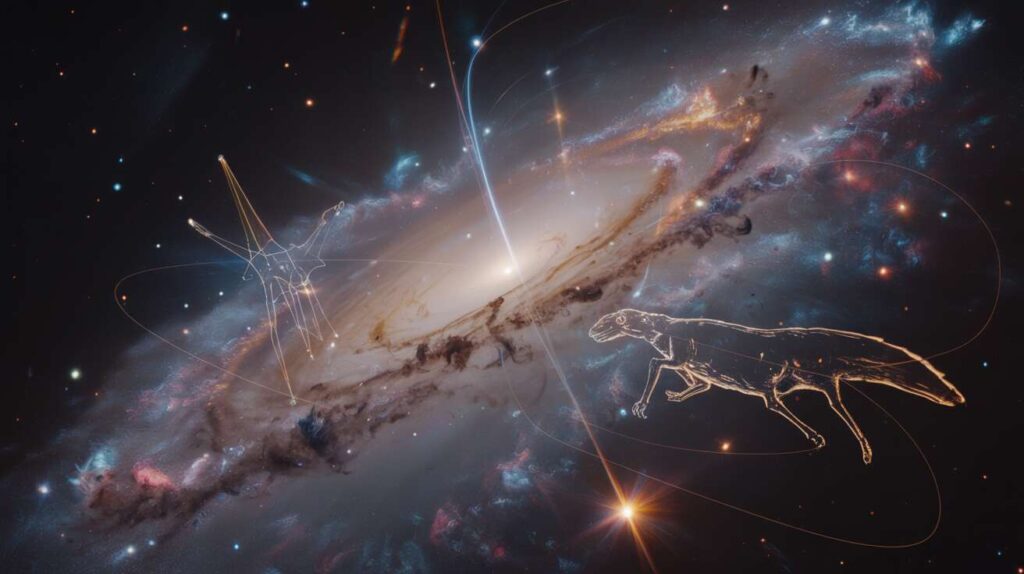
Gazing back to the dawn of time, astronomers have long sought the universe’s first light sources, the primordial stars that ignited in the cosmic darkness. Now, peering deeper into space than ever before, the James Webb Space Telescope (JWST) has returned an image that could fundamentally rewrite the opening chapters of cosmic history. The data points to the first direct evidence of a long-theorized but never-before-seen class of stellar objects: colossal stars from the universe’s infancy, so ancient and different from our modern sun that scientists have nicknamed them ‘dinosaur-like’ stars.
Revolutionary discovery of the James Webb Telescope
The groundbreaking observation centers on a faint smudge of light from a distant galaxy, its light having traveled for over 13.4 billion years to reach the telescope’s sophisticated mirrors. Within this nascent galaxy, designated CEERS-93316, the telescope’s Near-Infrared Spectrograph (NIRSpec) instrument isolated pockets of intense energy that do not match the profile of any known stellar populations. This discovery represents a monumental leap in observational cosmology, pushing the boundaries of what we can see and understand about the earliest epochs of the universe.
Pinpointing the cosmic dawn
The light from these objects was emitted when the universe was less than 400 million years old, a period known as the cosmic dawn. It was during this era that the first stars and galaxies formed, burning through the neutral hydrogen fog that permeated the cosmos. Finding these first-generation stars, known to theorists as Population III stars, has been a primary goal for the JWST. The evidence suggests these newly identified objects are prime candidates, offering a direct window into the processes that kickstarted the universe as we know it. The discovery is not just about finding an old star; it’s about witnessing the very mechanism of creation for the first time.
A signal from the void
What makes the finding so compelling is the unique chemical fingerprint, or spectrum, of the light. Unlike modern stars, which are rich in heavy elements forged in previous stellar generations, the light from these primordial objects indicates an environment almost entirely devoid of anything but hydrogen and helium. This pristine composition is the smoking gun that astronomers have been searching for, a clear sign that these are indeed the universe’s first stellar pioneers. It’s a signal that has traveled unimaginable distances, carrying the secrets of a universe just beginning to shine.
The initial findings have sent ripples through the astronomical community, as they not only confirm long-standing theories but also challenge them. The sheer size and luminosity inferred from the observations are at the upper limit of what models predicted. This discovery moves beyond theory and into the realm of direct observation, raising new questions about the nature of these ancient stellar behemoths. Understanding their properties is crucial, as these first stars are the ancestors of everything that came after, including our own galaxy and sun.
What is a ‘dinosaur-like’ star ?
The term ‘dinosaur-like’ star is an evocative moniker for what are scientifically known as Population III stars. The analogy is fitting: like the dinosaurs of Earth’s past, these stars were colossal, lived in a vastly different environment than their modern counterparts, and have long since gone extinct. They represent a bygone era of cosmic evolution, a time when the rules of star formation were fundamentally different. Their discovery is akin to finding a fossil from the very birth of the cosmos.
Characteristics of a primordial giant
These ancient stars were unlike anything in the modern universe. Theoretical models suggest they were almost unfathomably massive, potentially hundreds of times the mass of our sun. Their defining characteristic, however, was their chemical purity.
- Composition: They were forged from the primordial gas left over from the Big Bang, consisting almost exclusively of hydrogen and helium.
- Mass: Estimates range from 60 to over 300 solar masses, making them true heavyweights.
- Temperature: Due to their immense mass, they burned incredibly hot, with surface temperatures exceeding 100,000 Kelvin.
- Lifespan: They lived fast and died young, burning through their fuel in just a few million years, a mere blink of an eye in cosmic terms.
Why they are so different
The absence of heavy elements, which astronomers call ‘metals’, is the key to their unique nature. In modern star-forming clouds, these metals act as cooling agents, allowing the gas to fragment into many smaller clumps that form stars of various sizes, including smaller ones like our sun. In the early universe, without these metals, the primordial gas clouds could not cool efficiently. As a result, they collapsed into single, monolithic cores, giving birth to enormous, solitary stars rather than diverse stellar clusters. This unique formation process explains their gigantic scale and rarity today.
The existence of these stellar giants was first hypothesized decades ago to explain the chemical makeup of the universe. The ‘dinosaur-like’ stars, through their explosive deaths as supernovae, were the cosmic forges that created the first heavy elements, seeding the universe with the raw materials needed for the next generation of stars, planets, and eventually, life. Without them, the cosmos would have remained a simple mixture of hydrogen and helium.
Analysis of initial observations
The claim of discovering these primordial stars rests on a meticulous analysis of the light collected by the JWST. Astronomers used spectroscopy, the technique of breaking down light into its constituent colors or wavelengths, to decipher the chemical composition and physical properties of the distant light source. The resulting spectrum provided a wealth of information that strongly points toward a Population III stellar cluster.
Decoding the light signature
The primary evidence lies in the absence of spectral lines associated with elements like oxygen, carbon, and nitrogen. The spectrum from the candidate objects showed an overwhelming dominance of hydrogen and helium emission lines, exactly as predicted for a star with near-zero metallicity. Furthermore, a strong emission line from ionized helium (He II) was detected, a feature that requires an incredibly powerful source of ultraviolet radiation to produce. A cluster of extremely hot, massive, and metal-poor stars is the most plausible explanation for such an intense energy signature.
Comparing primordial and modern stars
To appreciate the significance of the findings, it’s helpful to compare the inferred properties of these ‘dinosaur-like’ stars with a familiar star like our sun, a typical modern, metal-rich star. The differences are stark and highlight just how exotic the early universe was.
| Property | ‘Dinosaur-like’ Star (Population III) | Modern Star (like the Sun) |
|---|---|---|
| Mass | 100-300 Solar Masses | 1 Solar Mass |
| Lifespan | ~2-3 Million Years | ~10 Billion Years |
| Metallicity | Effectively 0% (only H, He) | ~1.5% (contains heavy elements) |
| Surface Temperature | > 100,000 K | ~5,800 K |
This data underscores the extreme nature of these first cosmic objects and why their direct detection has been impossible until the advent of a tool as powerful as the JWST.
The analysis also involved ruling out other potential sources for the observed signal, such as active galactic nuclei or unusual gas clouds. However, none of these alternative explanations fully fit the unique spectral data. The combination of pristine chemistry and extreme luminosity makes the Population III star hypothesis the leading and most exciting interpretation of what the telescope has seen.
Implications for our understanding of the universe
Confirming the existence of these ‘dinosaur-like’ stars would not just be a feather in the cap for the JWST mission; it would trigger a paradigm shift in our understanding of cosmic evolution. These stars are the missing link in the story of the universe, bridging the gap between the simple, smooth state after the Big Bang and the complex, structured cosmos we see today. Their properties directly influence several key areas of astrophysics.
The first cosmic chemical factories
One of the most profound implications relates to the chemical enrichment of the universe. Since the Big Bang only produced hydrogen, helium, and trace amounts of lithium, every other element on the periodic table had to be created inside stars. Population III stars were the very first engines of this process. When these massive stars died in cataclysmic supernova explosions, they dispersed the first batches of carbon, oxygen, iron, and other heavy elements into the interstellar medium. This ‘pollution’ was the essential prerequisite for the formation of later generations of stars, rocky planets, and the chemistry required for life.
Solving the reionization puzzle
The discovery also offers crucial insights into the Epoch of Reionization. After the universe cooled from the Big Bang, it entered a period known as the cosmic dark ages, filled with a fog of neutral hydrogen gas. The intense ultraviolet radiation from the first stars is believed to have been the primary driver that ionized this gas, making the universe transparent to light. However, the exact timing and sources of this reionization have been debated. The immense power and heat of these ‘dinosaur-like’ stars make them perfect candidates for this cosmic transformation. Pinpointing their numbers and distribution could finally solve the puzzle of how the cosmic fog was lifted.
The sheer scale of these stars as observed by the JWST may force theorists to revise their models of early star formation and galaxy assembly. If such massive stars were common, they would have had a dramatic and violent impact on their surroundings, potentially regulating the growth of the first galaxies. This interplay between the first stars and their host galaxies is a frontier of modern astrophysics, one that these new observations have blown wide open.
Reactions from the scientific community
The announcement has been met with a wave of excitement and cautious optimism from astronomers worldwide. The potential to directly observe the universe’s first stars is a moment many have been anticipating for decades. The data, while compelling, is being subjected to intense scrutiny as researchers work to confirm the extraordinary claim.
A wave of excitement
Dr. Evelyn Reed, a cosmologist at the Massachusetts Institute of Technology who was not involved in the study, described the finding as “breathtaking.” In a published comment, she stated, “If this holds up, it’s everything we hoped the JWST would do and more. We’ve been operating with elegant theories about the first stars for years, but to see their actual light signature would be a transformative moment for the field. It’s like moving from studying fossils to observing a living, breathing dinosaur.” This sentiment is echoed across the community, with many researchers heralding the start of a new era in observational cosmology.
Calls for confirmation and further study
While the excitement is palpable, it is tempered with scientific rigor. Many experts are emphasizing the need for follow-up observations to definitively rule out any alternative explanations. Dr. Kenji Tanaka, a specialist in stellar atmospheres at the University of Tokyo, noted, “The evidence for near-zero metallicity is very strong, but the universe can be tricky. We need deeper spectra and observations of other similar candidate objects to build an irrefutable case.” The scientific process demands extraordinary evidence for extraordinary claims, and the work to validate this discovery is already underway. The initial paper has sparked a flurry of proposals for new JWST observation time dedicated to hunting for more of these primordial stellar systems.
The debate and verification process is a healthy and essential part of science. Whether this specific candidate is confirmed or not, the observation demonstrates that the JWST possesses the capability to probe this unexplored cosmic era. It has proven that the search for the first light is no longer a theoretical exercise but a tangible, observational quest.
Next steps for the James Webb Telescope
The initial detection of ‘dinosaur-like’ stars is not an endpoint but a spectacular beginning. The discovery has unlocked a new field of study and laid out a clear path for future research with the James Webb Space Telescope. The primary goal now is to move from a single compelling candidate to a robust sample, allowing for a statistical understanding of the first stellar generation.
Deepening the investigation
The immediate next step for the research team is to secure more observation time with the JWST to perform a deeper spectroscopic analysis of the original target, CEERS-93316. A longer exposure will improve the signal-to-noise ratio, allowing for a more precise measurement of its chemical composition and a stronger constraint on its metallicity. Scientists will be looking to confirm the absence of metal absorption lines with even greater certainty. This is the gold standard for verification and the top priority for the team.
Expanding the search
Beyond the initial target, astronomers are now combing through existing and future JWST deep-field images to identify other candidate objects. The unique spectral signature—strong ionized helium and a lack of metals—provides a clear template for what to look for. Future observation programs will be designed specifically to hunt for these signatures in the most distant galaxies the telescope can see. Key strategies include:
- Targeted Surveys: Focusing on regions of the sky where gravitational lensing by massive galaxy clusters magnifies the light from even more distant objects, bringing fainter and earlier galaxies into view.
- Wider Field Searches: Using the telescope’s imaging capabilities to identify promisingly bright and blue objects at high redshift before committing to time-intensive spectroscopic follow-up.
- Cross-instrument Analysis: Combining data from both the NIRSpec and the Mid-Infrared Instrument (MIRI) to gain a more complete picture of the stars’ environment and energy output.
These efforts will help answer critical questions, such as how common these massive stars were, whether they formed in isolation or in clusters, and how their properties varied in different environments across the early universe. The era of discovering the first stars has truly begun.
The groundbreaking detection of what appear to be the universe’s first stars by the James Webb Space Telescope marks a pivotal moment in our cosmic exploration. These so-called ‘dinosaur-like’ stars, massive and chemically pristine behemoths, represent the missing link in our understanding of how the universe evolved from the simplicity of the Big Bang to the rich complexity seen today. The analysis of their light provides the first direct evidence of the cosmic engines that forged the first heavy elements and helped lift the cosmic dark ages. While the scientific community works diligently to confirm and build upon this initial finding, the discovery has already opened a new window into the dawn of time, promising to reshape our fundamental theories of star formation and galaxy evolution.