

The universe is expanding, but a persistent debate rages among cosmologists about just how fast this expansion is occurring. This is not a mere academic quibble; the rate of expansion, known as the Hubble constant, underpins our entire model of the cosmos. Now, new observations using a cosmic phenomenon predicted by Einstein are adding a significant twist to the story. By using entire galaxies as lenses to see even farther into space, astronomers have obtained a measurement that deepens a growing crisis in cosmology, suggesting that our understanding of the universe may be incomplete.
Introduction to the concept of gravitational lensing
The curvature of spacetime
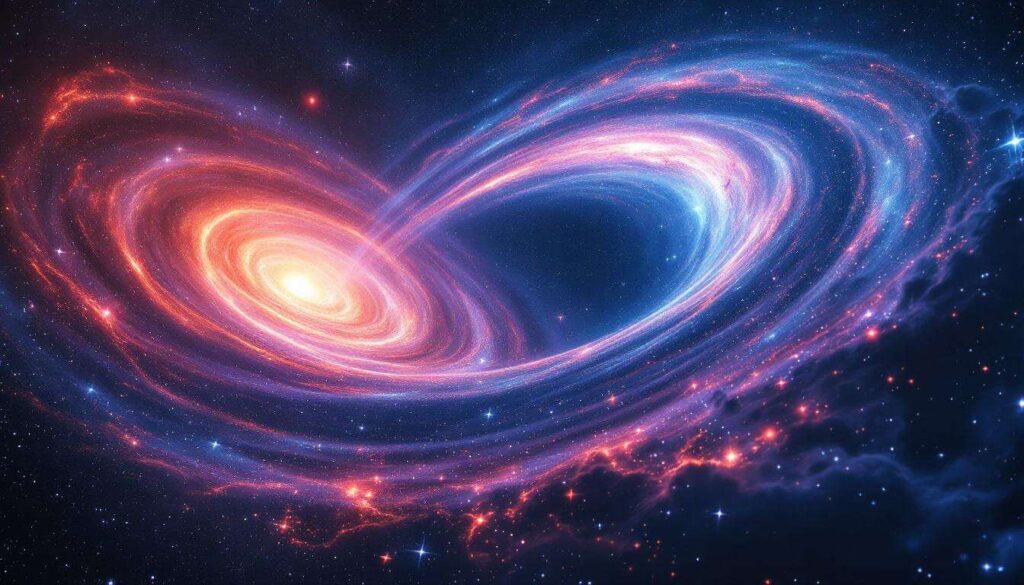
At the heart of gravitational lensing is Albert Einstein’s theory of general relativity. The theory posits that massive objects do not simply exert a gravitational pull but fundamentally warp the fabric of spacetime around them. Imagine a bowling ball placed on a stretched rubber sheet; it creates a dip. Now, roll a marble nearby. Instead of traveling in a straight line, its path will curve as it follows the indentation made by the bowling ball. In the cosmos, light behaves similarly. The immense mass of a galaxy or a cluster of galaxies creates such a profound warp in spacetime that light from a more distant object bends as it passes by. This celestial body acts as a natural, albeit imperfect, magnifying glass, or a gravitational lens.
Different manifestations of lensing
This cosmic bending of light can manifest in several ways, depending on the alignment and mass of the objects involved. Scientists categorize these effects to better study them. The primary types include:
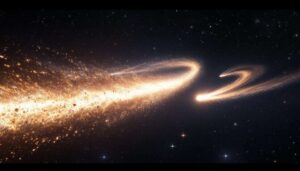
- Strong lensing: When the alignment between the observer, the lensing galaxy, and the distant source is nearly perfect, the light can be bent so dramatically that it produces multiple images of the background object, or even smears its image into arcs and spectacular patterns known as Einstein rings.
- Weak lensing: More commonly, the alignment is not perfect, and the effect is much subtler. Weak lensing causes slight, coherent distortions in the shapes of background galaxies. While the effect on any single galaxy is imperceptible, analyzing the collective distortion of thousands of galaxies in a region of the sky allows astronomers to map the distribution of mass, especially invisible dark matter.
- Microlensing: This occurs when a much smaller object, like a star or a planet, passes in front of a more distant star. The lensing effect causes a temporary and predictable brightening of the background star’s light, a phenomenon used to detect exoplanets and study the stellar populations of our galaxy.
While each of these effects provides valuable information, it is the dramatic phenomenon of strong lensing that has become a critical tool for measuring the very fabric of the expanding universe.
How gravitational lensing reveals the universe’s expansion
Time-delay cosmography
When strong gravitational lensing creates multiple images of a distant object, it offers a unique opportunity to measure cosmic distances. The technique, known as time-delay cosmography, relies on observing distant, variable sources like quasars. A quasar is an extremely bright galactic nucleus powered by a supermassive black hole. Its brightness flickers over time. Because the light from the quasar travels along different paths to form each of the multiple images, each path has a slightly different length and passes through a slightly different part of the gravitational field. Consequently, a flicker in the quasar’s brightness will not be observed in all images simultaneously. There will be a measurable time delay, ranging from days to months, between the arrival of the light for each image.
Calculating the Hubble constant
This time delay is the golden ticket for cosmologists. By precisely measuring the delay between the flickering of the different images and creating a detailed map of the mass distribution in the lensing galaxy, scientists can perform a direct, geometric calculation of the distance to the lens and the source. This method is incredibly powerful because it is independent of the so-called “cosmic distance ladder,” a traditional method that relies on a series of steps to estimate distances, with uncertainties accumulating at each step. Once an absolute distance is known, it can be combined with the redshift of the quasar (a measure of how much its light has been stretched by cosmic expansion) to calculate the universe’s expansion rate: the Hubble constant, or H₀.
This direct measurement provides a vital, independent check on other methods and has led to some startling conclusions about the cosmos.
The implications of the discovery on our understanding of the universe
The Hubble tension
Modern cosmology is facing a significant challenge known as the Hubble tension. Two primary methods of measuring the Hubble constant yield persistently different results. On one side, measurements of the early universe, specifically the cosmic microwave background (CMB) radiation left over from the big bang, predict how fast the universe should be expanding today. On the other side, measurements of the local, modern universe, using techniques like observing Cepheid variable stars and time-delay lensing, measure how fast it is actually expanding. The problem: the values do not match.
| Measurement Method | Source of Data | Result (km/s/Mpc) |
|---|---|---|
| Early Universe | Planck Satellite (CMB) | Approximately 67.4 |
| Local Universe | Supernovae/Cepheids (SH0ES project) | Approximately 73.0 |
| Local Universe | Gravitational Lensing (TDCOSMO) | Approximately 73.3 |
A crack in the standard model
This discrepancy is not a minor statistical fluke; it has reached a high level of statistical significance, suggesting it is a real phenomenon. If both sets of measurements are correct, it implies that the standard cosmological model, known as Lambda-CDM, is missing a key ingredient. This model has been incredibly successful at describing the universe, with its components of normal matter, dark matter, and dark energy (Lambda). The Hubble tension may be the first major crack in this model. It could be pointing towards new physics, such as:
- A more complex form of dark energy that changes over time.
- The existence of a new, undiscovered subatomic particle.
- A modification to Einstein’s theory of gravity on cosmic scales.
The latest data from gravitational lensing studies has only served to sharpen this cosmic conundrum, making it one of the most pressing questions in physics today.
Analysis of new astrophysical data
The TDCOSMO collaboration’s findings
A major research group, the TDCOSMO (Time Delay Cosmography) collaboration, has recently published results from a comprehensive analysis of multiple gravitationally lensed quasars. By combining high-resolution data from the Hubble Space Telescope with observations from ground-based observatories, they have achieved a new level of precision in their measurement of the Hubble constant. Their findings strongly support the higher value for H₀, coming in at approximately 73.3 km/s/Mpc, with an uncertainty of just over 2%. This result reinforces the measurements from the local universe and deepens the discrepancy with the value predicted from the early universe. The consistency between the lensing results and the Cepheid/supernova results makes it harder to dismiss the tension as a systematic error in just one method.
Strengthening the statistical case
The strength of the TDCOSMO result lies in its rigorous approach to understanding and mitigating potential errors. The team developed sophisticated models for each lensing galaxy, accounting for the distribution of both stars and dark matter. They also carefully considered the effects of all other mass along the line of sight between Earth and the lensed quasar, as these “external convergence” effects can subtly alter the time delays. By demonstrating that their result is robust against these potential sources of error, the collaboration has made a powerful case that the Hubble tension is real. Their work effectively shifts the burden of proof, challenging theorists to explain the mismatch rather than experimentalists to find a flaw in their measurements.
Achieving this level of precision is, however, an immense undertaking fraught with significant observational and analytical hurdles.
The technical and methodological challenges of observations
The mass modeling problem
The single greatest source of uncertainty in time-delay cosmography is modeling the mass distribution of the foreground lensing galaxy. The time delay between the lensed images depends critically on the precise gravitational potential of the lens. This means astronomers must create a detailed map of all the matter, both luminous and dark, in the galaxy. This is a complex inverse problem: one must infer the cause (the mass distribution) from the effect (the lensed images). Different assumptions about the density profile of the galaxy’s dark matter halo can lead to slightly different results for the Hubble constant. Reducing this uncertainty requires high-quality kinematic data, such as measurements of the motions of stars within the lensing galaxy, to constrain the models.
The demand for high-resolution imaging
To accurately measure the positions of the lensed images and the light profile of the lensing galaxy, astronomers require extraordinarily sharp images. The separation between lensed images is often tiny, on the order of an arcsecond. This necessitates the use of space-based observatories like the Hubble Space Telescope or the James Webb Space Telescope, which operate above the blurring effects of Earth’s atmosphere. Alternatively, ground-based telescopes equipped with advanced adaptive optics systems can achieve similar resolution. These systems use deformable mirrors to correct for atmospheric turbulence in real time, producing images that are nearly as sharp as those from space. Without this technological prowess, the precise measurements required for time-delay cosmography would be impossible.
Despite these difficulties, the future is bright, with next-generation observatories poised to revolutionize the field.
Future prospects and upcoming research
The era of big data lensing
The field of gravitational lensing is on the cusp of a data explosion. Upcoming facilities like the Vera C. Rubin Observatory are set to conduct massive sky surveys, discovering thousands of new strong lensing systems. This will transform the field from one of studying a few dozen hand-picked systems to one of large-scale statistical analysis. With a much larger sample, astronomers can better characterize and average out the uncertainties associated with individual mass models, leading to a far more precise and robust measurement of the Hubble constant. This statistical power will be crucial in definitively confirming or refuting the Hubble tension.
Synergy with other cosmic probes
The ultimate resolution to the Hubble tension will likely come from a combination of different observational methods. Future research will focus on combining the precise lensing data with information from other cosmic probes, such as gravitational waves from merging neutron stars, which provide an entirely independent way to measure H₀. This multi-messenger approach will help scientists cross-check their results and hunt down any remaining systematic errors. If the discrepancy persists across multiple, independent lines of evidence, it will provide undeniable proof that our standard model of cosmology needs a fundamental revision. The next decade promises to be a thrilling time in our quest to understand the origin, evolution, and ultimate fate of our universe.
Gravitational lensing has evolved from a theoretical curiosity into a premier tool for fundamental cosmology. The precise measurements of the universe’s expansion rate obtained through this method have solidified a major discrepancy at the heart of modern physics. This Hubble tension, now reinforced by lensing data, suggests we may be on the verge of discovering new physics that governs the cosmos. Whether the solution lies in a new form of dark energy, an undiscovered particle, or a flaw in our understanding of gravity, the path forward promises a deeper and more complete picture of our expanding universe.