



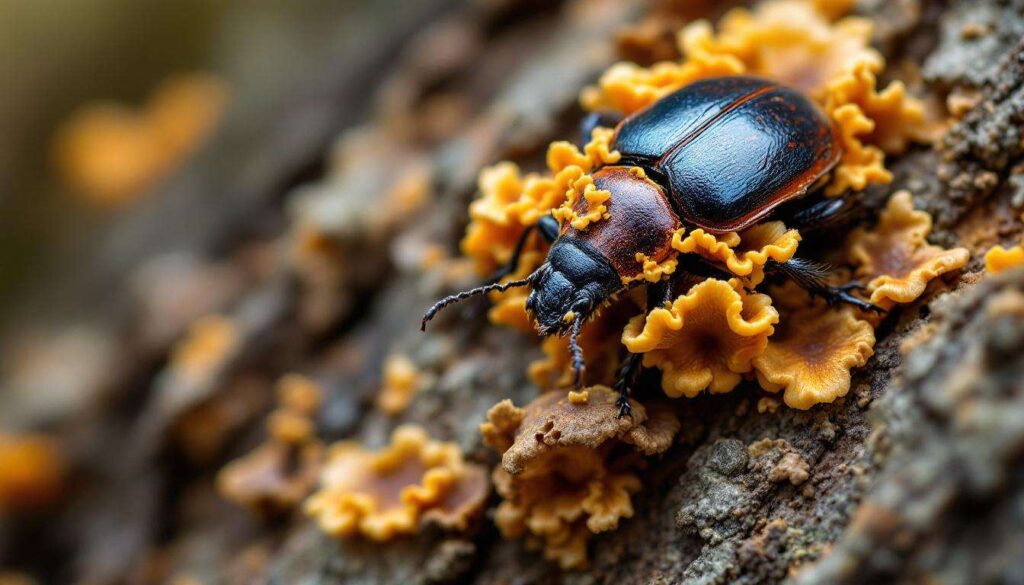
In the silent, slow-motion warfare of the forest, conifers wage a chemical battle for survival. When their bark is breached by an intruder, they unleash a potent, aromatic arsenal of toxins designed to repel or kill. For decades, scientists have studied how the diminutive bark beetle, a creature no larger than a grain of rice, can withstand this onslaught and orchestrate the downfall of towering pines. The answer, it turns out, is not in the beetle alone, but in a microscopic ally it carries into battle: a fungus that ingeniously disarms the tree’s chemical shields and turns them against their creator.
Origin of plant-derived toxins and their effect on bark beetle
Conifer defense mechanisms
Conifers have evolved a sophisticated, two-tiered defense system centered on resin. The first line of defense is a network of pre-formed resin ducts within the bark and wood. When a beetle bores into the tree, these ducts are severed, releasing a sticky flow of resin that can physically entomb the attacker, a process known as pitching out. If this initial barrier is overcome, the tree initiates a second, more potent response: an induced defense where it synthesizes and floods the attack site with additional, highly toxic chemical compounds. The primary weapons in this chemical arsenal are terpenes, a class of volatile organic compounds that give pine trees their characteristic scent.
The toxicity of terpenes
Terpenes are not merely fragrant; they are highly effective insecticides. Compounds like alpha-pinene and beta-pinene, which are abundant in conifer resin, are acutely toxic to bark beetles. These chemicals can act in several ways: as neurotoxins that disrupt the beetle’s nervous system, as solvents that damage cellular structures, or by simply overwhelming the insect’s metabolic capacity to detoxify foreign substances. A solitary beetle has virtually no chance of survival against the full chemical force of a healthy tree. Success depends entirely on a coordinated, mass attack that can deplete the tree’s defensive reserves faster than they can be replenished.
The challenge for bark beetles
The central paradox for the bark beetle is that it must spend a significant amount of time exposed to these toxins while it establishes a gallery for its eggs and larvae. The very act of boring into the tree triggers the most intense release of the chemical defenses it is trying to overcome. This creates immense selective pressure, where only beetles capable of managing this toxic environment can reproduce. For a long time, it was believed the beetle’s own physiology was solely responsible for this detoxification, but that is only part of the story. This understanding of the tree’s powerful chemical arsenal highlights the beetle’s predicament, raising the question of how it consistently breaches these defenses. The key is not just strength in numbers, but a crucial partnership with an organism that specializes in chemical warfare.
The crucial role of fungi associated with bark beetle
A symbiotic relationship
Bark beetles are not solitary invaders; they are vectors for a suite of microorganisms, most notably fungi from the ophiostomatoid group. This is not an accidental contamination but a highly evolved symbiotic relationship. Specialized structures on the beetle’s body, called mycangia, serve as protected pockets for carrying fungal spores. When a beetle bores into a new host tree, it simultaneously inoculates the wood with its fungal partner. The fungus germinates and grows, spreading through the tree’s tissues alongside the beetle’s galleries.
Fungal functions for the beetle
The benefits of this partnership for the beetle are manifold and critical for its success. The fungi are not passive passengers; they actively engineer the environment to the beetle’s advantage. Key functions include:
- Nutrition: Many bark beetle larvae do not feed on the wood itself but on the fungal mycelia growing on the gallery walls. The fungus predigests the wood, concentrating nutrients and making them accessible to the developing larvae.
- Habitat modification: The fungal growth helps to block the tree’s water transport systems, weakening it more rapidly and hastening its death.
- Detoxification: Most importantly, these fungi are masterful chemists, capable of breaking down the tree’s toxic terpenes, creating a safer environment for both the adult beetles and their offspring.
Species-specific pairings
This symbiotic relationship is often highly specific, a result of millions of years of co-evolution. Different species of bark beetles are frequently associated with a unique set of fungal partners, each adapted to the specific chemistry of their preferred host trees. This specificity underscores the importance of the relationship to the beetle’s life cycle.
| Bark Beetle Species | Primary Fungal Symbiont | Host Tree |
|---|---|---|
| Mountain Pine Beetle (Dendroctonus ponderosae) | Grosmannia clavigera | Lodgepole Pine, Ponderosa Pine |
| Southern Pine Beetle (Dendroctonus frontalis) | Entomocorticium sp. A | Loblolly Pine, Shortleaf Pine |
| Spruce Beetle (Dendroctonus rufipennis) | Leptographium abietinum | Engelmann Spruce, White Spruce |
This vital partnership is the cornerstone of the beetle’s ability to colonize a living tree. The fungus is not just helpful; it is an essential tool for overcoming the host’s defenses. The next piece of the puzzle is understanding the precise biochemical process by which these fungi perform their remarkable feat of detoxification.
Mechanism of toxin conversion by fungi
Biotransformation of terpenes
The fungal symbionts do not simply absorb or sequester the tree’s toxic terpenes. Instead, they actively metabolize them through a process called biotransformation. The fungus releases a cocktail of extracellular enzymes that chemically modify the terpene molecules, converting them into different, less harmful compounds. This process is remarkably efficient, neutralizing the most potent chemical weapons in the conifer’s arsenal directly at the site of the beetle attack.
The enzymatic process
At the heart of this biotransformation are powerful fungal enzymes, particularly a class of proteins known as cytochrome P450 monooxygenases. These enzymes are detoxification specialists, found in nearly all living organisms, including humans. The bark beetle’s fungal partners, however, have evolved P450s that are exceptionally effective at targeting the specific chemical structures of conifer terpenes. They work by adding oxygen atoms to the terpene molecule, a process called hydroxylation, which alters its shape, reduces its toxicity, and makes it more water-soluble and easier to process.
From toxin to pheromone
The most stunning aspect of this fungal chemistry is that the detoxification process often yields products that are directly beneficial to the beetle. In a remarkable twist of ecological judo, the fungus converts the tree’s defensive compounds into the beetle’s own communication signals. For example, the toxic monoterpene alpha-pinene is converted by the fungus into trans-verbenol, a key aggregation pheromone for the mountain pine beetle. This effectively turns the tree’s weapon into a beacon, broadcasting a signal to other beetles that a suitable host has been found and that reinforcements are needed.
| Original Compound (Tree Toxin) | Chemical Class | Converted Compound (Beetle Pheromone) | Function for Beetle |
|---|---|---|---|
| Alpha-Pinene | Monoterpene | trans-Verbenol | Aggregation Signal |
| Myrcene | Monoterpene | Ipsdienol | Aggregation Signal |
By hijacking the tree’s defensive chemistry and repurposing it for communication, the fungus dramatically amplifies the beetle’s ability to coordinate a mass attack. This biochemical assistance fundamentally changes the beetle’s offensive capabilities and has a direct impact on its chemical defense strategy.
Impact on bark beetle chemical defense
Enhancing aggregation signals
The fungal conversion of terpenes into pheromones is a game-changer for the beetle. A lone beetle can only produce a small amount of pheromone on its own. By enlisting its fungal partner, the production of the aggregation signal is massively scaled up, using the tree’s own resin as the raw material. This amplified signal travels further and attracts more beetles more quickly, ensuring the attack reaches a critical mass before the tree can mount a successful defense. It is the difference between a small skirmish and an overwhelming invasion.
Reducing the beetle’s metabolic load
Detoxifying powerful chemicals is an energy-intensive process. If the beetle had to rely solely on its own metabolic system to neutralize the flood of terpenes, it would expend a tremendous amount of energy that could otherwise be used for boring galleries and producing eggs. By outsourcing the bulk of the detoxification work to its fungal symbiont, the beetle conserves vital energy resources. This metabolic relief allows the beetle to allocate more energy to reproduction, ultimately leading to larger broods and more successful colonization.
A detoxified environment for larvae
The benefits extend to the next generation. The adult beetle and its fungal partner work in concert to create a less toxic environment within the phloem for the vulnerable eggs and larvae. The continuous biotransformation of resin by the growing fungal mycelium ensures that the developing brood is not exposed to the lethal concentrations of terpenes present in a resisting tree. This detoxification of the nursery galleries is crucial for ensuring a high rate of larval survival, which is essential for the population to grow and spread. This intricate interplay, where the fungus enhances beetle offense and defense, does not exist in isolation; it triggers a cascade of effects that can reshape entire forest ecosystems.
Ecological consequences of this interaction
Accelerated tree mortality and outbreaks
The primary and most visible consequence of this tripartite interaction is the dramatic increase in tree mortality. The beetle-fungus synergy allows beetle populations to overcome the defenses of even healthy, vigorous trees. This can transform endemic beetle populations, which typically only attack weakened trees, into epidemic outbreaks that kill millions of acres of forest. The fungus is the catalyst that enables this transition, making the beetle a far more potent agent of ecological change than it would be on its own.
Changes in forest structure and fire regimes
Large-scale tree mortality events driven by bark beetles fundamentally alter the structure and composition of forests. The death of dominant canopy trees, such as lodgepole pine, opens the forest floor to more sunlight, promoting the growth of different understory plants and tree species. This can shift the entire trajectory of forest succession. Furthermore, the massive accumulation of dead, dry wood dramatically increases the fuel load, leading to significant changes in fire behavior. Outbreaks often precede larger, more intense wildfires than the ecosystem would otherwise experience. Key ecological effects include:
- Canopy opening: altering light and temperature conditions on the forest floor.
- Fuel loading: increasing the risk and intensity of wildfires.
- Nutrient cycling: a massive pulse of nutrients is released as dead trees decompose.
- Habitat alteration: affecting wildlife species that depend on living trees for food or shelter.
Understanding the precise mechanisms of this powerful natural alliance is therefore more than just an academic pursuit. It offers critical insights that could lead to new strategies for managing the destructive bark beetle outbreaks that threaten forests across the globe.
Potential for biological control of bark beetle infestations
Targeting the fungal symbiont
Traditional methods for controlling bark beetle outbreaks, such as logging or insecticide spraying, are often impractical on a landscape scale and can have negative side effects. The discovery of the beetle’s reliance on its fungal partner opens up an entirely new avenue for control: targeting the symbiosis itself. Instead of fighting the beetle, management strategies could focus on disrupting its relationship with the fungus. Without its detoxification and nutrient-providing partner, the beetle’s ability to attack healthy trees would be severely compromised.
Developing disruptive agents
Research is now exploring the potential for developing highly specific antifungal agents that could inhibit the growth of the beetle’s symbiotic fungi. The goal would be to find a compound that is effective against ophiostomatoid fungi but benign to other, beneficial fungi in the ecosystem. Another approach involves identifying and utilizing competing microbes, or “antagonists,” that can outcompete the beetle’s fungus within the tree, effectively neutralizing the beetle’s life support system. A comparison of approaches shows a clear shift in strategy.
| Strategy | Target | Mechanism | Potential Advantage |
|---|---|---|---|
| Conventional | Bark Beetle | Insecticides, sanitation logging | Directly removes beetles |
| Symbiont-Based | Fungal Partner | Antifungal agents, microbial competitors | Highly specific, less non-target impact |
| Behavioral | Beetle Behavior | Synthetic pheromones (trapping) | Non-toxic monitoring and control |
Exploiting the mechanism for ‘push-pull’ strategies
A deeper understanding of the chemical ecology also allows for more sophisticated behavioral manipulation. In a ‘push-pull’ strategy, high-value areas could be protected by deploying compounds that repel beetles (the ‘push’), such as synthetic versions of the tree’s own toxins. Simultaneously, beetles could be lured into designated trap areas using the very aggregation pheromones that are produced by their fungal partners (the ‘pull’). This integrated approach, grounded in the fundamental biology of the beetle-fungus interaction, offers a more nuanced and potentially more sustainable way to manage beetle populations and protect forest resources.
The intricate relationship between the bark beetle and its symbiotic fungus is a powerful example of co-evolution, demonstrating how a microscopic organism can enable a tiny insect to alter entire landscapes. The fungus’s ability to neutralize a tree’s chemical defenses and convert those same toxins into a call to arms for the beetle is a masterful stroke of natural engineering. This understanding not only solves a long-standing ecological puzzle but also provides a roadmap for developing innovative and targeted strategies to mitigate the impact of beetle outbreaks, highlighting the complex, hidden connections that govern the health and resilience of our forests.