



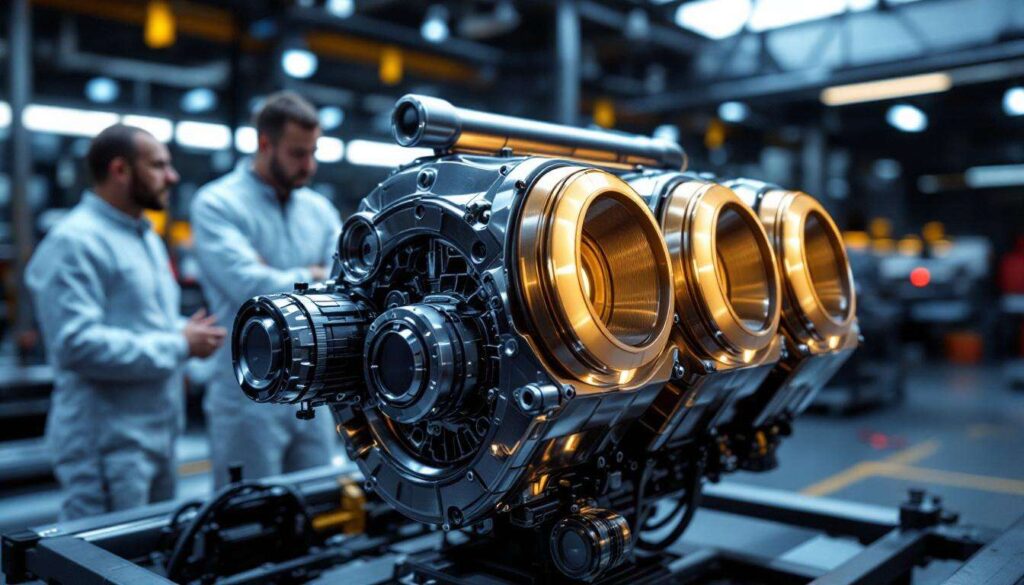
In the relentless pursuit of automotive excellence, the internal combustion engine has been refined for over a century, with its core components seemingly perfected. Yet, from the storied workshops of Maranello, Italy, a fundamental redesign has emerged. Ferrari, a name synonymous with high-performance engineering, has unveiled a patent for an oblong piston, a development that challenges conventional engine design and promises a new frontier of power and efficiency. This unexpected innovation could represent a pivotal moment for the future of high-performance powertrains.
Presentation of Ferrari’s oblong piston technology
What is an oblong piston ?
At its core, the concept is a radical departure from the circular piston that has been a mainstay of engine design since its inception. Instead of a perfect circle, Ferrari’s design features a piston with an elongated, or stadium-shaped, profile. This non-traditional geometry means the piston crown has two parallel flat sides connected by two semicircular ends. It moves within a cylinder bore that perfectly matches this unique shape, requiring a complete rethink of not just the piston itself, but also the cylinder block, piston rings, and potentially even the connecting rod and crankshaft assembly.
Key design features
The patent filings reveal several critical features that make this technology viable. The design is not merely about changing the shape; it is a holistic approach to re-engineering the engine’s core. Key aspects of the technology include:
- Optimized crown surface: The flat, elongated surface is designed to maximize the area upon which combustion pressure acts, a key factor in generating torque.
- Advanced materials: To withstand the unique stress distributions of an oblong shape, Ferrari is likely employing advanced, lightweight, and high-strength alloys, possibly incorporating ceramic coatings for thermal management.
- Complex ring design: Sealing a non-circular piston is a major engineering hurdle. The patent details a sophisticated piston ring system designed to maintain a perfect seal against the cylinder wall despite the complex geometry and thermal expansion.
- Reinforced structure: The piston’s internal structure, particularly the wrist pin bosses, is heavily reinforced to handle the altered load paths and prevent deformation under extreme pressure.
Ferrari’s patent and initial reveal
The technology came to light through a series of detailed patent applications filed by Ferrari, which were subsequently uncovered by industry analysts. These documents provide a rare glimpse into the company’s forward-thinking research and development. While Ferrari has not made an official public announcement regarding a production model featuring this engine, the level of detail in the patents suggests this is far more than a theoretical exercise. It represents a significant investment in pushing the boundaries of what an internal combustion engine can achieve.
Understanding the fundamental design of this new piston naturally leads to the question of why Ferrari would deviate so dramatically from a proven, century-old standard.
The reasons behind choosing an oblong design
Maximizing surface area
The primary motivation behind the oblong piston is rooted in fundamental physics. The power an engine produces is a direct result of the pressure from combustion pushing down on the piston’s crown. By elongating the piston, Ferrari significantly increases the surface area of the piston top without increasing the engine’s overall width. A larger surface area allows the same combustion pressure to generate a greater downward force, which translates directly into more torque at the crankshaft. This is a clever way to increase an engine’s displacement and power potential within a constrained physical package.
Optimizing the combustion chamber
The oblong shape has a profound effect on the cylinder head design. A conventional round cylinder limits the size and number of valves that can be placed directly above it. The elongated combustion chamber created by an oblong piston provides more real estate in the cylinder head. This allows engineers to:
- Incorporate more valves per cylinder (e.g., five or even six valves) for improved airflow.
- Use larger diameter intake and exhaust valves, which is critical for high-revving, naturally aspirated engines.
- Optimize the placement of spark plugs for a more complete and efficient fuel burn.
This newfound freedom in cylinder head design could unlock significant gains in volumetric efficiency, allowing the engine to breathe better at high rpm.
Addressing historical challenges
The idea of a non-circular piston is not entirely new; it has been explored in experimental engines in the past, most notably in two-stroke designs. However, these attempts were often plagued by insurmountable challenges, primarily related to achieving a reliable seal with the piston rings and managing uneven thermal expansion and wear. Ferrari’s patent suggests it has developed novel solutions, likely involving cutting-edge materials science and precision manufacturing techniques, to overcome these historical obstacles and make the oblong piston a practical reality for a high-performance application.
With the rationale for this ambitious design choice established, the focus shifts to the tangible benefits this technology could deliver in a real-world engine.
Potential impact on engine performance
Increased power output
The most anticipated outcome of this technology is a substantial increase in power and torque. By increasing the effective piston area, the engine can generate more force from each combustion event. This could allow Ferrari to build engines with displacement-to-power ratios previously thought impossible for a naturally aspirated configuration. For instance, a V12 engine could potentially achieve the power output of a much larger engine while retaining a more compact and lighter form factor. The table below illustrates a hypothetical comparison based on piston crown area.
| Metric | Conventional Round Piston (94mm bore) | Hypothetical Oblong Piston (same width) |
|---|---|---|
| Shape | Circle | Stadium (oblong) |
| Crown Surface Area | ~6,940 mm² | ~8,500 mm² (+22%) |
| Potential Torque Increase (at same pressure) | Baseline | Up to 22% |
Improved thermal efficiency
A more optimized combustion chamber shape, enabled by the oblong design, can lead to a faster and more complete burn of the air-fuel mixture. This improved combustion process means that more of the fuel’s chemical energy is converted into useful mechanical work, rather than being lost as waste heat. Enhanced thermal efficiency not only contributes to higher power output but also has the potential to slightly improve fuel economy and reduce emissions, a crucial consideration even for high-performance vehicles in the modern era.
Higher revving capabilities
While the larger piston may suggest increased mass, Ferrari is likely leveraging advanced, lightweight materials to keep reciprocating mass to a minimum. Furthermore, the ability to improve engine breathing with larger or more numerous valves is a key enabler for achieving higher engine speeds. If the engineering challenges of balance and component strength are met, this technology could allow Ferrari’s future engines to rev even higher, delivering the thrilling top-end power and sound for which the brand is famous.
Such a fundamental shift in engine architecture has not gone unnoticed, prompting a wave of analysis and debate among automotive engineering circles.
Reactions from engineers and industry experts
Skepticism and technical hurdles
The announcement has been met with a healthy dose of professional skepticism from many corners of the automotive engineering world. The primary concerns revolve around the immense technical challenges. Experts point to the difficulty of manufacturing a perfectly shaped oblong cylinder and piston ring set with the required tolerances. The most cited hurdle is piston ring sealing. A circular ring naturally exerts even pressure on the cylinder wall, but an oblong ring will have a tendency to distort and create uneven pressure, potentially leading to oil consumption and loss of compression, especially under high temperatures and pressures.
Praise for innovation
Despite the challenges, there is widespread admiration for Ferrari’s boldness and commitment to advancing the internal combustion engine. Many experts see it as a testament to the brand’s engineering prowess and its refusal to concede that the traditional engine has reached its developmental peak. If Ferrari can successfully solve the associated problems, it would represent a monumental achievement in mechanical engineering. This move is seen as a powerful statement that innovation in core engine technology is still possible, even as the industry pivots toward electrification.
Speculation on application
Speculation is rampant about where this technology might first appear. The consensus is that it will likely debut in a limited-edition, flagship model, such as the successor to the LaFerrari or a new Icona series car. This would allow Ferrari to introduce the technology as a technological showcase without the immediate need for mass production. Engineers are also debating whether this design is best suited for a naturally aspirated V12, where maximizing airflow is paramount, or a turbocharged V8, where it could help generate massive torque from a more compact package.
To fully appreciate the magnitude of this innovation, it is helpful to place it in context with the technologies it seeks to replace.
Comparison with conventional piston technologies
Round vs. oblong: a fundamental shift
The conventional round piston has been the undisputed standard for over a century for good reason: it is simple, strong, and easy to manufacture and seal. Its perfect symmetry ensures even distribution of forces and heat. The shift to an oblong piston abandons this simplicity for higher performance potential. It trades the inherent stability and proven reliability of a circular design for the promise of a larger surface area and a more flexible combustion chamber layout. It is a classic engineering trade-off of complexity for capability.
Performance metrics comparison
When compared directly, the differences become stark. The table below outlines some key comparative points between the two technologies.
| Characteristic | Conventional Round Piston | Ferrari Oblong Piston |
|---|---|---|
| Power Density | High | Potentially much higher |
| Manufacturing Complexity | Low | Extremely high |
| Sealing Reliability | Very high (proven) | Major engineering challenge |
| Cylinder Head Design | Constrained by bore diameter | More flexible (larger/more valves) |
| Development Cost | Low (mature technology) | Very high |
Manufacturing and cost implications
The cost and complexity of manufacturing an engine with oblong pistons would be exponentially higher than a conventional one. Creating the oblong cylinder bores requires specialized computer-numerical control (CNC) machining processes. Forging or casting the pistons themselves is more complex, and producing piston rings that can seal effectively without excessive wear is a significant challenge. This high cost is a primary reason why the technology will almost certainly be reserved for Ferrari’s most exclusive and expensive models.
The successful implementation of such a complex and costly technology will undoubtedly shape the direction of the company’s powertrain strategy for years to come.
Consequences for the future of Ferrari engines
A new era for the internal combustion engine
In an automotive landscape increasingly dominated by electric vehicles, Ferrari’s investment in such a radical new internal combustion engine design is a bold declaration. It signals that the company believes there is still significant performance to be extracted from gasoline-powered engines. This technology could represent the ultimate evolution of the naturally aspirated engine, a final, spectacular crescendo before emissions regulations make them unfeasible. It ensures that Ferrari’s final generation of pure internal combustion engines will be remembered as technological marvels.
Integration with hybrid systems
This innovation does not exist in a vacuum. It is highly likely that this new engine architecture is being designed to work in concert with advanced hybrid systems. A more powerful and efficient internal combustion engine serves as a perfect foundation for a hybrid powertrain. The instant torque from electric motors can complement the high-revving nature of the new engine, creating a vehicle with an unparalleled breadth of performance. The engine’s potential for higher efficiency could also help offset the weight of a battery pack and electric motors.
Exclusivity and technological showcase
Ultimately, the oblong piston engine will serve as a powerful differentiator for the Ferrari brand. It is a piece of “unobtainium” technology that few, if any, other manufacturers could or would attempt to develop. By introducing it in a flagship hypercar, Ferrari reinforces its image as the pinnacle of automotive engineering and innovation. It becomes more than just an engine; it becomes a core part of the car’s legend and a powerful marketing tool that underscores the brand’s exclusivity and technical superiority.
Ferrari’s development of oblong piston technology represents a bold and fascinating gamble on the future of the internal combustion engine. This radical redesign challenges a century of established engineering principles to unlock new levels of performance by maximizing piston surface area and optimizing combustion chamber design. While facing significant technical hurdles in sealing and manufacturing, the potential rewards in power, efficiency, and brand prestige are immense. This innovation could define the ultimate generation of Ferrari’s combustion engines, securing their place in automotive history.