



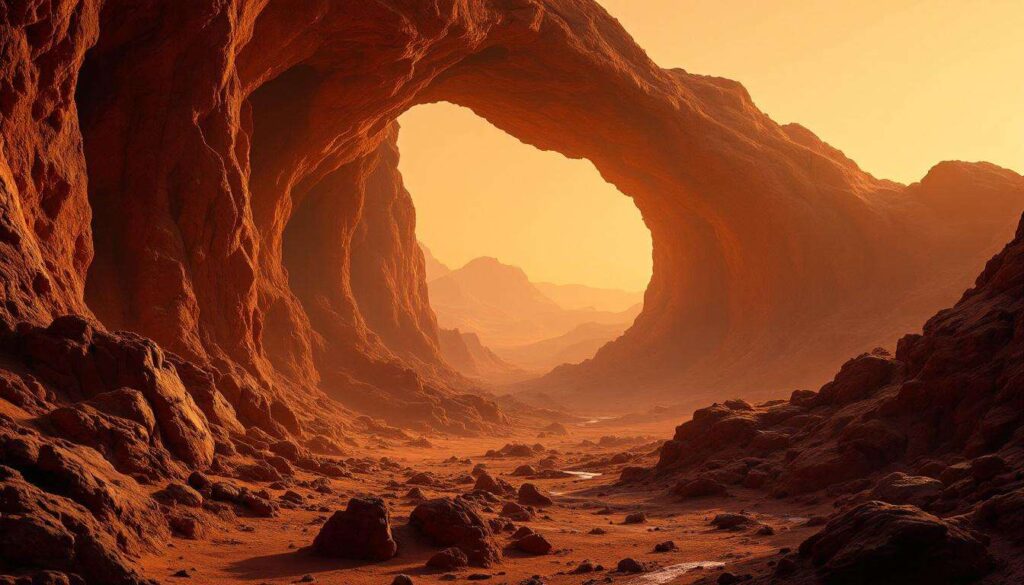
Consider the search for extraterrestrial life, a quest that has long focused on the barren, irradiated surface of Mars. A compelling new body of research now directs our attention downward, into the planet’s depths. Evidence suggests that colossal caves, carved by ancient water flows, may be sheltering the very biosignatures scientists have been seeking. These subterranean voids, hidden beneath the red dust, could represent the most promising locations to find definitive proof of past or even present Martian life.
Discovery of Martian caves: a new lead
Identifying subterranean features from orbit
The initial clues pointing to these vast underground networks did not come from a rover’s drill but from the keen eyes of satellites orbiting the red planet. High-resolution imagery from missions like the Mars Reconnaissance Orbiter (MRO) has revealed intriguing geological formations known as pit craters. These are not impact craters; they are deep, steep-sided shafts that appear to be skylights, openings into much larger voids below. Scientists have cataloged hundreds of these features, particularly in volcanic regions like Arsia Mons, suggesting a widespread system of subterranean cavities. These discoveries have shifted the focus of astrobiological research, presenting a new and tantalizing frontier.
Geological markers and indirect evidence
Beyond direct imaging of pit craters, geologists infer the presence of extensive cave systems through other surface markers. Sinuous channels that suddenly disappear, large-scale surface collapses, and specific mineral signatures associated with water-rock interactions all point to significant subsurface erosion. These features are analogous to karst landscapes on Earth, which are formed by the dissolution of soluble rocks like limestone. On Mars, the process might involve the melting of subsurface ice or the flow of groundwater through basaltic rock, carving out immense labyrinths over billions of years. The sheer scale of these implied systems is staggering, with some individual caves potentially dwarfing any known cavern on Earth.
| Martian Region | Primary Evidence | Estimated Age |
|---|---|---|
| Arsia Mons | Numerous pit craters (skylights) | Late Amazonian (relatively young) |
| Hellas Planitia | Collapsed terrain, evidence of ancient water flow | Noachian (ancient) |
| Valles Marineris | Layered deposits, signs of groundwater seepage | Hesperian to Amazonian |
The analysis of these geological features provides a roadmap for where to look, but understanding how they formed is crucial to evaluating their potential as biological sanctuaries.
The origin of the gigantic cavities
The role of ancient water flows
The primary architect of these Martian caves is believed to be liquid water. Billions of years ago, Mars was a warmer and wetter planet with a thicker atmosphere. Rivers, lakes, and possibly even oceans covered its surface. This water would have percolated deep into the crust, creating vast aquifers. Over time, this subsurface water would have chemically and physically eroded the rock, carving out channels and caverns. The process is similar to how underground rivers form caves on Earth. The immense scale of features like Valles Marineris suggests that cataclysmic flood events may have also played a role, rapidly excavating enormous volumes of material and creating complex underground networks.
Volcanic activity and lava tubes
In volcanic regions, another powerful cave-forming mechanism comes into play. When molten lava flows across the surface, its exterior can cool and solidify while the hot, liquid interior continues to flow, eventually draining away. This process leaves behind a long, hollow tunnel known as a lava tube. Mars, with its history of massive shield volcanoes like Olympus Mons, is an ideal candidate for harboring extensive lava tube systems. These tubes can be exceptionally large—far larger than their terrestrial counterparts due to Mars’ lower gravity—and structurally stable, providing protected environments for eons. The pit craters observed on the flanks of Arsia Mons are widely believed to be collapsed sections of these gigantic lava tubes.
The combination of water erosion and volcanic activity has likely created a diverse and complex Martian “underworld,” one whose environmental conditions differ dramatically from the hostile surface.
Conditions conducive to Martian life
Shielding from harsh surface radiation
The modern Martian surface is an incredibly hostile environment. Its thin atmosphere offers little protection from a constant bombardment of galactic cosmic rays and intense solar radiation, which are lethal to life as we know it. Any organic molecules or microorganisms on the surface would be quickly sterilized. However, just a few meters beneath the ground, this radiation is significantly attenuated. Martian caves would provide a near-perfect shield, creating a sanctuary where life could potentially thrive. This protection is considered one of the most critical factors in the search for extant Martian organisms.
Potential for stable liquid water and moderate temperatures
While the surface of Mars is frozen, geothermal heat from the planet’s interior could keep temperatures within these deep caves above freezing. This would allow for the presence of stable liquid water, the most fundamental prerequisite for life. Subsurface aquifers, fed by melting ice, could create subterranean lakes or seeping springs along cave walls. Furthermore, the enclosed environment of a cave would moderate the extreme temperature swings seen on the surface, which can vary by over 100 degrees Celsius between day and night. This stability creates a much more hospitable environment. The potential life-sustaining conditions include:
- Protection: Shielding from UV and cosmic radiation.
- Water: Possible presence of briny liquid water or water ice deposits.
- Temperature: More stable and potentially warmer temperatures than the surface.
- Chemistry: Access to water-rock interfaces, providing chemical energy sources (chemosynthesis).
These favorable conditions make the caves a prime target, but reaching and exploring them presents a formidable technological challenge.
Research and detection techniques
Next-generation rovers and robotic explorers
Current Martian rovers, like Perseverance and Curiosity, are designed for surface exploration and are not equipped to rappel into or navigate a cave. Future missions will require a new class of robotic explorer. Concepts for these “cave-bots” are already under development and include autonomous drones, snake-like robots that can slither through tight passages, and tethered rovers capable of descending steep pit crater walls. These machines would need to operate with a high degree of autonomy, as direct communication from Earth would be impossible deep underground. Their scientific payload would be specifically designed to search for biosignatures in the dark, using instruments like spectrometers and organic molecule detectors.
Remote sensing and subsurface mapping
Before sending a robot into a cave, we must first map the subsurface to identify the most promising and accessible targets. This is the job of orbital and surface-based remote sensing instruments. The SHARAD (Shallow Radar) instrument on the MRO can already peer hundreds of meters below the surface, and future ground-penetrating radar systems could provide much higher-resolution maps of underground voids. Another technique, gravimetry, measures minute variations in the local gravitational field to detect areas of lower density, which could indicate the presence of a large cave. Combining these techniques will allow scientists to create a 3D map of the Martian subsurface, illuminating the hidden world below and pinpointing the best entry points for exploration.
The successful deployment of these technologies would not only revolutionize our understanding of Mars but would also have profound implications for the future of space exploration.
Implications of discoveries for future exploration
A paradigm shift in astrobiology
Discovering life, even microbial life, within a Martian cave would be one of the most significant scientific achievements in human history. It would confirm that life is not unique to Earth and would fundamentally alter our understanding of our place in the universe. Such a discovery would shift the focus of astrobiology from simply searching for habitable environments to studying a second, independent genesis of life. This would provide an invaluable data point for determining how common life might be throughout the cosmos. The focus would turn to understanding Martian biology: its structure, its metabolism, and its evolutionary history.
Prime targets for human missions
Beyond the profound scientific implications, these caves represent prime real estate for future human explorers. The same properties that make them potential habitats for Martian life—shielding from radiation, moderate temperatures, and potential access to water ice—also make them ideal locations for a human base. An underground habitat would provide natural protection for astronauts, reducing the need to transport heavy shielding materials from Earth. A base established within a lava tube or water-carved cavern could offer long-term security and access to vital resources. Therefore, the robotic exploration of these caves is not just a search for alien life; it is also a critical reconnaissance mission for the eventual human settlement of Mars.
Re-evaluate the search for life beyond Earth. The clues may not be etched on the windswept plains but hidden in the silent, dark depths of the red planet. Exploring these subterranean worlds is the next logical step in our quest to answer one of humanity’s oldest questions.