



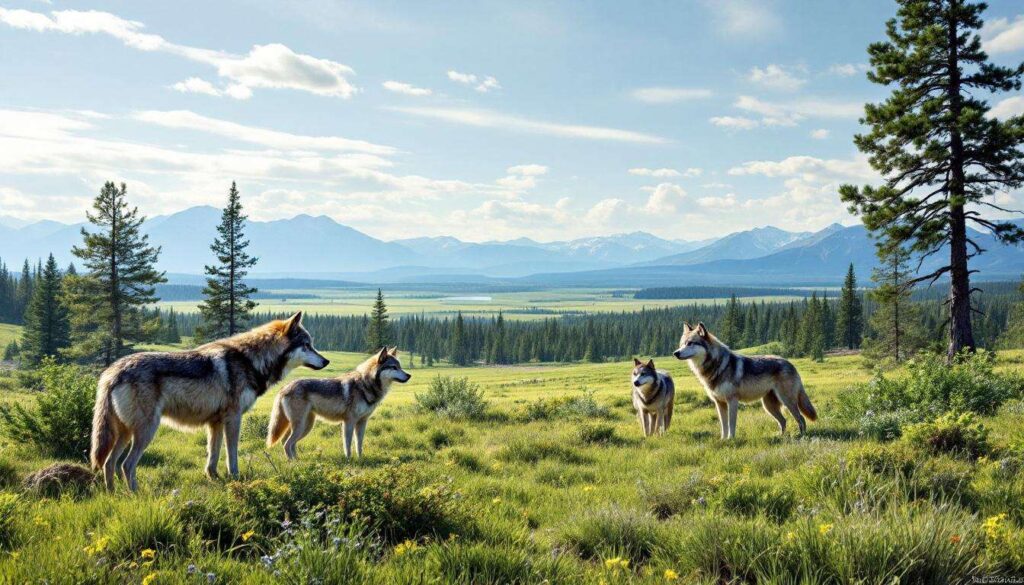
The story of the gray wolf’s return to Yellowstone National Park is often told as a modern conservation fable. An ecosystem thrown out of balance by the removal of its apex predator is miraculously healed by its return, triggering a cascade of positive changes that even reshaped the flow of rivers. This powerful narrative has captured the public imagination and become a textbook example of ecological restoration. However, as with many compelling stories, the reality on the ground is far more complex and nuanced. Decades of research have revealed a picture that is less a simple chain reaction and more an intricate web of interacting forces, sparking a vigorous debate among scientists about what really happened when the wolves came home.
Introduction to the reintroduction of wolves in Yellowstone
The return of an apex predator
In 1995, after a nearly 70-year absence, gray wolves (Canis lupus) were deliberately reintroduced into Yellowstone National Park. The U.S. Fish and Wildlife Service, in a landmark conservation effort, transported wolves from Canada to the park’s Lamar Valley. This was not merely an act of returning a single species to its former habitat ; it was an ambitious experiment in ecological restoration, designed to reinstate a critical component that had been missing from the Greater Yellowstone Ecosystem for generations. The project was both celebrated and controversial, marking a significant shift in wildlife management philosophy from predator eradication to predator conservation.
Goals of the project
The reintroduction was underpinned by several key objectives aimed at restoring the park’s natural equilibrium. The primary goal was to re-establish a viable wolf population in the region, but the vision extended far beyond the wolves themselves. Biologists and park managers hoped that the return of this keystone species would initiate a series of ecological adjustments. The core objectives included :
- Restoring a key predator-prey dynamic, primarily between wolves and the park’s large elk herds.
- Reducing the over-browsing of vegetation by elk, which had severely impacted plant communities.
- Enhancing overall biodiversity by creating ripple effects that would benefit other species.
- Studying the long-term ecological impact of an apex predator on a temperate ecosystem.
These goals were based on the ecological theory that the removal of a top predator had caused significant and detrimental changes. Understanding why the wolves were gone in the first place is crucial to appreciating the full context of their celebrated return.
Why did wolves disappear from Yellowstone ?
A history of conflict
The disappearance of wolves from Yellowstone was not a natural event but a direct result of human action. As European settlers expanded across the American West in the 19th century, they brought with them livestock and a deep-seated fear of large predators. Wolves were viewed as a direct threat to cattle and sheep, as well as a competitor for wild game like deer and elk. This conflict between human interests and wolf survival created an environment where the predators were seen not as a part of the ecosystem, but as vermin to be eliminated.
Systematic eradication
By the late 1800s and early 1900s, this conflict escalated into a systematic, government-sanctioned eradication campaign. Predator control became a federal policy. Bounties were placed on wolves, and a concerted effort involving hunting, trapping, and poisoning was carried out across the West. Within Yellowstone National Park itself, park rangers were tasked with eliminating predators to “protect” the more “desirable” species like elk and deer. The campaign was brutally effective. By 1926, the last known wolf pack within Yellowstone’s boundaries had been killed, and for decades, the park’s ecosystem functioned without its top canine predator. The absence of this key player would have profound and lasting consequences, setting the stage for the dramatic changes observed after their return.
The positive effects of wolves on the ecosystem
Controlling the elk population
The most immediate and well-documented effect of the wolf’s return was on the northern Yellowstone elk herd. In the absence of their primary predator, elk populations had swelled, and their behavior had changed. They browsed with little fear in open areas, particularly along riverbanks. The reintroduction of wolves changed everything. Not only did wolf predation begin to reduce the overall number of elk, but it also, and perhaps more importantly, instilled a “landscape of fear.” Elk became more vigilant, avoiding high-risk areas like valleys and gorges where they were more vulnerable to ambush. This behavioral shift had cascading consequences.
The ripple effect on flora
With elk spending less time browsing in riparian zones, vegetation that had been suppressed for decades began to recover. Young willow, aspen, and cottonwood trees, previously eaten down to stumps, started to grow tall. This recovery was not uniform across the park, but in certain areas, the change was dramatic. The regrowth of these trees had a stabilizing effect on riverbanks, leading to less erosion and more defined river channels. This is the origin of the famous claim that wolves changed rivers, a powerful symbol of their ecosystem-wide influence.
Benefits for other species
The changes initiated by wolves rippled out to benefit a wide array of other animals. The recovery of streamside vegetation and the new availability of carrion from wolf kills created new opportunities for many species. Some of the documented beneficiaries include :
- Beavers : With more willows available for food and dam-building materials, beaver colonies began to expand, creating ponds and wetlands that serve as critical habitat for fish, amphibians, and waterfowl.
- Songbirds : The growing canopy of trees provided increased nesting habitat for various species of songbirds.
- Scavengers : Wolf-killed carcasses provided a year-round, reliable food source for scavengers like coyotes, eagles, and bears. Grizzly bears, in particular, benefited from usurping wolf kills in early spring after emerging from hibernation.
This intricate chain of cause and effect, where a change at the top of the food web reverberates all the way to the bottom, is a classic example of a powerful ecological principle.
The concept of ecological cascade
Defining a trophic cascade
An ecological cascade, or more specifically a trophic cascade, is an ecological process that starts at the top of a food chain and tumbles down to the bottom. It occurs when a predator’s actions suppress the abundance or alter the behavior of its prey, which in turn releases the next lower trophic level from predation or grazing pressure. In simpler terms : the enemy of my enemy is my friend. For plants, the wolf is a friend because it preys on their enemy, the elk. This indirect effect of predators on plant life is the defining characteristic of a top-down trophic cascade.
Yellowstone as the poster child
The story of Yellowstone’s wolves became the most famous and compelling example of this concept for a global audience. It was visually intuitive and narratively satisfying. The idea that a single species could restore balance, bring back trees, and even alter the physical landscape was a powerful testament to the interconnectedness of nature. The reintroduction provided a real-world, large-scale demonstration of ecological theory in action, transforming a complex scientific concept into a story of renewal that was easy for the public to grasp. The cascade can be visualized as a simple chain of events.
From top to bottom
The classic Yellowstone trophic cascade narrative can be broken down into a clear sequence of effects, as illustrated in the table below.
| Trophic Level | Key Species/Element | Observed Effect |
|---|---|---|
| Apex Predator | Gray Wolves | Prey on and alter the behavior of elk. |
| Primary Consumer | Elk | Population is reduced and they avoid risky areas. |
| Producer | Willows and Aspen | Regrow in riparian zones due to less browsing. |
| Ecosystem Engineer | Beavers | Return as willows recover, creating new wetlands. |
| Geomorphology | Rivers and Streams | Banks stabilize, leading to less erosion. |
While this model provides a clear and compelling framework, subsequent scientific scrutiny has revealed that the full story is not quite so linear, introducing a number of other factors and differing interpretations.
Scientific studies and differing viewpoints
Challenging the simple narrative
For over two decades, scientists have been studying the changes in Yellowstone, and a more complex picture has emerged. While no one disputes that the return of wolves had a profound impact, many researchers now argue that the classic trophic cascade story is an oversimplification. They contend that attributing all the observed changes solely to wolves ignores other significant forces at play in the ecosystem. The direct line from wolves to rivers is now seen by many as more of a compelling narrative than a complete scientific explanation.
The role of other factors
Several other factors are believed to have contributed to the ecological shifts in Yellowstone during the same period. Critics of the simple cascade hypothesis point to a confluence of influences that also affected elk populations and vegetation growth. These include :
- Climate : A warming climate and periods of drought have a significant impact on both plant growth and animal survival, independent of predation.
- Other predators : The populations of grizzly bears and cougars, which also prey on elk (especially calves), were also changing during this time.
- Human influences : Changes in park management, hunting policies outside the park, and human development have all played a role in shaping the ecosystem.
A more complex picture
More recent studies have shown that the recovery of willow and aspen is patchy and inconsistent. In some areas where elk are actively hunted by wolves, the trees have not recovered, suggesting other factors are limiting their growth. The idea that wolves single-handedly re-engineered the park’s rivers is now heavily debated, with many hydrologists pointing to long-term climate cycles and other physical processes as more dominant drivers of river morphology. The emerging consensus is that while wolves were a critical catalyst for change, they are part of a much larger, more intricate web of interactions rather than the single pull of a master lever. This ongoing scientific debate shapes how we think about the park’s future.
What is the future for biodiversity in Yellowstone ?
Moving beyond a single-species focus
The key lesson from the Yellowstone wolf debate is the need to move beyond single-species conservation and embrace a more holistic, ecosystem-based approach. The park’s future health does not depend on wolves alone, but on the complex interplay between all its components : predators, prey, climate, water, and human management. Future conservation strategies will likely focus less on a single “keystone” species and more on understanding and managing the multiple stressors and drivers that shape the entire ecosystem. This means acknowledging that there is no simple fix for ecological health.
Adaptive management strategies
Yellowstone National Park is often described as a living laboratory, and its management must be equally dynamic. An adaptive management approach, which treats policies as experiments to be monitored and adjusted, is crucial. This requires a commitment to long-term scientific research and a willingness to revise strategies as new data emerges. The debate over the wolves’ impact is not a sign of failure but a sign of a healthy scientific process that continually refines our understanding. Managing such a complex system requires flexibility and humility in the face of nature’s intricacy.
The enduring legacy of the wolf
Regardless of the scientific nuances, the reintroduction of the gray wolf to Yellowstone remains one of the most significant conservation triumphs of the 20th century. It unequivocally demonstrates that restoring apex predators can trigger substantial and often beneficial ecological change. While the story may not be the simple fable it was once believed to be, the wolves’ return has undeniably increased the park’s biodiversity and restored critical ecological processes. Their legacy is a wilder, more complex, and more resilient Yellowstone.
The reintroduction of wolves to Yellowstone was a landmark ecological experiment that triggered undeniable changes within the park. The popular narrative of a simple trophic cascade, while compelling, has been refined by two decades of science to reveal a more complex reality. The park’s transformation is now understood to be the result of an intricate interplay between wolves, other predators, their prey, and powerful environmental forces like climate. Ultimately, the story of the Yellowstone wolf is not one of simple cause and effect, but a powerful lesson in the complexity of ecosystems and the profound importance of restoring every piece of the puzzle.