



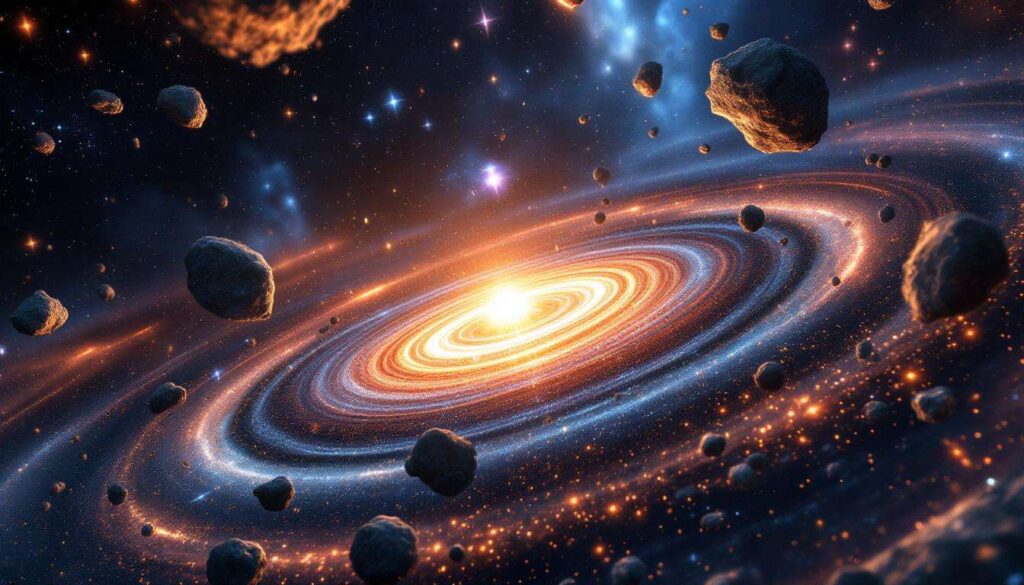
In the vast expanse surrounding distant stars, astronomers are uncovering vibrant ecosystems of cosmic dust and debris. These are not the primordial clouds from which planets are born, but rather the aftermath: sprawling disks of rubble that serve as glowing fingerprints of unseen worlds. By sifting through the light from these distant stellar systems, scientists are piecing together a gallery of celestial structures, each telling a unique story of collisions, gravitational nudges, and the fundamental building blocks of planets. These observations provide a crucial window into the chaotic and dynamic environments where asteroids and comets, much like those in our own solar system, shape the final architecture of their planetary homes.
What is a debris disk ?
Definition and characteristics
A debris disk is a circumstellar ring of dust and larger bodies, known as planetesimals, orbiting a star. Unlike a protoplanetary disk, which is a gas-rich environment where planets are actively forming, a debris disk is typically gas-poor and represents a later stage in a solar system’s evolution. It is essentially a second-generation disk, where the dust is not primordial but is continuously replenished by collisions between planetesimals, which are the leftover building blocks of planets. These disks are the extrasolar equivalents of our own asteroid belt and Kuiper Belt, but often much more massive and luminous.
Key components and composition
The material within a debris disk is a diverse mix of cosmic rubble, a testament to the violent history of planet formation. The main components include:
- Dust grains: Microscopic particles of silicate rock, carbon, and ices that are the most easily detected component because they absorb starlight and re-radiate it as heat.
- Planetesimals: Larger bodies ranging from kilometers to hundreds of kilometers in size, akin to asteroids and comets. These bodies form the main reservoir of mass in the disk.
- Icy bodies: In the colder, outer regions of a disk, planetesimals are often rich in frozen volatiles like water, carbon monoxide, and methane, making them cometary in nature.
- Rocky bodies: Closer to the star, where temperatures are higher, the planetesimals are primarily composed of rock and metal, analogous to the asteroids found in our inner solar system.
Comparison to our solar system
Understanding debris disks is made easier by comparing them to familiar structures within our own cosmic neighborhood. While extrasolar debris disks can be much more massive, the underlying principles are the same. The following table highlights the key analogues between a typical debris disk and our solar system’s belts.
| Feature | Typical Debris Disk | Our Solar System Analogue |
|---|---|---|
| Location | Wide range of distances, often far from the star | Inner Asteroid Belt and outer Kuiper Belt |
| Composition | Rocky (inner) and icy (outer) planetesimals | Rocky asteroids and icy comets/dwarf planets |
| Primary Source of Dust | Collisions between planetesimals | Collisions and cometary activity |
| Governing Dynamics | Gravitational influence of the star and planets | Gravitational influence of the sun and planets (e.g., Jupiter, Neptune) |
The study of these distant disks provides a glimpse into what our own solar system might have looked like in its more turbulent youth. The intricate processes that shaped these celestial junkyards are the very same ones that govern their formation and long-term evolution.
Formation and evolution of debris disks
From protoplanetary disk to debris disk
The life of a planetary system begins with a dense, gas-rich protoplanetary disk. Over millions of years, dust grains within this disk clump together to form planetesimals, which then accumulate to create planetary embryos and eventually full-fledged planets. During this chaotic process, most of the primordial gas is either incorporated into giant planets or blown away by the young star’s radiation. What remains is a system of planets and a vast population of leftover planetesimals. This marks the transition to the debris disk phase. The remaining planetesimals, now on unstable orbits, begin a long history of colliding with one another.
The crucial role of collisions
A debris disk is a dynamically active environment. The fine dust that makes these disks visible to our telescopes has a very short lifespan; stellar radiation and wind would clear it out in a few thousand years. Therefore, the dust we see must be continuously replenished. This replenishment comes from a relentless cascade of collisions between larger parent bodies. A collision between two kilometer-sized asteroids or comets can shatter them, creating a cloud of smaller fragments. These fragments then collide with others, grinding down into the fine dust that we can detect. A debris disk is, therefore, a visible sign of an unseen, active population of planetesimals.
Lifespan and gradual fading
Debris disks are not permanent fixtures. They evolve and fade over billions of years. The brightest and most massive disks are typically found around young stars, where the reservoir of colliding planetesimals is still large. As time goes on, the collisional cascade grinds down the planetesimal population, and many bodies are ejected from the system through gravitational interactions. Consequently, the rate of dust production decreases, and the disk becomes fainter and harder to detect. The brightness of a debris disk can serve as a rough clock for the age and dynamical maturity of a planetary system. This fading glow carries with it subtle clues, often written in the disk’s structure, that point to the presence of asteroids, comets, and even hidden planets.
Manifestations of asteroids and comets in debris disks
Asymmetries and sculpted structures
A perfectly uniform, symmetric disk is rare. More often, observations reveal intricate structures that betray the gravitational influence of unseen bodies. An orbiting planet can act like a cosmic shepherd, carving gaps, creating sharp edges, or stirring the disk into eccentric or warped shapes. These structures are direct evidence of ongoing dynamical interactions. Key features include:
- Gaps and clearings: A massive planet can clear its orbital path, creating a wide gap in the disk, much like Saturn does with its rings.
- Clumps and arcs: Planets can trap dust in stable gravitational points, known as resonances, causing material to pile up in dense clumps that co-orbit with the planet.
- Eccentric rings: A planet on an elliptical orbit can force the entire debris ring into a similarly offset shape, creating a lopsided or “apricot-shaped” structure.
These features are smoking-gun evidence for the existence of exoplanets and allow astronomers to infer their mass and orbit without ever seeing the planet itself.
Spectral signatures of dust composition
The light reflected and emitted by the dust contains a wealth of information about its composition. By using spectroscopy to break the light down into its constituent wavelengths, astronomers can identify chemical fingerprints. For example, the presence of specific silicate features, like olivine and pyroxene, points to the dust originating from the collisional grinding of rocky, asteroid-like bodies. Conversely, the detection of water ice or crystalline structures that can only form at very low temperatures suggests the dust comes from icy, comet-like objects originating in the frigid outer reaches of the system. This technique allows us to perform remote geology on the building blocks of alien worlds.
Variable phenomena and major impacts
Some debris disks are not static but change over time. Astronomers have observed disks that suddenly brighten or produce transient clouds of dust. Such events are interpreted as the result of a recent, massive collision between two large planetesimals. Witnessing such an event is like seeing the aftermath of an impact that, in our own solar system’s history, might have formed our moon or delivered water to the early Earth. These variable phenomena provide a real-time look at the violent processes that shape planetary systems. To capture these fleeting yet informative events, astronomers rely on a suite of powerful instruments and sophisticated techniques.
Main instruments and observation techniques
Infrared telescopes
The dust in debris disks is too cold to shine in visible light. Instead, it absorbs energy from its host star and re-radiates it as thermal energy, primarily in the infrared part of the spectrum. Consequently, infrared telescopes are the workhorses of debris disk research. Space-based observatories like the James Webb Space Telescope (JWST), and its predecessors Spitzer and Herschel, are particularly effective because they operate above Earth’s atmosphere, which absorbs much of the incoming infrared light. These telescopes can detect the faint glow of dust and analyze its properties in unprecedented detail.
Coronagraphy and high-contrast imaging
Observing a faint disk right next to its brilliant host star is like trying to spot a firefly next to a searchlight. To overcome this challenge, astronomers use an instrument called a coronagraph, which contains a small mask to block the direct light from the star. This allows the much fainter light reflected by the disk to be seen. This technique, known as high-contrast imaging, is often combined with adaptive optics on large ground-based telescopes to correct for the blurring effect of Earth’s atmosphere. It has been instrumental in producing some of the most spectacular and detailed images of debris disk structures.
Millimeter and submillimeter arrays
While infrared telescopes are excellent for detecting fine dust, they cannot see larger particles. Radio telescope arrays, such as the Atacama Large Millimeter/submillimeter Array (ALMA) in Chile, are sensitive to longer wavelengths emitted by millimeter-sized grains and pebbles. By observing at these wavelengths, ALMA can map the distribution of the larger, more massive particles in the disk, which more closely trace the location of the parent planetesimals. This provides a complementary view to infrared observations.
| Instrument Type | Primary Wavelength | Key Capability | Example Observatory |
|---|---|---|---|
| Infrared Space Telescope | Infrared | Detects warm, fine dust and its composition | James Webb Space Telescope (JWST) |
| Ground-based Telescope with Coronagraph | Visible / Near-Infrared | Images scattered light and fine disk structures | Very Large Telescope (VLT) |
| Millimeter/Submillimeter Array | Radio (mm/sub-mm) | Maps larger dust grains and pebbles | Atacama Large Millimeter/submillimeter Array (ALMA) |
The combined power of these different observational methods provides a multi-faceted understanding of debris disks, revealing their critical role in the broader context of planetary science.
Importance of debris disks for studying solar systems
Tracers of unseen planets
Perhaps the most significant role of debris disks is their ability to act as signposts for planets that are otherwise undetectable. The gravitational pull of a planet, even a small one, is enough to leave an indelible mark on the structure of a nearby debris disk. By analyzing the gaps, clumps, and warps in a disk, astronomers can infer the presence, location, and even the mass of the planet responsible. In many cases, a planet has been predicted based on disk structures and later confirmed through direct imaging. Debris disks are therefore an essential indirect tool in the search for exoplanets.
Probing the composition of exoplanetesimals
Debris disks offer a unique opportunity to study the raw materials from which planets are made. The dust we observe is a direct sample of the asteroids and comets being ground down in that system. By analyzing the spectral signatures of this dust, we can determine its chemical composition. This tells us whether the building blocks of planets in that system were rocky and dry, like in our inner solar system, or rich in water and organic molecules, like the comets in our outer solar system. This provides invaluable clues about the potential habitability of the planets that may have formed there.
A window into planetary system architecture
The location and extent of a debris disk can reveal much about the overall architecture of a planetary system. For example, a sharp inner edge to a debris belt might indicate the orbit of the outermost planet, which has cleared out all the material interior to its path. Studying the distribution of multiple debris belts in a single system can help map the zones where planetesimals were able to survive. This allows astronomers to reconstruct the system’s history and understand the large-scale arrangement of its planets, providing a crucial piece of the puzzle in understanding how these systems form and evolve.
Impact of research on our understanding of planet formation
Refining planetary migration models
Classical theories of planet formation assumed that planets form and remain on stable, circular orbits. However, the structures observed in debris disks often point to a much more dynamic past. The presence of eccentric disks or scattered planetesimals suggests that planets may have migrated significantly from their birthplaces, a process known as planetary migration. Observations of debris disks provide concrete evidence that helps constrain and refine these migration models. They show that gravitational shuffling and rearrangement of planets is likely a common feature in the evolution of planetary systems, including our own.
Revealing the diversity of planetary systems
The study of hundreds of debris disks has revealed a stunning diversity in their properties. Some systems have narrow, dense rings like our Kuiper Belt, while others have broad, tenuous disks. Some are highly structured, and others are smooth. This variety implies that there is no single, universal pathway for planet formation. Instead, the outcome depends on a complex interplay of factors, such as the mass of the initial disk, the properties of the host star, and the chaotic nature of gravitational interactions. Debris disks demonstrate that our solar system is just one possible outcome among a vast range of possibilities.
Connecting formation to final architecture
Debris disks serve as a critical link between the very early stages of planet formation in protoplanetary disks and the mature, stable planetary systems we see today. They represent the “teenage” years of a solar system, a long-lived phase where the final architecture is settled through collisions and gravitational sculpting. By studying these disks, we are essentially performing planetary archaeology, using the leftover rubble to piece together the history of a system’s construction. This research helps complete our picture of how a quiet, stable system like ours can emerge from a chaotic and violent beginning.
The scattered light from these distant rings of cosmic dust does more than create beautiful astronomical images. It illuminates the fundamental processes that govern the birth and evolution of planets. Each observed disk is a snapshot of a planetary system’s history, revealing the remnants of its building blocks and the gravitational echoes of its hidden worlds. By studying this gallery of debris, we not only discover the diversity of solar systems throughout the galaxy but also gain a deeper understanding of our own cosmic origins.