


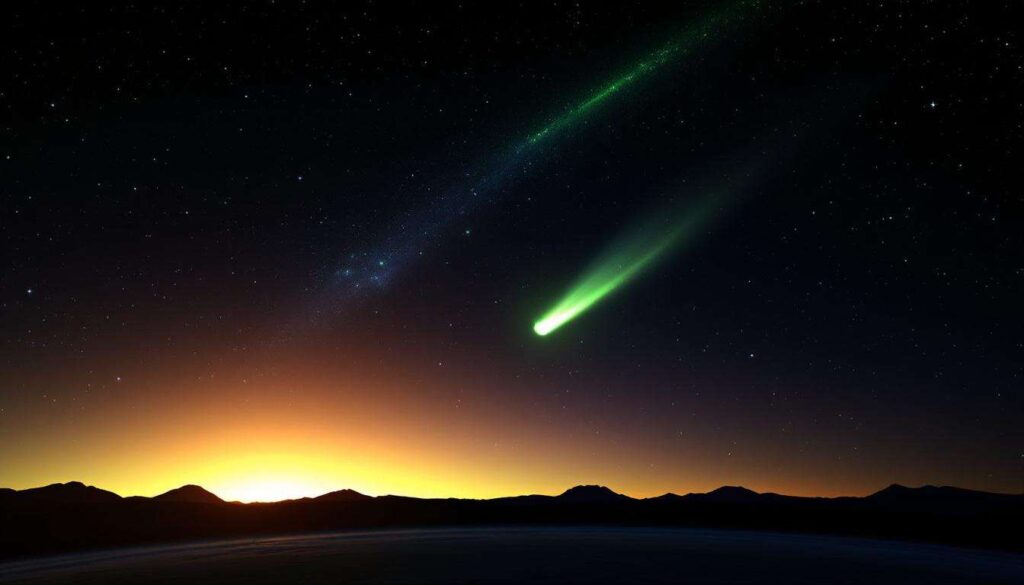
A celestial visitor is making its presence known in our cosmic neighborhood. Comet 3I/ATLAS, a traveler from the frigid outer reaches of the solar system, is currently on a trajectory that brings it closer to both the sun and Earth. Recent observations and striking new images reveal a dynamic object undergoing significant changes. The comet is not only becoming substantially brighter but is also displaying an increasingly vibrant and distinctive green glow, capturing the attention of both professional astronomers and amateur sky-gazers alike. This event offers a rare opportunity to witness the dramatic behavior of a comet as it responds to the intense energy of our star.
The appearance of comet 3I/ATLAS
A dirty snowball in space
At its core, comet 3I/ATLAS is what astronomers often refer to as a dirty snowball. Its central body, or nucleus, is a relatively small conglomerate of ice, rock, and frozen gases such as carbon dioxide, methane, and ammonia. This nucleus is typically only a few kilometers in diameter, making it far too small and dark to be seen directly from Earth. What we observe is not the solid body itself, but the spectacular atmosphere and tail it develops as it nears the sun. This composition makes it a pristine remnant from the formation of our solar system billions of years ago.
The coma and tail structure
As 3I/ATLAS ventures into the inner solar system, the sun’s radiation heats its nucleus, causing the ices to sublimate, or turn directly from a solid into a gas. This process releases a cloud of gas and dust that envelops the nucleus, forming a vast, glowing atmosphere called the coma. This coma can expand to be hundreds of thousands of kilometers across, making the comet appear as a fuzzy, luminous patch in the sky. Furthermore, the solar wind and radiation pressure push this material away from the nucleus, creating two distinct tails: a bright, curved dust tail that reflects sunlight and a fainter, straight ion tail that glows with its own light.
The evolving appearance of these features, particularly the expanding and brightening coma, provides the most visible evidence of the comet’s activity. This activity is precisely what is causing its recent, more dramatic display, including its notable shift in color.
Comet 3I/ATLAS: an increasing green hue
The chemistry behind the color
The captivating emerald glow of comet 3I/ATLAS is not a random phenomenon but a direct result of its chemical composition interacting with sunlight. The green color is primarily caused by the presence of diatomic carbon (C2), a simple molecule consisting of two carbon atoms bonded together. As the sun’s heat breaks down more complex organic molecules on the comet’s nucleus, diatomic carbon is released into the coma. This process unfolds in a few key steps:
- Sunlight, particularly its ultraviolet (UV) component, bombards the gas in the coma.
- The UV radiation excites the diatomic carbon molecules, pushing their electrons into a higher energy state.
- When these electrons fall back to their normal, lower energy state, they release the excess energy in the form of photons, or particles of light.
- These photons are emitted at a specific wavelength that our eyes perceive as green.
Interestingly, this green glow is almost exclusively confined to the comet’s head, or coma. The same solar radiation that creates the green light also destroys the diatomic carbon molecules before they can travel far enough to illuminate the tail.
Evidence from recent astrophotography
New images captured by observatories and skilled astrophotographers around the world confirm the intensification of this green hue. Comparing photographs taken over recent weeks reveals a clear trend: the coma is not only growing larger but its greenish tint is becoming more saturated and prominent. This suggests that the rate of sublimation and chemical reactions is accelerating as the comet gets closer to the sun, releasing more of the parent molecules that produce the diatomic carbon. This visual evidence is invaluable for scientists studying the comet’s outgassing patterns.
The increasing vibrancy of its green coma is directly linked to the overall increase in the comet’s luminosity, a process driven by fundamental solar physics.
Why the comet brightens as it approaches Earth
Sublimation and solar radiation
The primary reason for a comet’s brightening is its proximity to the sun. The relationship is straightforward: the closer the comet gets to the sun, the more intense the solar radiation it receives. This increased energy accelerates the sublimation of ices on the nucleus. As more gas and dust are ejected, the coma expands and becomes denser. A larger, denser coma reflects significantly more sunlight, causing the comet’s apparent magnitude, or its brightness as seen from Earth, to increase dramatically. This effect is often exponential, with the comet’s brightness surging as it crosses the orbits of Mars and Earth.
The role of outgassing and reflectivity
Brightness is not just about reflected sunlight; it is also about the comet’s own activity. The jets of gas and dust erupting from the nucleus, a process known as outgassing, can be unpredictable. If a new, large fissure opens up on the nucleus, it can expose fresh ice to sunlight, triggering a sudden outburst that can cause the comet to brighten by several magnitudes in just a few days. The dust released in these events is particularly important for reflectivity. Fine dust particles are highly effective at scattering sunlight, acting like a giant, dusty mirror in space. The table below illustrates the typical relationship between a comet’s distance from the sun and its brightness.
| Distance from Sun (AU) | Expected Apparent Magnitude | General Visibility |
|---|---|---|
| 3.0 AU (Asteroid Belt) | +15 | Requires large telescope |
| 2.0 AU (Mars’ Orbit) | +10 | Visible in amateur telescopes |
| 1.5 AU (Approaching Earth) | +7 | Visible with binoculars |
| 1.0 AU (Earth’s Orbit) | +5 or brighter | Potentially visible to the naked eye |
This dynamic brightening makes comet 3I/ATLAS an increasingly compelling target, creating both new opportunities and some minor complications for those who watch the skies.
Potential impact on astronomical observation
A boon for amateur astronomers
For amateur astronomers and casual sky-watchers, the increasing brightness of 3I/ATLAS is fantastic news. What was once an object requiring a powerful telescope and long-exposure photography is becoming accessible to those with more modest equipment. As it brightens further, it should become an easy target for standard binoculars and even small backyard telescopes. This provides a wonderful opportunity for public outreach and education, allowing more people to connect with the cosmos and witness a dynamic celestial event firsthand. Many astronomy clubs are organizing viewing events to guide the public in spotting this green visitor.
Considerations for professional research
While a bright comet is exciting, it can present minor challenges for professional observatories conducting other research. For deep-sky surveys searching for faint galaxies or supernovae, a bright comet passing through the field of view can introduce unwanted light, contaminating sensitive data. Astronomers must carefully schedule their observations to avoid the comet’s path or use advanced software to subtract its light from their images. However, for planetary scientists, the comet itself becomes the prime target. The increased brightness allows for more detailed spectroscopic analysis of the coma’s composition, providing a clearer look at the chemicals being released from the nucleus.
With its growing visibility, knowing exactly when and where to look is key to catching a glimpse of this spectacular object.
The best time to observe comet 3I/ATLAS
Finding the comet in the night sky
Locating comet 3I/ATLAS requires some preparation. It is not a stationary object but moves against the background of stars from night to night. To find it, you will need an up-to-date star chart or a stargazing app on your smartphone, which can show its precise location. Generally, the comet will be visible in the pre-dawn or post-dusk sky, away from the direct glare of the sun. The key to a successful observation is finding a location with minimal light pollution. A dark sky site, far from city lights, will make the faint, fuzzy glow of the coma and its potential tail much easier to discern. Remember to allow your eyes at least 15-20 minutes to adapt to the darkness.
Key observation windows
The visibility of comet 3I/ATLAS will peak as it makes its closest approach to both the Earth and the sun. Observers should pay close attention to astronomical news and websites for updated predictions. The table below provides a general guide to its expected visibility over the coming period, though a sudden outburst could make it significantly brighter than forecast.
| Time Period | Expected Peak Magnitude | Best Viewing Time | Required Equipment |
|---|---|---|---|
| Early Approach | +9 to +11 | Pre-dawn | Medium to large telescope |
| Close Approach to Earth | +6 to +8 | Pre-dawn / Post-dusk | Binoculars or small telescope |
| Perihelion (Closest to Sun) | +5 or brighter | Post-dusk | Potential naked eye visibility |
This period of peak visibility is not just a spectacle; it represents a critical window for gathering scientific data.
The scientific implications of studying 3I/ATLAS
Clues to the early solar system
Comets like 3I/ATLAS are often described as cosmic time capsules. They are thought to be pristine remnants from the formation of our solar system, having spent most of their existence in the deep freeze of the Oort cloud, far beyond the planets. By studying the light from the comet’s coma using spectroscopy, scientists can determine its chemical makeup. This analysis reveals the mixture of ices, organic molecules, and dust that existed in the protoplanetary disk from which Earth and the other planets formed over 4.5 billion years ago. Each comet provides a unique sample, helping to piece together the puzzle of our cosmic origins.
Understanding cometary evolution
Observing a comet as it actively sublimates provides a real-time laboratory for studying the processes that govern its life cycle. By monitoring changes in its brightness, color, and structure, astronomers can refine their models of cometary behavior. Key questions they seek to answer include:
- How quickly do different ices sublimate at various distances from the sun ?
- What triggers the sudden outbursts that cause rapid brightening ?
- How does the nucleus rotate and what is its surface like ?
- What is the dust-to-gas ratio, and what does it tell us about where the comet formed ?
The data gathered from 3I/ATLAS will contribute to a broader understanding of how these icy bodies evolve and, eventually, disintegrate over thousands of orbits.
Comet 3I/ATLAS offers a compelling celestial event, a beautiful green smudge in our night sky that is growing brighter by the day. This visitor provides a direct link to the dawn of our solar system, presenting a valuable opportunity for scientists to analyze primordial materials and for the public to witness the dynamic nature of the cosmos. Its journey through the inner solar system is a transient but powerful reminder of the active and evolving universe we inhabit.