


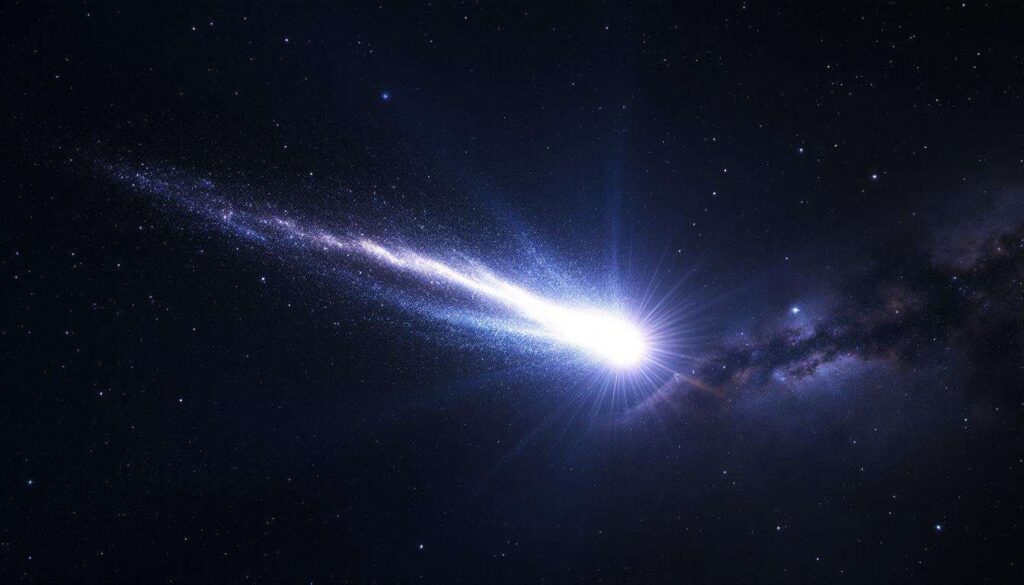
Examine the curious case of Comet 3I/ATLAS, an interstellar visitor whose journey through our solar system is not governed by gravity alone. This celestial nomad is being pushed by an unseen force, a phenomenon that offers astronomers a rare opportunity to study the raw mechanics of cometary activity. Its anomalous movement forces us to look beyond simple orbital mechanics and delve into the chaotic, powerful physics that animate these icy relics from distant stars.
Discovery of Comet 3I/ATLAS
A Serendipitous Find by ATLAS
The discovery of Comet 3I/ATLAS is credited to the Asteroid Terrestrial-impact Last Alert System (ATLAS), a robotic astronomical survey and early warning system based in Hawaii. The system, designed to detect near-Earth objects, scanned the sky and identified a faint, moving object. Initially designated A10bMLz, it was quickly recognized as a comet due to the development of a faint coma, the fuzzy envelope of gas and dust surrounding its nucleus. This finding was not just another comet; subsequent analysis revealed its extraordinary origin from beyond our solar system, earning it the “I” for interstellar in its official designation, 3I/ATLAS.
Initial Observations and Classification
Upon its discovery, astronomers worldwide turned their telescopes toward the newcomer to characterize its properties. It was the third interstellar object ever detected, following ‘Oumuamua and 2I/Borisov. Initial data suggested it was a relatively small object, but what made it particularly intriguing was its trajectory. The comet’s path was hyperbolic, meaning it was traveling fast enough to escape the sun’s gravitational pull and was only passing through our solar system once. Its composition appeared to be similar to comets from our own Oort cloud, yet its path was a clear indicator of its extrasolar origins. These early observations laid the groundwork for detecting the subtle deviations in its path that would soon become the focus of intense scientific scrutiny.
The comet’s initial brightness and activity levels were high, but it soon began to show signs of fragmentation. This disintegration provided a spectacular, if short-lived, show for observers. However, the most scientifically compelling aspect of 3I/ATLAS was not its appearance but the subtle force altering its course, a force known as non-gravitational acceleration.
Understanding Non-Gravitational Acceleration
Beyond Newton’s Law
In the grand theater of the cosmos, gravity is the undisputed director. The paths of planets, asteroids, and moons are dictated almost entirely by the gravitational pull of the sun and other massive bodies. These forces are predictable, allowing astronomers to calculate orbits with incredible precision. However, some objects, particularly comets, refuse to follow the script perfectly. They exhibit non-gravitational acceleration, a term for any change in velocity that cannot be attributed to gravity. It is a tiny nudge, a gentle push or pull that, over vast distances, can significantly alter an object’s trajectory. For Comet 3I/ATLAS, this effect was measurable and significant, confirming that forces other than gravity were at play.
A Common Cometary Phenomenon
While the term sounds exotic, non-gravitational acceleration is a well-documented phenomenon for comets originating within our own solar system. As these “dirty snowballs” approach the sun, they heat up, causing their ices to turn directly into gas. This process, known as sublimation, is the primary driver of this effect. The key difference with 3I/ATLAS was the opportunity to study this process on an object formed around another star. Observing this acceleration provided a direct window into its physical makeup and behavior, offering clues about the conditions of its home star system. It confirmed that the physical processes governing comets are likely universal, a fundamental insight for astrophysics.
This acceleration is not random; it is the direct result of physical processes occurring on the comet’s nucleus. Understanding these mechanisms is key to predicting its path and deciphering the secrets locked within its icy core.
The Mechanisms Behind This Acceleration
The Engine of Sublimation
The primary mechanism driving the non-gravitational acceleration of Comet 3I/ATLAS is the sublimation of volatile ices. A comet’s nucleus is a conglomerate of rock, dust, and frozen gases like water, carbon monoxide, and carbon dioxide. As the comet nears the sun, solar radiation warms its surface. This energy causes the ices to bypass the liquid state and transform directly into gas. The process is uneven and depends on several factors:
- Surface Composition: Different ices sublimate at different temperatures, so the activity changes as the comet gets closer to or farther from the sun.
- Rotation: As the comet rotates, different areas are exposed to sunlight, leading to periodic bursts of activity.
- Surface Topography: Craters, fissures, and smooth plains on the nucleus can all influence where and how intensely outgassing occurs.
Rocket-Like Jets
The gas produced by sublimation does not simply float away. It erupts from the surface in powerful jets, carrying dust and ice particles with it. According to Newton’s third law of motion, for every action, there is an equal and opposite reaction. These jets, therefore, act like miniature rocket engines. If a jet erupts from the sun-facing side of the comet, it will push the comet away from the sun, slightly slowing it down. If the jet is on the “dark” side, a delayed effect from the rotation, it can push the comet forward, accelerating it. The sum of all these chaotic, unpredictable jets results in the net non-gravitational force that alters the comet’s orbit. The force is faint but relentless.
| Force Type | Source | Effect | Predictability |
|---|---|---|---|
| Gravitational | Sun, Planets | Primary orbital path | Very High |
| Non-Gravitational | Sublimation/Outgassing | Perturbation of orbit | Low to Moderate |
The complex interplay of these jets is precisely what makes a comet’s path so difficult to forecast with perfect accuracy, creating significant implications for its long-term trajectory.
Implications for the Comet’s Trajectory
The Challenge of Prediction
The presence of non-gravitational forces turns orbital prediction into a complex puzzle. While gravity provides a clear, calculable baseline, the acceleration from outgassing is far more erratic. The strength and direction of the jets can change as the comet rotates or as new pockets of volatile ice are exposed to sunlight. This means that a trajectory calculated at one point in time can become inaccurate weeks or even days later. For an interstellar object like 3I/ATLAS, which will never return, each observation is a critical piece of data needed to refine our understanding of its path through our solar system and its ultimate destination in interstellar space.
Refining Orbital Models
To account for this unpredictability, astronomers have developed sophisticated models that incorporate non-gravitational parameters. These models attempt to estimate the magnitude and direction of the outgassing forces based on the comet’s brightness, its distance from the sun, and observations of its coma and tail. However, these models are not perfect and rely on continuous data. Tracking 3I/ATLAS and measuring its deviation from a purely gravitational orbit allows scientists to test and improve these models. This work is crucial not only for understanding this specific visitor but for better predicting the paths of all active comets, including those that could potentially pose a hazard to Earth. The strange journey of 3I/ATLAS serves as a real-world laboratory for honing these essential predictive tools.
This constant need for data underscores the vital role of persistent and collaborative astronomical observation in modern space science.
The Importance of Astronomical Observations
A Global Effort
Tracking an object like Comet 3I/ATLAS is not the work of a single observatory but a coordinated effort involving astronomers and facilities around the globe. Both professional and amateur astronomers play a role. Large survey telescopes, like the one that discovered it, provide initial detection and orbital data. Subsequently, specialized instruments are used to perform detailed studies, such as:
- Spectroscopy: This technique analyzes the light from the comet’s coma to determine its chemical composition, revealing which ices are sublimating.
- Photometry: By measuring the comet’s brightness over time, astronomers can infer its rotation period and the level of its activity.
- Astrometry: This involves precisely measuring the comet’s position against background stars to detect even the slightest deviations from its expected path.
This continuous stream of data from a global network is essential for building a complete picture of the comet’s behavior.
Unlocking the Secrets of Another Solar System
For an interstellar comet, every observation is precious. Since 3I/ATLAS originated from another star system, its composition provides a direct sample of the materials that were present in that system’s protoplanetary disk. By studying the gases in its coma, scientists can compare the chemical makeup of this distant system to our own. The non-gravitational acceleration itself is a clue; the force it generates is directly related to the amount and type of sublimating ice. This allows researchers to estimate the ratio of different volatiles, offering profound insights into the formation conditions around its parent star. Therefore, observing 3I/ATLAS is not just about tracking a moving point of light; it is a form of interstellar archaeology.
The knowledge gained from these observations has practical applications, influencing how we plan and execute future missions into the solar system and beyond.
Consequences for Future Space Missions
Navigational Challenges and Opportunities
The unpredictable nature of comets powered by non-gravitational forces presents both a hazard and an opportunity for space exploration. For any mission designed to rendezvous with or fly by an active comet, its erratic movements are a significant navigational challenge. A spacecraft must have sufficient fuel reserves and autonomous navigation capabilities to make real-time course corrections. The jets of gas and dust that cause the acceleration also create a hazardous environment, posing a risk of impact to the spacecraft. Conversely, these jets are a prime scientific target. A mission could fly through the plume to directly sample the material erupting from the nucleus, providing unprecedented data on its composition.
Designing a Mission to an Active Comet
Engineers planning a mission to a comet like 3I/ATLAS must incorporate its dynamic nature into every aspect of the design. The spacecraft would need robust shielding to protect it from dust impacts. Its scientific payload would have to include instruments capable of analyzing gases and dust particles on the fly. Furthermore, the mission’s trajectory would need to be flexible, with multiple contingency plans to adapt to the comet’s changing activity. Studying an interstellar comet up close remains a long-term goal for space agencies, and the lessons learned from observing 3I/ATLAS from afar are invaluable for designing future missions that can safely navigate these chaotic environments and unlock their scientific treasures.
Reflect on the journey of Comet 3I/ATLAS. Acknowledge that the universe operates on principles far more complex than simple gravitational clockwork. The subtle push of sublimating gas, a non-gravitational force, reshapes a comet’s destiny, reminding us that these ancient objects are active and dynamic worlds. Understand that only through persistent observation and advanced modeling can we chart the paths of these interstellar wanderers, decipher their chemical secrets, and prepare for future exploration of the cosmos.