

Scientists at the European Organization for Nuclear Research, known as CERN, have reported compelling new evidence from the ATLAS experiment. For the first time, they have witnessed the direct decay of the Higgs boson into a pair of fundamental particles called muons. This rare event, long predicted by the Standard Model of particle physics but incredibly difficult to detect, opens a new window into the nature of the particle that gives mass to the universe and provides a crucial test of our fundamental understanding of physics.
Discovery at CERN: the Higgs boson and its decay
The elusive Higgs boson
First theorized in the 1960s, the Higgs boson is the fundamental particle associated with the Higgs field, an invisible energy field that permeates the entire universe. As other fundamental particles, such as quarks and electrons, travel through this field, they acquire mass. The more they interact with the field, the more massive they become. The landmark discovery of the Higgs boson at CERN’s Large Hadron Collider (LHC) in 2012 was a monumental achievement, confirming the existence of this mass-giving mechanism and completing the Standard Model of particle physics.
The significance of decay channels
The Higgs boson is inherently unstable, decaying into other, less massive particles almost instantaneously after it is produced in high-energy proton-proton collisions. Physicists cannot see the Higgs boson directly; instead, they study its “decay products” to infer its existence and properties. The different ways a Higgs boson can decay are known as decay channels. By meticulously measuring the rates of these different decays, scientists can probe the Higgs boson’s interactions with other particles and rigorously test the predictions of the Standard Model. Each confirmed decay channel adds another piece to the puzzle of how our universe is constructed at the most fundamental level.
A rare phenomenon
The Standard Model predicts that the Higgs boson interacts more strongly with heavier particles. Consequently, it is far more likely to decay into very massive particles like W and Z bosons or top quarks. Its decay into muons, which are about 200 times more massive than electrons but significantly lighter than many other particles, is an exceedingly rare event. It is estimated to happen only about 0.02% of the time. This rarity makes the signal incredibly faint and difficult to distinguish from the overwhelming background “noise” of other particle interactions that also produce muons. The table below illustrates the challenge by comparing the probabilities, or “branching ratios”, of different Higgs decay channels.
| Decay Channel | Predicted Branching Ratio (Approximate) | Mass of Decay Products |
|---|---|---|
| Bottom quark-antiquark pair | 58% | High |
| W boson pair | 21% | Very High |
| Tau lepton-antilepton pair | 6.3% | Medium |
| Muon-antimuon pair | 0.022% | Low |
Detecting such a fleeting signal required an instrument of immense power and precision, capable of sifting through trillions of particle collisions to find the few that bear the signature of this specific decay.
The role of ATLAS in particle detection
A colossal detector
ATLAS, which stands for A Toroidal LHC ApparatuS, is one of the four major experiments at the Large Hadron Collider. It is a particle detector of staggering proportions: 46 meters long, 25 meters high, and weighing 7,000 tons. Located in a cavern 100 meters underground near Geneva, Switzerland, its primary purpose is to explore a wide range of physics, from searching for the Higgs boson to investigating extra dimensions and particles that could constitute dark matter. Its complex system of sub-detectors is designed to measure the trajectory, momentum, and energy of the particles produced in LHC collisions with extraordinary precision.
How ATLAS “sees” particles
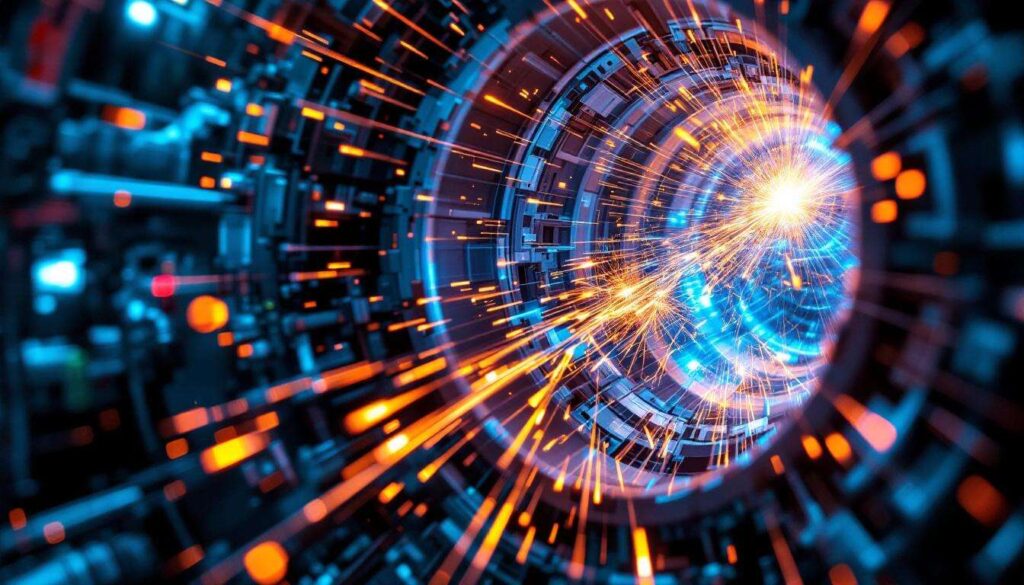
Inside the LHC, beams of protons are accelerated to 99.9999991% the speed of light and smashed together. The immense energy released in these collisions, governed by Einstein’s E=mc², creates a shower of new, often exotic particles. The ATLAS detector is built like a massive, multi-layered digital camera that surrounds the collision point to capture a “snapshot” of each event. Its components include:
- An Inner Detector that tracks the paths of charged particles.
- Calorimeters that measure the energy of most particles by stopping them.
- A Muon Spectrometer, the outermost layer, which is specifically designed to identify and measure the momentum of muons, as these particles can penetrate the inner layers of the detector.
By combining data from all these systems, physicists can reconstruct the event and identify the particles involved.
Isolating the signal from the noise
The central challenge in finding the Higgs-to-muon decay was not just its rarity, but the enormous background of other processes that also create muons. For every Higgs boson that decays into two muons, millions of other events produce similar-looking signatures. To find the signal, the ATLAS collaboration analyzed a massive dataset from the second run of the LHC. They looked for events with two opposite-charge muons and calculated their combined invariant mass. The signature of the Higgs decay would appear as a small, narrow “bump” in the distribution of this mass, centered around 125 Giga-electronvolts (GeV), the known mass of the Higgs boson. After years of painstaking data collection and sophisticated statistical analysis, this subtle but clear excess of events was finally identified, providing strong evidence for the decay. This process of isolating a faint signal is a testament to the power of both the detector and the analytical methods developed to interpret its data.
Understanding the muon-antimuon pair
What are muons ?
Muons are fundamental particles, much like electrons, but with a key difference: they are approximately 207 times more massive. They belong to the second of three “generations” of matter particles in the Standard Model. While the first generation contains the familiar electrons and the up and down quarks that make up protons and neutrons, the second and third generations contain heavier, unstable cousins. Muons are all around us, created naturally when cosmic rays strike particles in Earth’s upper atmosphere, but the ones produced at the LHC are the result of high-energy collisions.
The Standard Model’s predictions
A core tenet of the Standard Model is that the Higgs field gives mass to fundamental particles, and the strength of the Higgs boson’s interaction, or “coupling”, with a particle is directly proportional to that particle’s mass. This is why decays to heavy particles are common and decays to light ones are rare. The decay to muons is especially significant because it is the first time the Higgs has been seen coupling to second-generation particles. Observing this decay at the rate predicted by the theory provides powerful confirmation that the Higgs mechanism works not just for the heaviest particles but for the lighter generations of matter as well.
Matter and antimatter
For every type of matter particle, there exists a corresponding antimatter particle with the same mass but an opposite charge. The antimatter counterpart to the muon is the antimuon. When the Higgs boson decays via this channel, it produces one muon and one antimuon. The ATLAS detector can distinguish between them by observing the direction they curve in its powerful magnetic field. This production of a matter-antimatter pair is a common outcome in particle decays and is a fundamental aspect of the laws of physics. The precise measurement of this pair production helps to further validate our understanding of these interactions.
Implications for particle physics
Testing the Standard Model
The Standard Model of particle physics has been incredibly successful, but it is known to be incomplete. It does not, for example, account for gravity, dark matter, or dark energy. Therefore, physicists are constantly searching for any crack or deviation from its predictions that might point the way to a more complete theory. The observation of the Higgs boson decaying into muons provides a new, high-precision test. The fact that the measured rate of this decay aligns with the Standard Model’s prediction further solidifies the model’s foundation, even as it narrows the space where “new physics” might be hiding.
Probing the mass-coupling relationship
This result is a critical step in painting a complete picture of the Higgs boson. Before this, Higgs interactions had only been observed with the heavier third-generation particles (like the tau lepton and top and bottom quarks) and with the massive force-carrying bosons. This first evidence of an interaction with a second-generation particle (the muon) confirms that the Higgs behaves as expected with lighter particles. It strongly supports the idea that the same mechanism is responsible for generating the mass of all different generations of matter, a key assumption of the Standard Model.
Searching for new physics
While the current result is consistent with the Standard Model, it also serves as a powerful tool in the search for what lies beyond it. Many theories of new physics predict the existence of new, undiscovered particles that could subtly alter the rate at which the Higgs boson decays into different channels. Any significant discrepancy between the measured rate of the muon decay and the theoretical prediction could be an indirect sign of such new phenomena. For now, the agreement is strong, but more precise measurements in the future will continue to probe for these subtle effects, potentially revealing the first hints of a deeper theory of the universe.
Future perspectives and research
Increasing statistical significance
In the language of particle physics, the current result is classified as “evidence,” which corresponds to a statistical significance of three sigma. This means there is only about a 1 in 740 chance that the signal is a random statistical fluctuation. To claim a formal “observation,” physicists require a five-sigma significance, which corresponds to a one-in-3.5-million chance of being a fluke. Achieving this higher level of certainty will require collecting and analyzing significantly more data from LHC collisions.
The High-Luminosity LHC
The next major step for CERN is the upgrade to the High-Luminosity LHC (HL-LHC). This project will dramatically increase the accelerator’s luminosity, which is a measure of how many proton-proton collisions occur in a given amount of time. The HL-LHC is expected to produce at least 10 times more data than the current machine over its lifetime. This massive increase in data will allow physicists to study rare processes like the Higgs-to-muon decay with unprecedented precision. It will transform the current “evidence” into a definitive “observation” and enable a much more sensitive search for subtle deviations from Standard Model predictions.
Exploring other rare decays
The quest to understand the Higgs boson is far from over. Scientists are now focused on observing other rare decay channels to complete the puzzle. A key target is the decay of the Higgs boson into a charm quark and an anticharm quark, another second-generation particle pairing. This decay is predicted to be more common than the muon decay but is even harder to detect due to experimental challenges. Observing it, along with continuing to refine measurements of all other decay channels, will provide the most complete portrait yet of this remarkable particle and its central role in the fabric of the cosmos.
Acknowledge the evidence that the Higgs boson decays into a muon-antimuon pair. Recognize this finding as a crucial validation of the Standard Model’s prediction for second-generation particles. Continue to support the collection of more data to increase measurement precision and to search for physics beyond our current understanding.