



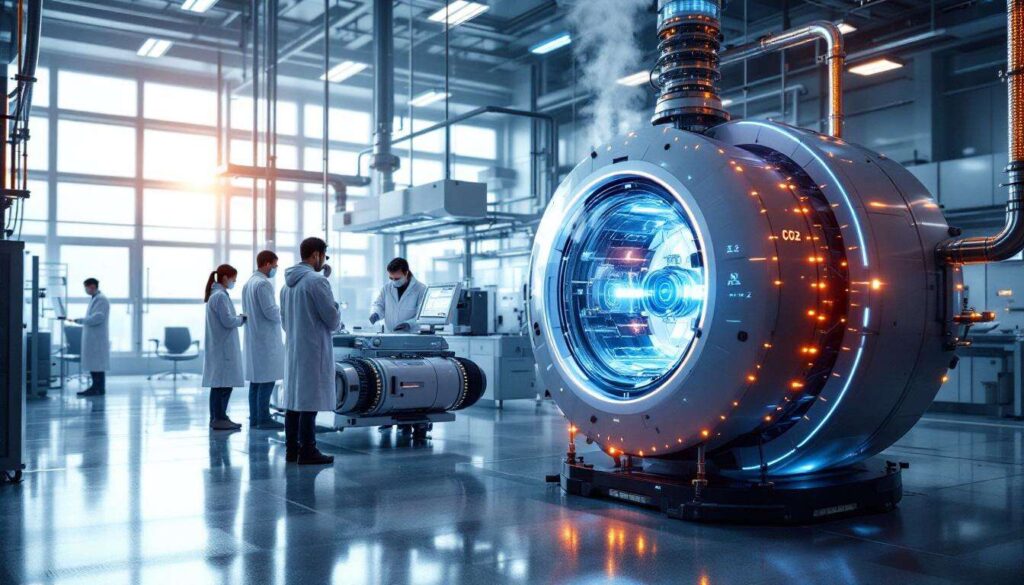
Re-examine everything you know about carbon dioxide. For decades, it has been cast as the primary antagonist in our planet’s climate narrative, a waste product to be captured, buried, and forgotten. A groundbreaking development, however, forces a radical shift in this perspective. Scientists have now demonstrated a viable pathway to transform this ubiquitous greenhouse gas not into a liability, but into a powerful asset: a source of clean, sustainable energy. This is not a theoretical exercise; it is a demonstrated reality that could fundamentally reshape our energy landscape and our approach to climate change.
The potential of CO2 as an energy source
The concept of using carbon dioxide to generate energy hinges on a process known as carbon capture and utilization (CCU). Unlike carbon capture and storage (CCS), which simply sequesters CO2 underground, CCU aims to convert it into valuable products. The core idea is to reverse the combustion process. By adding energy, typically in the presence of a catalyst, the strong chemical bonds in the CO2 molecule can be broken, allowing it to be reformed into energy-rich fuels like methanol, methane, or even gasoline.
The science of carbon conversion
At its heart, converting CO2 into fuel is a chemical reduction process. It requires a source of hydrogen and a significant energy input to trigger the reaction. The most promising route involves combining captured CO2 with hydrogen (H2) to produce hydrocarbons and water. The sustainability of this entire cycle depends critically on the sources of these inputs. For the process to be truly carbon-neutral or even carbon-negative, the following conditions must be met:
- The CO2 must be captured directly from the atmosphere or from industrial flue gas.
- The hydrogen must be produced via electrolysis powered by renewable energy sources, known as green hydrogen.
- The energy required to drive the chemical conversion itself must also come from renewable sources like solar or wind.
Benefits of a circular carbon economy
Successfully harnessing CO2 as a fuel source would create a circular carbon economy. Instead of extracting fossil fuels, burning them, and releasing CO2 into the atmosphere in a one-way street to pollution, we could capture that same CO2 and recycle it back into fuel. This offers a dual benefit: it reduces the concentration of greenhouse gases in the atmosphere while simultaneously decreasing our dependence on finite fossil fuel reserves. It effectively turns a waste stream into a raw material, creating a closed-loop system for energy.
This scientific potential has long been understood, but moving from laboratory theory to a practical, large-scale demonstration has remained a significant hurdle. That is, until now.
China’s revolutionary experiment
In a major scientific leap, researchers at the Dalian Institute of Chemical Physics, part of the Chinese Academy of Sciences, have successfully demonstrated a scalable method for converting CO2 into gasoline. Their pilot project marks a pivotal moment, proving that direct hydrogenation of carbon dioxide into high-octane liquid fuel is not just possible, but commercially viable. This achievement stands as a testament to years of dedicated research in catalysis and chemical engineering.
The breakthrough process
The Chinese team developed a highly efficient and stable catalyst that overcomes many of the previous limitations of CO2 conversion. The catalyst, based on a combination of iron and sodium, facilitates a multi-step reaction within a single reactor. It first reduces CO2 to carbon monoxide (CO) and then, in a subsequent step, converts the CO and hydrogen into long-chain hydrocarbons that form the basis of gasoline. This integrated approach is significantly more efficient than previous methods that required multiple, separate stages.
Performance and efficiency metrics
The results from the pilot plant are impressive and offer a glimpse into the technology’s potential. The process not only produces a clean-burning gasoline blend but does so with remarkable efficiency. The key is the catalyst’s selectivity, which minimizes the production of unwanted byproducts and maximizes the yield of the desired fuel. Below is a comparison of the key performance indicators.
| Metric | Conventional Methods | Dalian Institute Process |
|---|---|---|
| CO2 Conversion Rate | Low to moderate | High single-pass conversion |
| Gasoline Selectivity | Often below 50% | Approximately 78% |
| Catalyst Stability | Degrades quickly | Stable for over 1,000 hours |
| Energy Source | Fossil fuel-derived heat | Can be integrated with renewables |
This successful demonstration moves the technology out of the realm of pure science and into the world of practical engineering, opening the door for global consideration and replication.
The global implications of a new energy source
The verification of a scalable CO2-to-fuel process carries profound implications that extend far beyond the laboratory. It has the potential to disrupt global energy markets, redefine climate policy, and alter geopolitical dynamics. If this technology can be deployed worldwide, it represents a paradigm shift in how we manage carbon emissions and source our energy. The ability to create liquid fuels from an atmospheric gas could fundamentally change the energy equation for many nations.
Reshaping energy geopolitics
Nations lacking significant domestic fossil fuel reserves could suddenly find themselves with a new path to energy independence. The primary resources required would no longer be oil and gas deposits, but rather access to renewable electricity and CO2, which can be captured anywhere. This decentralization could have several major effects:
- Reduced reliance on oil-exporting nations: It could diminish the strategic importance of regions like the Middle East.
- Enhanced energy security: Countries could produce fuel domestically, insulating their economies from volatile global oil prices and supply chain disruptions.
- A new market for carbon: CO2 itself would become a traded commodity, a valuable feedstock rather than a costly pollutant.
Impact on climate change goals
This technology offers a powerful new tool in the fight against climate change. It provides a pathway for decarbonizing sectors that are difficult to electrify, such as aviation and long-haul shipping. Synthetic fuels created from CO2 are chemically similar to their fossil-derived counterparts and can be used in existing engines and infrastructure, avoiding the need for a costly and complete overhaul of the world’s vehicle fleet. This makes it a pragmatic, transitional solution that could be implemented relatively quickly.
However, realizing this potential on a global scale is contingent on navigating a series of significant hurdles that lie between a successful pilot plant and a worldwide energy revolution.
The technical and economic challenges to overcome
Despite the monumental breakthrough, the road to widespread adoption of CO2-based energy is fraught with substantial technical and economic obstacles. The promise of turning pollution into power is alluring, but the reality involves overcoming issues of scale, cost, and energy efficiency. These challenges must be addressed before synthetic fuels can compete with established fossil fuels in the open market.
The energy input dilemma
The most significant challenge is the sheer amount of energy required for the conversion process. Converting a stable molecule like CO2 into a high-energy fuel is an energy-intensive endeavor. For the final product to be considered “green,” all of this energy must come from renewable sources. This requires a massive build-out of solar, wind, and other clean energy infrastructure specifically dedicated to powering CO2 conversion plants. Currently, the global capacity for renewable energy is not sufficient to support both existing electrical grids and a new, large-scale synthetic fuel industry.
The cost of production
At present, the production cost of synthetic gasoline from CO2 is significantly higher than that of conventional gasoline. The primary cost drivers are the capital expenditure for the conversion plants and, more importantly, the price of green hydrogen, which is the main feedstock alongside CO2. The cost of producing green hydrogen via electrolysis remains high, though it is expected to decrease as renewable electricity becomes cheaper and electrolyzer technology improves. A cost parity analysis shows the steep hill this technology must climb.
| Fuel Source | Estimated Production Cost (per gallon) | Key Variables |
|---|---|---|
| Conventional Gasoline | $2.00 – $3.00 | Crude oil price, refining costs |
| Synthetic Gasoline (current) | $7.00 – $12.00+ | Green hydrogen cost, electricity price |
Achieving economic viability will require major innovations in catalyst efficiency, reactor design, and the scaling up of green hydrogen production.
Beyond the technical and economic factors, a thorough analysis of the true environmental footprint is essential to ensure this solution does not create new problems.
The environmental impact and sustainability issues
While the prospect of a circular carbon economy is exciting, it is crucial to scrutinize the full lifecycle environmental impact of CO2-derived fuels. The “green” label is only earned if the entire process, from capturing CO2 to burning the final fuel, is genuinely sustainable and results in a net reduction of atmospheric greenhouse gases. This requires a holistic view that accounts for every input and output.
The green hydrogen imperative
The single most critical factor determining the sustainability of this technology is the source of the hydrogen. The process requires vast quantities of H2, and its production method is paramount.
- Grey Hydrogen: Produced from natural gas, this is the most common and cheapest method, but it releases significant amounts of CO2, defeating the purpose of the entire cycle.
- Blue Hydrogen: This is grey hydrogen where the CO2 emissions from production are captured. It is better, but not entirely carbon-free.
- Green Hydrogen: Produced by splitting water using renewable electricity, this is the only truly sustainable option. The entire climate benefit of CO2-based fuels rests on the availability of affordable, large-scale green hydrogen.
Lifecycle analysis considerations
A comprehensive lifecycle analysis must also consider other factors, such as the energy and materials needed to build the conversion plants and the carbon capture facilities. There is also the question of water usage, as electrolysis for green hydrogen production requires significant amounts of fresh water. Furthermore, while burning synthetic gasoline is carbon-neutral in theory (releasing the same CO2 that was captured), it still produces other pollutants like nitrogen oxides (NOx) and particulates, which impact local air quality. It is a solution for climate change, not necessarily for urban smog.
These considerations highlight that while the core technology is sound, its implementation must be carefully managed to ensure it delivers on its environmental promise as we look toward its future integration.
Future prospects for CO2-based energy
The path forward for CO2-based energy is one of cautious optimism, driven by scientific innovation and strategic investment. China’s success has ignited a global race to refine and scale this technology. The coming years will be critical in determining whether synthetic fuels become a niche solution for specific industries or a mainstream pillar of our future energy system. The focus is now shifting from proving possibility to achieving practicality.
Advancements in catalysis and reactor design
Future research will concentrate on developing even more efficient, durable, and cost-effective catalysts. Scientists are exploring novel materials, including nanomaterials and metal-organic frameworks, to reduce the energy required for conversion and improve the selectivity for desired fuels. Simultaneously, engineers are working on modular reactor designs that can be mass-produced, lowering capital costs and allowing for more flexible deployment. These parallel tracks of materials science and engineering are essential for driving down the price of synthetic fuels.
The role of policy and investment
Government policy will play a decisive role in accelerating the transition. Carbon pricing, tax credits for carbon utilization, and mandates for sustainable aviation fuel are powerful incentives that can create a market for these emerging technologies. Public and private investment in green hydrogen infrastructure and large-scale demonstration projects will be necessary to de-risk the technology and build investor confidence. The journey from a single pilot plant to a global industry will require a concerted effort from scientists, entrepreneurs, and policymakers alike.
Acknowledge the immense potential held within this scientific breakthrough. The conversion of carbon dioxide from a global liability into a critical energy asset is now a tangible possibility. While formidable economic and technical challenges remain, the successful demonstration of this technology marks a pivotal step toward a circular carbon economy. Pursue innovation in catalysis, invest in green hydrogen infrastructure, and implement supportive policies to unlock this transformative energy pathway. The future of fuel may no longer be buried beneath the earth, but floating in the air around us.