

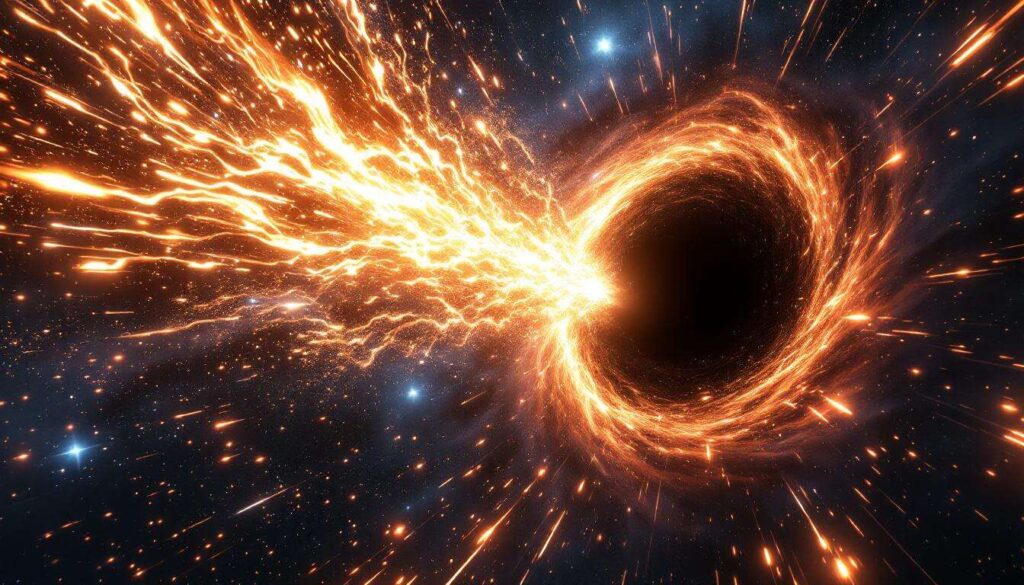
In a stunning display of cosmic power, astronomers have witnessed a stellar-mass black hole violently ejecting clouds of plasma at speeds approaching 20% the speed of light. The event, originating from the black hole system known as V404 Cygni, is remarkable not just for its velocity but for its mechanism. For the first time, scientists have observed a black hole launching matter through a process strikingly similar to the magnetic explosions seen on the surface of our own sun. This discovery provides a powerful new link between the physics governing stars and the extreme environments surrounding the universe’s most enigmatic objects.
Unique astrophysical phenomenon
The V404 Cygni outburst
The system V404 Cygni, located approximately 7,800 light-years from Earth, consists of a black hole about nine times the mass of our sun and a companion star in a tight orbit. The black hole actively pulls material from its companion, forming a swirling, superheated structure around it called an accretion disk. While this process is common, the 2015 outburst of V404 Cygni was anything but ordinary. Using a combination of high-speed optical and X-ray observatories, an international team of researchers captured the event in unprecedented detail. They observed distinct, rapid-fire ejections of plasma, or ionized gas, being launched away from the black hole’s vicinity in powerful jets.
Unprecedented speeds and observations
The material was clocked moving at truly staggering velocities. The jets of plasma were not a steady stream but discrete “bullets” of matter, each containing more material than the planet Earth and fired off in intervals of just a few hours. These ejections reached speeds exceeding 60,000 kilometers per second, or about one-fifth the speed of light. This is one of the fastest moving phenomena ever observed originating from a stellar-mass black hole. The data gathered allowed scientists to directly link the ejection of these plasma clouds to dramatic flares in X-ray and visible light, providing a complete picture of the event as it unfolded.
| Parameter | Value |
|---|---|
| Object Type | Stellar-mass black hole binary system |
| Distance from Earth | ~7,800 light-years |
| Black Hole Mass | ~9 solar masses |
| Companion Star | Early K-type giant star |
| Observed Ejection Velocity | ~20% speed of light (~60,000 km/s) |
This detailed observation of a powerful, intermittent jet provided the crucial evidence needed to understand the physical engine driving it, a mechanism that was previously only theorized for such objects. The structure and behavior of black holes themselves are central to understanding how such immense power is generated.
Structure and formation of black holes
The nature of an event horizon
A black hole is a region of spacetime where gravity is so strong that nothing, not even light, can escape. The boundary of this region is called the event horizon. For a non-rotating black hole, this is a perfectly spherical surface. Anything that crosses the event horizon is lost from the observable universe. However, the dramatic events associated with black holes, like the jets from V404 Cygni, do not originate from inside the event horizon but from the material swirling just outside it. This material, in the accretion disk, is subjected to extreme gravitational and magnetic forces before it takes its final plunge.
Stellar-mass black holes
Black holes come in various sizes, and V404 Cygni is a stellar-mass black hole. These objects form from the cataclysmic collapse of a massive star at the end of its life, an event known as a supernova. The core of the star implodes under its own gravity, compressing matter into an incredibly dense point. If the progenitor star is massive enough, typically more than 20 times the mass of our sun, its core will collapse into a black hole. Many of these black holes exist in binary systems, where they were once paired with another star that survived the supernova, creating the exact conditions for an accretion disk to form.
The accretion disk is the powerhouse for the phenomena we observe. It is a chaotic, intensely hot environment where matter is accelerated to near-light speeds, generating immense friction and radiation. It is within this disk that the magnetic fields are generated and amplified, setting the stage for explosive releases of energy.
Magnetic interactions and explosions
The role of the magnetic field
The key to the V404 Cygni explosion lies in its magnetic field. As plasma from the companion star spirals into the accretion disk, it carries magnetic fields with it. The rapid rotation and intense turbulence within the disk twist and stretch these magnetic field lines, storing a tremendous amount of energy, much like a rubber band being wound tighter and tighter. This process creates a powerful, organized magnetic field that extends away from the disk. This magnetic energy becomes the primary fuel for the observed ejections, far exceeding the energy available from gravity or radiation alone.
A cosmic catapult effect
The ejections are thought to be caused by a process called magnetic reconnection. At a certain point, the tangled magnetic field lines in the accretion disk become so strained that they suddenly snap and reconfigure into a simpler, lower-energy state. This sudden release of stored magnetic energy is explosive. It heats the surrounding plasma to millions of degrees and accelerates it outward along the newly configured field lines, creating the high-velocity jets. This process acts as a cosmic catapult, flinging massive amounts of matter into space at a significant fraction of the speed of light. The intermittent nature of the V404 Cygni jets corresponds to repeated cycles of magnetic energy build-up and explosive release.
This mechanism of magnetic reconnection is not entirely alien to us. In fact, a very similar process occurs on a much smaller scale much closer to home, providing a fascinating point of comparison.
Comparison with our sun
Solar flares and coronal mass ejections
Our own sun regularly demonstrates the power of magnetic reconnection. Sunspots, cooler regions on the sun’s surface, are areas of intense and complex magnetic activity. When the magnetic field lines above these sunspots become tangled and snap, they release bursts of energy known as solar flares. Often, these flares are accompanied by coronal mass ejections (CMEs), which are enormous bubbles of plasma and magnetic field that are hurled into space. These CMEs can travel at speeds of hundreds or even a few thousand kilometers per second, but this is a mere fraction of the speeds seen at V404 Cygni.
A difference in scale
While the underlying physics—magnetic reconnection—is the same, the scale of the event at V404 Cygni dwarfs anything our sun can produce. The energy released by the black hole’s outburst was billions of times greater than that of the most powerful solar flare ever recorded. The key difference lies in the source of the magnetic field and the gravitational environment.
| Feature | Our Sun (Typical Large CME) | Black Hole V404 Cygni |
|---|---|---|
| Central Object Mass | 1 solar mass | ~9 solar masses |
| Ejection Speed | ~1,000 km/s (~0.3% light speed) | ~60,000 km/s (~20% light speed) |
| Energy Source | Magnetic field from solar interior | Magnetic field amplified by accretion disk |
| Gravitational Field | Strong | Extreme |
The black hole’s immense gravity allows its accretion disk to spin much faster and reach far higher temperatures, generating a magnetic field of unimaginable strength. This supercharged environment allows for a much more efficient and powerful energy release. Recognizing this shared mechanism has profound implications for our understanding of the universe.
Implications for modern astrophysics
Unifying physical models
This discovery is a significant step toward a unified model of astrophysical jets. For decades, scientists have studied jets from a wide variety of objects, including young stars, neutron stars, and supermassive black holes at the centers of galaxies. The observation of a sun-like magnetic process in a stellar-mass black hole suggests that the same fundamental physical mechanism may be at play across a vast range of cosmic scales. This principle, where similar physics operates in vastly different environments, is a cornerstone of modern astrophysics. It simplifies our understanding of the universe, suggesting that a few core principles govern phenomena from our local star to the most distant quasars.
Understanding accretion processes
The study of V404 Cygni also provides critical insights into how black holes feed and grow. The ejections act as a feedback mechanism, carrying away energy and momentum from the accretion disk. This process can regulate the rate at which a black hole consumes matter. Understanding this regulation is key to modeling:
- The growth of supermassive black holes over cosmic time.
- The impact of black hole jets on their host galaxies, a process known as “galactic feedback.”
- The formation of heavy elements in the universe, as these jets can enrich the interstellar medium.
This single observation has opened up new avenues for research, prompting scientists to refine their models and plan for future observations to test these new hypotheses.
Future observations and ongoing studies
New instruments, new insights
The detailed study of V404 Cygni was made possible by coordinating multiple telescopes observing across the electromagnetic spectrum. Future advancements in observational astronomy promise even deeper insights. Instruments like the James Webb Space Telescope can provide high-resolution infrared data, while next-generation radio arrays like the Square Kilometre Array will be able to map the magnetic fields around black holes with unprecedented precision. These new tools will allow astronomers to move from capturing snapshots of these events to creating detailed movies, tracking the flow of matter and the twisting of magnetic fields in real time.
The search for similar events
With a confirmed mechanism in hand, astronomers are now actively searching for similar sun-like magnetic ejections from other black hole systems. Identifying a population of these events would allow for a statistical study to determine how factors like black hole mass, spin, and accretion rate affect the power and frequency of these outbursts. Each new observation will serve as a crucial data point to test and refine the unified model of astrophysical jets, bringing us closer to a complete understanding of how these cosmic engines work. The hunt is on for more black holes that behave like our sun, only on a scale that defies imagination.
The discovery at V404 Cygni has reshaped our understanding of the dynamic environments around black holes. By revealing that the same magnetic processes that drive solar flares are responsible for launching plasma at nearly the speed of light, it establishes a profound physical connection between stars and black holes. This finding not only solves a long-standing puzzle about the power source of these cosmic jets but also provides a unified framework for studying the most extreme phenomena in the universe, highlighting that the laws of physics operate in consistent, if spectacularly scaled-up, ways across the cosmos.