



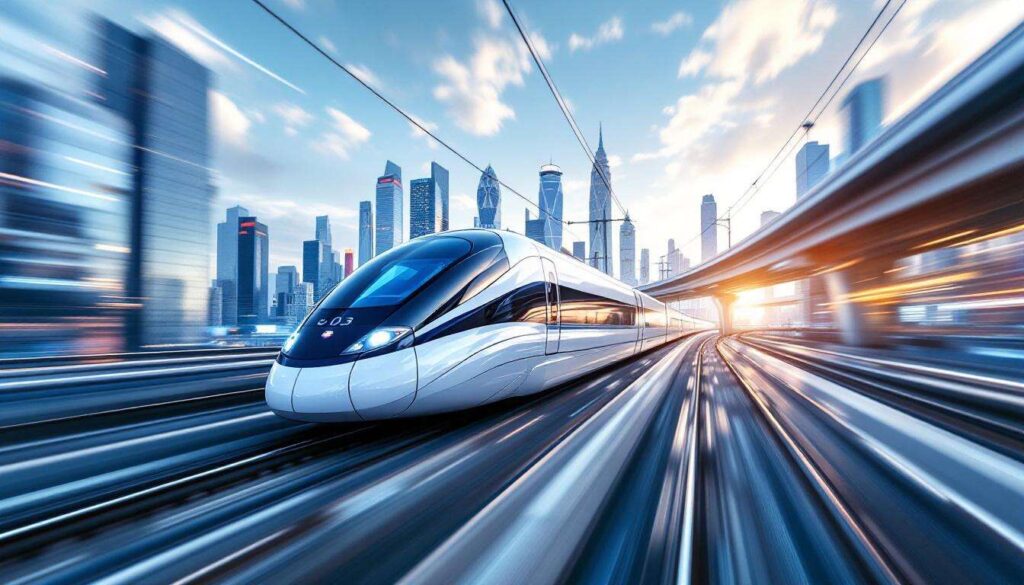
A new era in ground transportation has dawned, marked by a feat of engineering that blurs the line between train travel and aviation. On a specialized test track, a sleek, futuristic vehicle accelerated past a threshold once thought to be the exclusive domain of aircraft, reaching a blistering speed of 603 kilometers per hour. This milestone, achieved by a magnetic levitation train, not only shatters previous land speed records but also signals a profound shift in how we might travel between cities in the near future. The event represents the culmination of decades of research, immense investment, and a relentless pursuit of speed, efficiency, and technological supremacy.
An engineering feat: the new speed record
Shattering previous limits
The world of transportation witnessed a landmark event as the SCMaglev L0 Series train, developed by the Central Japan Railway Company, clocked an astonishing 603 kilometers per hour (approximately 375 mph) on a test track in Yamanashi Prefecture. This achievement didn’t just inch past the old record; it smashed it, cementing its place in history. The previous public record, also held by a Japanese maglev train, stood at 581 km/h for over a decade, a testament to the immense engineering challenge of breaking the 600 km/h barrier. This new benchmark firmly establishes the L0 Series as the fastest train ever built.
A record-breaking run
The record was achieved during a series of tests designed to push the vehicle to its absolute limits. Engineers and technicians monitored thousands of data points in real-time, ensuring the train’s stability and performance under extreme aerodynamic and electromagnetic stress. The test run was not a fleeting moment but a sustained demonstration of power and control, covering several kilometers at speeds exceeding the operational velocity of most commercial aircraft during takeoff. This was not just about raw speed; it was about proving the viability and reliability of the technology under the most demanding conditions imaginable.
Putting the speed into perspective
To truly grasp the significance of 603 km/h, it’s helpful to compare it with other forms of high-speed transport. This new benchmark places the maglev train in a league of its own, significantly outpacing conventional high-speed rail and approaching the cruising speed of some short-haul airplanes. A journey from Paris to Marseille, which takes over three hours on a conventional high-speed train, could theoretically be completed in just over an hour.
| Vehicle | Top Recorded Speed (km/h) | Typical Operational Speed (km/h) |
|---|---|---|
| SCMaglev L0 Series | 603 | ~500 (projected) |
| Shanghai Transrapid Maglev | 501 | 431 |
| TGV (Conventional Rail) | 574.8 | 320 |
| Boeing 737 (Aircraft) | N/A (Cruising Speed) | ~850 |
This new record is more than just a number; it represents a monumental leap in ground transportation technology. But achieving such velocity is not magic; it is the result of a sophisticated and elegant scientific principle that eliminates the most fundamental barrier to speed on the ground: friction.
The secrets of magnetic levitation
Eliminating friction
The core technology enabling these incredible speeds is magnetic levitation, or maglev. Unlike conventional trains that rely on wheels rolling on steel tracks, a maglev train floats above its guideway, suspended by powerful magnetic forces. By eliminating the physical contact between the train and the track, maglev technology eradicates rolling friction, which is a major limiting factor for traditional rail systems. The only significant force the train must overcome is air resistance, which becomes the primary challenge at such high velocities.
The power of magnets
The SCMaglev system employs a sophisticated array of superconducting magnets on the train and coils on the guideway. This technology operates on a simple principle of magnetism: like poles repel, and opposite poles attract. The system works in three key ways:
- Levitation: Powerful magnets on the train’s undercarriage interact with coils on the guideway walls, generating a repulsive force that lifts the train about 10 centimeters into the air once it reaches a certain speed.
- Guidance: The same magnetic forces are used to keep the train perfectly centered within the U-shaped guideway, ensuring stability without any physical contact.
- Propulsion: The guideway coils are energized in a controlled sequence, creating a shifting magnetic field that both pushes and pulls the train forward. This “magnetic wave” allows for incredibly smooth and rapid acceleration.
A smoother, quieter ride
A significant benefit of eliminating wheels and friction is a remarkably different passenger experience. The ride on a maglev train is exceptionally smooth and quiet compared to its wheeled counterparts. The absence of vibrations from wheels on rails creates a serene cabin environment, even at speeds exceeding 500 km/h. This focus on passenger comfort is a key selling point, promising a future where long-distance travel is not only faster but also more relaxing. This advancement in passenger experience is a critical part of what makes maglev a major step forward for the entire industry.
A major advancement for railway transport
Redefining travel times
The most immediate and transformative impact of this technology is the drastic reduction in travel times. The planned Chuo Shinkansen line in Japan, which will use this L0 Series technology, aims to connect Tokyo and Nagoya, a distance of about 286 kilometers, in just 40 minutes. This is less than half the time it takes on the current Tokaido Shinkansen, one of the world’s most advanced conventional high-speed lines. Such time savings could effectively turn sprawling megaregions into single, interconnected commuter zones, reshaping economies, real estate markets, and lifestyles.
Connecting economic hubs
By making long-distance travel faster and more efficient, maglev has the potential to forge stronger links between major economic centers. Businesses can operate more seamlessly between cities, and talent pools become geographically larger. This enhanced connectivity can spur economic growth, foster collaboration, and increase productivity. The infrastructure itself, while expensive, becomes a long-term strategic asset for a nation’s economy. The promise is a future where distance is no longer a primary barrier to opportunity, but this future can only be realized if the immense safety challenges are met.
The challenges of high-speed safety
Ensuring stability at extreme speeds
Operating a vehicle at over 600 km/h on the ground presents unprecedented safety challenges. The primary concern is maintaining stability. Even minor imperfections in the guideway or unexpected aerodynamic forces could have catastrophic consequences. Engineers have developed advanced control systems that constantly monitor the train’s position and make thousands of micro-adjustments per second to the magnetic fields. The U-shaped guideway is also a key safety feature, as it physically contains the train and makes a traditional derailment virtually impossible.
Braking and emergency procedures
Bringing a multi-ton vehicle from 500 km/h to a standstill safely and efficiently is a complex problem. The primary braking system is regenerative: the same linear motors used for propulsion are reversed to slow the train down, converting kinetic energy back into electricity. However, multiple redundant systems are required for emergencies. These include:
- Aerodynamic brakes: Retractable panels that increase air resistance, similar to spoilers on an aircraft.
- Emergency friction brakes: In the event of a total power failure, the train would lower onto skids that create friction with the guideway to bring it to a stop.
Extensive emergency protocols, including evacuation procedures for tunnels, are also a critical part of the overall safety framework. The high cost of these safety measures is often weighed against the system’s potential environmental benefits.
Ecological impact and sustainable development
Energy consumption concerns
While maglev technology is often praised as a green alternative to air travel, its energy consumption is a significant consideration. The power required to generate the immense magnetic fields and overcome air resistance at such high speeds is substantial. Critics point out that the per-passenger energy usage could be higher than that of conventional high-speed rail. However, proponents argue that the electricity can be sourced from renewable energy, making the system’s carbon footprint dependent on the nation’s overall energy grid. The efficiency of the system is a key area of ongoing research.
A greener alternative to air travel
Despite its energy demands, maglev offers a compelling environmental advantage over short-haul flights. For inter-city routes of 300 to 1,000 kilometers, maglev trains produce significantly fewer direct carbon emissions per passenger. Unlike airplanes, they do not emit pollutants at high altitudes where they can have a more damaging effect. By shifting a portion of the domestic travel market from air to maglev, countries can make substantial progress toward their climate goals. This makes maglev a key component of a sustainable, integrated transportation network for the future, a vision that is driving fierce international competition.
International competition in the train industry
A global race for speed
Japan’s record-breaking achievement did not occur in a vacuum. It is part of an intense global competition to develop the next generation of high-speed ground transportation. Several nations are investing heavily in maglev and other advanced rail technologies, viewing them as symbols of technological prowess and key drivers of future economic competitiveness. This race is not just about national pride; it’s about securing a leading position in a multi-billion dollar global industry for infrastructure and rolling stock.
Key players on the world stage
While Japan is the current record holder with its SCMaglev, other countries are formidable competitors. China operates the world’s first commercial maglev line in Shanghai and is aggressively developing its own 600 km/h prototype. South Korea has its own operational urban maglev system, and Germany was a pioneer in the technology with its Transrapid system. The United States has also shown renewed interest, with several high-speed rail projects under consideration, some of which are exploring maglev technology as a potential solution for connecting major cities like Washington D.C. and Baltimore. This global rivalry is accelerating innovation and pushing the boundaries of what is possible in ground transport.
| Country | Key Project/Technology | Status |
|---|---|---|
| Japan | SCMaglev L0 Series (Chuo Shinkansen) | World Record Holder; Under Construction |
| China | Shanghai Transrapid; CRRC 600 km/h Prototype | Operational; Prototype Testing |
| South Korea | Incheon Airport Maglev | Operational |
| Germany | Transrapid System | Technology developed; no domestic lines |
The race is on, and the recent record set by the L0 Series is a powerful statement in this ongoing technological contest.
The new speed record of 603 km/h is far more than a statistic. It marks a pivotal moment for transportation, showcasing a technology that promises to shrink distances and reshape economies. Powered by the elegant physics of magnetic levitation, this new generation of trains offers a glimpse into a future of faster, smoother, and potentially more sustainable travel. While significant safety, economic, and environmental challenges remain, the relentless push for speed and efficiency continues to drive innovation, heralding a new chapter in the long and storied history of the railway.