


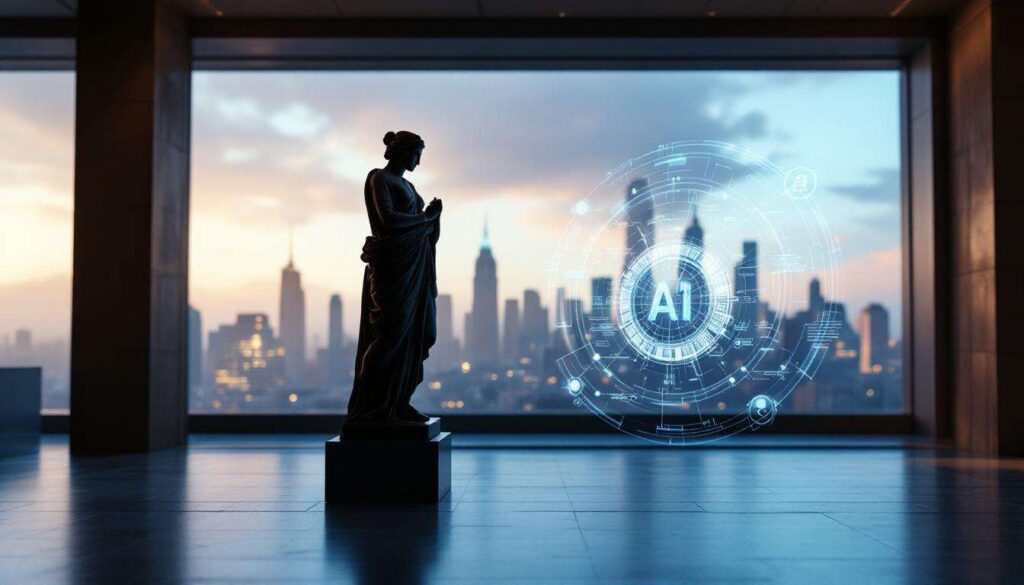
The concept of artificial intelligence, often framed as a cutting-edge product of the digital age, is in fact an ancient dream. Long before the first line of code was written, humanity was already exploring the promise and peril of artificial beings through myths, legends, and philosophical inquiry. These foundational stories, from automated servants forged in a god’s fire to clay giants brought to life by sacred words, reveal a timeless fascination with creating non-human intelligence. They are not mere fantasies but cultural artifacts that have profoundly shaped our modern hopes, anxieties, and ethical debates surrounding AI.
The mythological origins of artificial intelligence
Hephaestus and his mechanical servants
In the annals of Greek mythology, the first roboticist was not a mortal but a god: Hephaestus, the master blacksmith of Olympus. The epic poems of Homer describe his workshop as a hub of automated innovation. He famously crafted golden maidens who were endowed with reason and speech, serving as his assistants. These beings could move of their own accord, anticipate needs, and communicate, embodying an early vision of helpful, humanoid AI. His creations also included a fleet of three-legged tables that could wheel themselves into the divine assembly and retreat on command, a precursor to today’s autonomous vehicles and smart home devices.
Talos: the bronze automaton
Perhaps the most striking example of an ancient automaton is Talos, the giant bronze man created to protect the island of Crete. Described in the tale of Jason and the Argonauts, Talos circled the island’s shores three times a day, hurling boulders at approaching ships. He was, in essence, an ancient autonomous weapon system. His single weakness was a vein running from his neck to his ankle, sealed by a single bronze nail. When the sorceress Medea removed the nail, the divine fluid, or ichor, drained out, and the giant collapsed. The story of Talos is a powerful early narrative about the vulnerability of even the most formidable artificial creations, a theme that resonates in modern discussions about AI safety and control.
These ancient tales of automated beings and thinking machines established a narrative framework that continues to influence our collective imagination. They were not just stories of technological marvels but also complex allegories about creation, power, and the inherent risks of emulating life.
The impact of ancient narratives on our perception
The duality of creation: helper or destroyer
Ancient myths established a fundamental duality in our perception of artificial beings, a theme that persists in every contemporary discussion about AI. On one hand, creations like Hephaestus’s golden helpers represent the utopian vision of AI: loyal, tireless servants designed to alleviate human labor and enhance our lives. On the other hand, figures like Talos and Pandora, who unleashed suffering upon the world from her jar (often mistranslated as a box), embody the dystopian fear. They represent the risk of creations that are either uncontrollable, inherently destructive, or whose actions lead to devastating unintended consequences. This ancient dichotomy is the direct ancestor of modern debates pitting AI as a potential savior against AI as an existential threat.
Shaping our hopes and fears
The narratives we inherit from antiquity act as a cultural lens through which we view modern technology. The awe inspired by a thinking machine is not new; it echoes the wonder ancient Greeks must have felt hearing tales of a god’s animated statues. Similarly, the fear of a robot uprising is a modern retelling of the story of an automaton turning against its purpose. These foundational stories provide us with familiar archetypes to understand complex new technologies. When we discuss AI ethics, we are, in many ways, continuing a conversation started thousands of years ago about the responsibility of the creator for their creation.
| Narrative Theme | Ancient Manifestation | Modern AI Parallel |
|---|---|---|
| Utopian Helper | Hephaestus’s golden maidens | AI personal assistants, automated labor |
| Dystopian Threat | Talos, the destructive guardian | Autonomous weapons, job displacement |
| Unintended Consequences | Pandora’s jar releasing ills | Algorithmic bias, data privacy issues |
| The Creator’s Burden | Daedalus and his son Icarus | Ethical AI development, accountability |
The enduring power of these myths demonstrates that our relationship with technology is not just about logic and engineering but is also deeply emotional and psychological. This historical context is crucial for understanding why public and political discourse on AI can often seem so polarized, oscillating between unbridled optimism and profound alarm.
The evolution of myths throughout the centuries
From divine magic to human craft
As classical antiquity gave way to the medieval period, the source of artificial life shifted from the forge of the gods to the hands of mortals empowered by esoteric knowledge. The most famous example from this era is the Golem of Prague, a figure from Jewish folklore. According to the legend, a 16th-century rabbi created a giant from clay to protect the Jewish community from persecution. The golem was brought to life by placing a parchment with a sacred name, a shem, in its mouth. Unlike the divine creations of Hephaestus, the golem was a product of human ritual and mysticism. However, it shared a common theme with its predecessors: the story often ends with the creation growing too powerful and destructive, forcing its creator to deactivate it by removing the shem.
The age of automata and enlightenment
The Renaissance and the Enlightenment brought a further shift, replacing magic with mechanics. The fascination with creating artificial life moved into the workshops of inventors and clockmakers. This period saw the rise of intricate automata, mechanical figures designed to mimic life with astonishing precision. Notable examples include:
- The Digesting Duck: Created by Jacques de Vaucanson in 1739, this mechanical duck could flap its wings, eat grain, and even simulate digestion and defecation.
- The Writer: Built by Pierre Jaquet-Droz, this automaton from the 1770s could write custom phrases with a quill pen, a remarkable feat of mechanical programming.
- The Turk: A famous chess-playing machine from the late 18th century that toured Europe, defeating challengers like Napoleon Bonaparte. It was later revealed to be an elaborate hoax with a human chess master hidden inside.
While these automata were not truly intelligent, they represented a significant conceptual leap. They demonstrated that the illusion of life and intelligence could be achieved through gears, springs, and clever engineering. This mechanical paradigm laid the groundwork for the computational models that would later define the field of artificial intelligence, moving the dream of creating a thinking machine from the realm of myth into the domain of science.
Modern beliefs surrounding AI
The persistent myth of the singularity
One of the most powerful modern myths about artificial intelligence is the concept of the technological singularity. This is the hypothetical point in the future when technological growth becomes uncontrollable and irreversible, resulting in the emergence of a superintelligence that radically changes human civilization. Popularized by science fiction and debated by technologists, this idea often evokes apocalyptic imagery of machines surpassing and subjugating humanity. While it serves as a compelling narrative, most mainstream AI researchers view the singularity as a speculative and distant possibility, not an imminent reality. They emphasize that current AI systems are narrowly focused tools, not general intelligences on a path to consciousness. The myth, however, continues to dominate public perception and drive fears about AI’s ultimate trajectory.
AI as the ultimate job destroyer
Another prevalent belief is that AI will lead to mass unemployment by automating most human jobs. This fear is not new; it echoes the anxieties of past industrial revolutions. While AI and automation are certainly transforming the labor market, the narrative of a “jobless future” is an oversimplification. Economic studies show a more complex picture, where AI displaces some jobs while creating new ones and augmenting many others. The challenge is less about a total lack of work and more about workforce transition, reskilling, and addressing the economic inequality that may arise. The myth focuses on replacement, while the reality is a more nuanced process of restructuring and collaboration between humans and machines.
These modern myths, much like their ancient counterparts, reflect our deepest anxieties about control, purpose, and the future of humanity. They often conflate the specialized AI of today with the sentient, autonomous beings of science fiction, creating a gap between public perception and the actual state of the technology. This gap highlights the ongoing influence of storytelling on our understanding of innovation.
The influence of religious figures on AI
The Vatican’s dialogue with technology
Religious institutions, long the arbiters of questions about creation and the human soul, are increasingly engaging with the ethical dimensions of artificial intelligence. The Vatican, in particular, has taken a proactive role. In 2020, the Pontifical Academy for Life, along with companies like Microsoft and IBM, promoted the “Rome Call for AI Ethics.” This initiative outlines a set of principles for the ethical development of AI, emphasizing transparency, inclusion, responsibility, and impartiality. The Vatican’s involvement reframes the AI debate, moving it beyond purely technical or economic concerns to include profound moral and philosophical questions about human dignity and the common good. This engagement is not about condemning technology but about guiding it in a direction that is human-centric and socially beneficial.
When a pope gets a chatbot
The intersection of religion and AI occasionally takes on a more popular, and sometimes unusual, form. The brief appearance of a chatbot named “Father Justin” or viral deepfakes of Pope Francis in fashionable attire illustrate how AI can be used to both disseminate and parody religious authority. While a chatbot cannot offer spiritual guidance in any meaningful way, its existence forces a conversation about the role of technology in faith. Can an algorithm mediate a spiritual experience ? What are the boundaries between using AI as a tool for communication and treating it as a source of wisdom ? These questions show that even the oldest institutions are grappling with how to integrate, and regulate, a technology that touches upon the very definition of communication, knowledge, and even consciousness. The dialogue initiated by figures like the pope serves as a powerful reminder that AI is not just a technological issue but a deeply humanistic one.
Towards a realistic understanding of artificial intelligence
Separating science fiction from reality
To navigate the future of AI effectively, it is crucial to demystify the technology and separate the speculative narratives from its current capabilities. Today’s artificial intelligence, even in its most advanced forms like large language models, does not possess consciousness, intent, or understanding in the human sense. These systems are sophisticated pattern-recognition machines, trained on vast amounts of data to predict outcomes and generate responses. They are tools, not sentient beings. The myth of the all-knowing, all-powerful AI stems from our tendency to anthropomorphize complex systems. A realistic view requires us to see AI for what it is: a powerful but limited technology whose behavior is a reflection of its design and the data it was trained on.
Focusing on the real challenges
Moving beyond the myths allows us to focus on the tangible and pressing challenges that AI presents today. Instead of fearing a hypothetical robot uprising, a more productive approach is to address the real-world ethical and social issues that are already emerging. These include:
- Algorithmic bias: AI systems can perpetuate and amplify existing societal biases present in their training data, leading to unfair outcomes in areas like hiring, loan applications, and criminal justice.
- Data privacy: The collection and use of massive datasets to train AI models raise significant concerns about surveillance and individual privacy.
- Accountability and transparency: When an AI system makes a critical error, determining who is responsible—the developer, the user, or the owner—is a complex legal and ethical problem.
- Economic disruption: The immediate impact of AI on the labor market requires proactive policies for education, reskilling, and social safety nets to manage the transition.
By grounding our conversation in these practical realities, we can work towards developing AI that is not only innovative but also responsible, equitable, and aligned with human values. The goal is not to stop progress but to steer it wisely, informed by a clear understanding of both its potential and its limitations.
From the bronze giant Talos to the algorithms shaping our digital world, the story of artificial intelligence has always been intertwined with the story of humanity itself. These narratives, ancient and modern, are not just cautionary tales; they are reflections of our enduring quest to understand creation, intelligence, and our own place in the universe. Acknowledging this long history allows for a more grounded conversation, one that moves beyond the dichotomy of utopia and dystopia to focus on the practical and ethical challenges of building a future where human and artificial intelligence can coexist productively.