



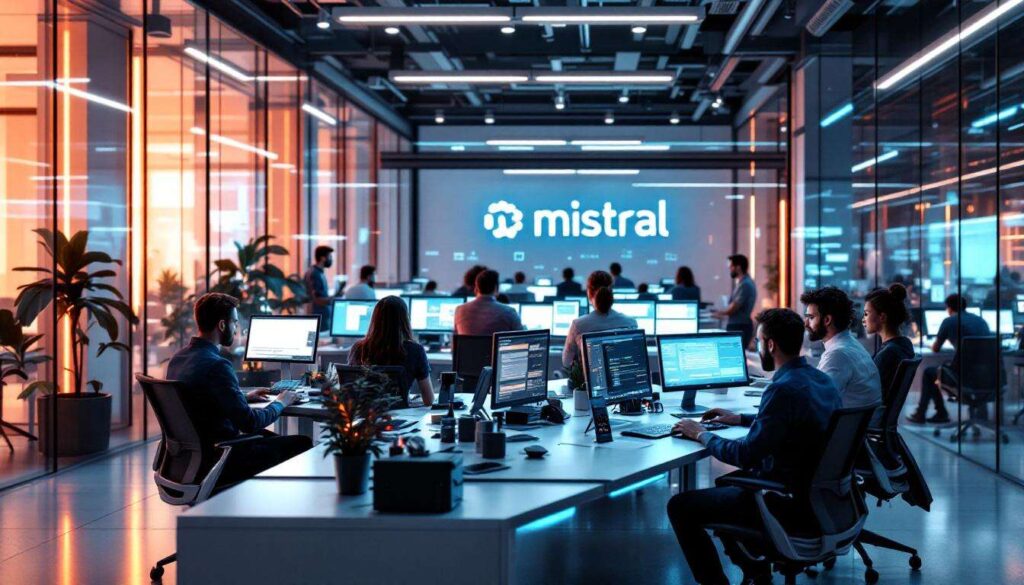
In the high-stakes arena of artificial intelligence, where behemoths like OpenAI and Google have long dictated the terms of engagement, a Parisian upstart has rapidly ascended to challenge the status quo. Mistral AI, now a certified decacorn valued at over six billion dollars, is not merely building another large language model. Instead, it is waging a calculated war on a different front: efficiency. By pioneering models that deliver formidable performance without the colossal computational appetite of its rivals, Mistral is fundamentally altering the AI development paradigm and proving that smarter, not just bigger, is the key to victory.
The rise of Mistral in AI
From Parisian startup to global contender
Founded by former researchers from Google’s DeepMind and Meta, Mistral AI emerged from the vibrant Paris tech scene with a clear and ambitious vision. The company’s trajectory has been nothing short of meteoric. Within months of its inception, it secured one of the largest seed funding rounds in European history, signaling immense investor confidence in its approach. This initial momentum was quickly followed by subsequent funding that propelled its valuation past the ten-billion-dollar mark, earning it the coveted decacorn status. This rapid financial and technical ascent has firmly established Mistral as a critical player on the global stage, representing a powerful European counterweight to American dominance in the AI sector.
Core philosophy and open-source commitment
At the heart of Mistral’s strategy lies a deep-seated commitment to the open-source community. While competitors like OpenAI have progressively moved towards more proprietary, closed-off models, Mistral has embraced transparency. By releasing powerful base models under permissive licenses, the company has empowered a global network of developers and researchers to build upon, scrutinize, and improve its technology. This approach not only accelerates innovation but also builds trust and fosters a collaborative ecosystem. Key releases that cemented this reputation include:
- Mistral 7B: A highly efficient 7-billion-parameter model that outperformed much larger models on a variety of benchmarks upon its release.
- Mixtral 8x7B: An advanced model utilizing a sparse Mixture-of-Experts architecture, offering top-tier performance while only using a fraction of its total parameters for any given inference task.
This dedication to open-source principles is not just ideological; it is a strategic maneuver to drive widespread adoption and create a de facto standard in the developer community.
Forging strategic alliances
A significant catalyst in Mistral’s growth has been its ability to forge key strategic partnerships. Most notably, its collaboration with Microsoft has provided a major distribution channel, making Mistral’s premium models available on the Azure cloud computing platform. This move grants Mistral access to a vast enterprise customer base and places its technology alongside that of its primary competitor, OpenAI, within the same ecosystem. Such alliances provide the necessary scale and credibility to compete directly with established giants, transforming Mistral from a promising startup into a serious enterprise-grade provider. These partnerships have been crucial in validating its technology and business model in the eyes of the market.
Efficiency strategies against competitors
The ‘Mixture of Experts’ (MoE) advantage
Mistral’s primary technological gambit is its sophisticated use of a Mixture of Experts (MoE) architecture. Unlike traditional dense models where the entire network is activated to process a request, an MoE model is composed of numerous smaller, specialized “expert” networks. For any given input, a routing mechanism selects only the most relevant experts to handle the task. This means that a large model like Mixtral 8x7B can possess a vast number of parameters in total but use the computational resources of a much smaller model for each inference. The result is a dramatic increase in speed and a reduction in operational costs, without sacrificing performance. This computational frugality is Mistral’s secret weapon.
Optimizing for size and deployment
The company has demonstrated a consistent focus on creating models that are pound-for-pound champions. The philosophy is to achieve maximum performance from the smallest possible model size. This has profound implications for deployment. Smaller, more efficient models are not confined to massive data centers; they can be run on local hardware, edge devices, or more modest cloud instances. This accessibility broadens the potential user base to include businesses and developers who lack the resources to operate larger, more demanding models from Google or OpenAI. By optimizing for a smaller footprint, Mistral is effectively democratizing access to state-of-the-art AI.
A hybrid open-weight and commercial model
Mistral operates on a clever dual-track strategy. It releases powerful “open-weight” models to the community, building brand loyalty and fostering an ecosystem of innovation. Simultaneously, it develops and offers even more powerful, proprietary models through its API platform, “Le Platform,” and its conversational AI, “Le Chat.” This hybrid approach allows it to capture both ends of the market: the developers and startups who thrive on open-source tools, and the large enterprises that require the performance, reliability, and support of a commercial product. This balance allows it to monetize its most advanced research while still contributing to the broader community.
Comparison with OpenAI and Google
Model performance benchmarks
When stacked against the competition, Mistral’s models consistently demonstrate the success of their efficiency-first approach. While raw benchmark scores can vary, the key takeaway is the performance achieved relative to model size and computational cost. Mistral’s models often match or exceed the capabilities of much larger models from competitors on reasoning and knowledge-based tasks.
| Model | Architecture Type | MMLU Benchmark (Reasoning) | Notes |
|---|---|---|---|
| Mistral Large | Dense Transformer | 81.2% | Mistral’s flagship proprietary model, second only to GPT-4 on this key benchmark. |
| OpenAI GPT-4 | Proprietary (likely MoE) | 86.4% | The current industry leader, but with significantly higher computational requirements. |
| Google Gemini Pro | Dense Transformer | 71.8% | A strong competitor, but outmatched by Mistral’s flagship on this metric. |
| Mixtral 8x7B | Sparse MoE | 70.6% | An open-weight model that competes with commercial offerings like Gemini Pro. |
Business models: open vs. closed
The philosophical and strategic differences between the three companies are stark. OpenAI, once a champion of openness, now operates a largely proprietary model focused on its ChatGPT product and API access. Google integrates its AI, Gemini, deeply into its vast suite of existing products, from search to cloud services. Mistral, in contrast, offers a more flexible path.
- OpenAI: Primarily a closed-source, API-driven business model focused on maximizing performance.
- Google: An ecosystem-driven model where AI enhances existing services and is offered via the Google Cloud Platform.
- Mistral: A hybrid model that leverages open-source releases to build community and a developer base, while monetizing its most advanced models via a commercial API. This strategy grants developers more control and transparency.
Highlighted technological innovations
Advancements in attention mechanisms
Beyond its MoE architecture, Mistral has introduced key technical innovations that enhance its models’ efficiency. One such development is Sliding Window Attention (SWA). In traditional transformer models, the computational cost of attention grows quadratically with the length of the input sequence, making it very expensive to process long documents. SWA allows the model to handle much longer contexts by having each layer attend to a fixed-size window of previous layers, drastically reducing the computational load while maintaining the ability to process extensive information. This makes Mistral’s models particularly adept at tasks involving long-form content analysis.
A pragmatic approach to AI safety
Mistral has also taken a distinct stance on AI safety and content moderation. While competitors often build strict, hard-coded guardrails directly into their models, Mistral advocates for a more modular approach. Its open-weight models are released with minimal baked-in restrictions, and the company instead provides separate tools and guidance for developers to implement their own safety layers tailored to their specific applications. This philosophy champions developer freedom and adaptability, arguing that a one-size-fits-all approach to safety is often too restrictive and culturally biased for a global user base.
Impact on the AI market
Shifting the focus from scale to efficiency
Perhaps Mistral’s most significant impact has been to challenge the prevailing industry narrative that “bigger is always better.” By consistently delivering models that punch far above their weight class, the company has forced the entire market to pay closer attention to performance-per-parameter and performance-per-watt. This shift is critical for the long-term sustainability of AI, as it encourages innovation in model architecture and optimization rather than a brute-force race to build ever-larger, more energy-intensive models. Efficiency is no longer a secondary consideration; it is a primary competitive advantage.
Empowering a new wave of innovation
Mistral’s open-source contributions are fueling a Cambrian explosion of innovation. Startups, independent researchers, and developers around the world are using Mistral’s base models to create new applications, conduct research, and fine-tune specialized models for niche use cases. This democratization of access to cutting-edge AI prevents the technology from being hoarded by a handful of tech giants and ensures a more diverse and competitive market. It lowers the barrier to entry, allowing brilliant ideas to flourish without requiring access to a billion-dollar data center.
Future outlook for Mistral
Navigating enterprise and regulatory frontiers
Looking ahead, Mistral’s path involves a dual focus on expanding its enterprise offerings and navigating the complex global regulatory landscape. The partnership with Microsoft is a clear signal of its enterprise ambitions, where reliability, customization, and data privacy are paramount. As a European company, Mistral is also uniquely positioned to influence and adapt to regulations like the EU AI Act. Its open and transparent approach could serve as a model for responsible AI development that balances innovation with public trust, potentially giving it an edge in compliance-heavy industries.
The ongoing pursuit of efficient intelligence
Mistral’s core mission will undoubtedly remain centered on the pursuit of more efficient forms of intelligence. Future research will likely explore even more advanced architectures that can deliver greater capabilities with fewer computational resources. This relentless focus on optimization is not just a business strategy but a scientific endeavor to understand how to build truly intelligent systems in a sustainable and scalable way. As the AI race continues, Mistral’s pragmatic and efficient approach may prove to be the most enduring path toward more advanced artificial intelligence.
Mistral AI has successfully carved out a formidable position by refusing to play the same game as its larger rivals. Its strategic focus on computational efficiency, coupled with a savvy blend of open-source community building and high-performance commercial products, presents a potent challenge to the established order. This approach is not only reshaping the competitive landscape but is also fostering a more accessible, sustainable, and diversified future for the entire field of artificial intelligence.