

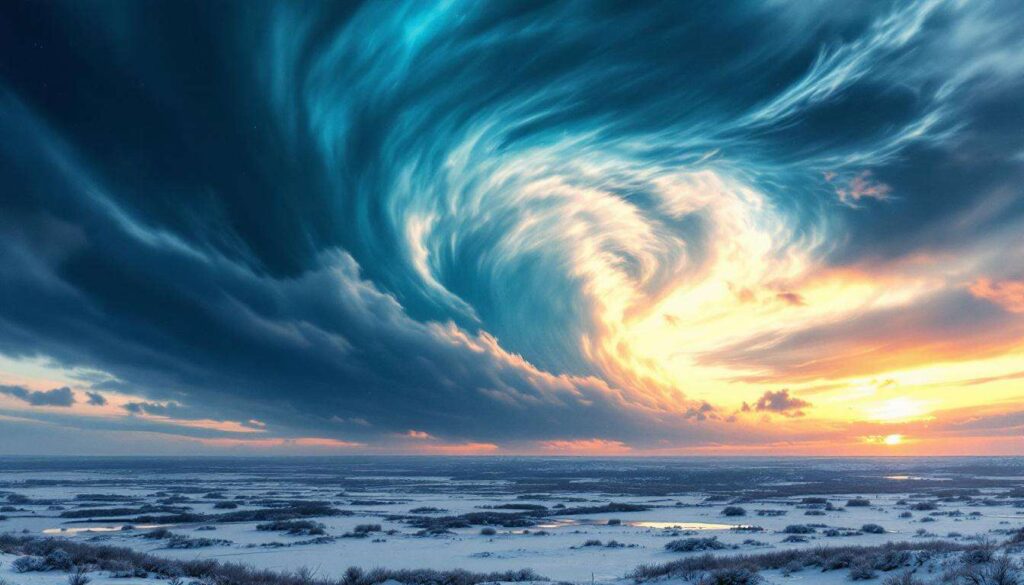
High above the silent, frozen landscapes of the North Pole, a vast circulation of frigid air typically spins in a stable, predictable pattern throughout the winter. This feature, known as the stratospheric polar vortex, acts as a gatekeeper, locking the coldest air on the planet within the Arctic circle. Recently, however, this atmospheric sentinel has faltered. An unusual and powerful disruption in early winter has sent shockwaves through the atmosphere, raising urgent questions among scientists about its causes and what it portends for weather across the northern hemisphere in the coming weeks and months.
Impact of the polar vortex on winter temperatures
Understanding the polar vortex
The polar vortex is not a storm, but rather a large-scale, persistent area of low pressure and cold air that rotates over the poles. There are actually two vortices: one in the troposphere, the layer of the atmosphere where our weather occurs, and a second, more influential one high above it in the stratosphere. When the stratospheric vortex is strong and stable, it spins rapidly and maintains a tight, circular shape. This configuration effectively pens the coldest Arctic air in its polar home, leading to relatively mild winter conditions across much of North America and Eurasia. The jet stream, a fast-moving river of air that steers weather systems, tends to flow in a more direct west-to-east path under these conditions.
When the vortex weakens: Arctic outbreaks
A disruption event, however, fundamentally changes this dynamic. When the stratospheric vortex weakens, it can become elongated, split into two or more smaller “sister” vortices, or even reverse its direction of rotation. This breakdown allows the dense, frigid air it normally contains to spill southward. This process is not instantaneous; the effects from the stratosphere can take days or weeks to propagate down to the surface. The result is often a series of severe cold air outbreaks that plunge deep into the mid-latitudes, bringing with them dangerously low temperatures, heavy snowfall, and icy conditions. The jet stream becomes wavier and more amplified, creating persistent weather patterns that can last for weeks.
| Vortex State | Typical Jet Stream Behavior | Mid-Latitude Winter Temperature Anomaly |
|---|---|---|
| Strong and Stable | Zonal (West to East) Flow | Warmer than average |
| Weak and Disrupted | Meridional (Wavy) Flow | Colder than average |
The stark difference in surface weather highlights the critical role this high-altitude phenomenon plays in our daily lives, turning what should be a predictable winter into a period of extreme and hazardous conditions. The underlying reasons for such a dramatic atmospheric shift are complex and are the subject of intense scientific investigation.
Causes of an unusual polar vortex disruption
The power of Sudden Stratospheric Warmings
The primary trigger for a major polar vortex disruption is an event known as a Sudden Stratospheric Warming (SSW). Despite the name, this phenomenon results in colder weather at the surface. An SSW is a dramatic event where temperatures in the polar stratosphere, about 30 kilometers above the surface, can rise by as much as 50°C (90°F) in just a few days. This rapid injection of heat severely weakens or reverses the west-to-east winds of the polar vortex, causing it to break down. The December event was particularly unusual due to its timing and intensity, occurring earlier in the season than is typical for major warmings.
Planetary waves: The atmospheric catalyst
Sudden Stratospheric Warmings are not random. They are caused by the propagation of large-scale atmospheric waves, known as “planetary waves” or Rossby waves. These waves are a natural feature of the Earth’s atmosphere, generated by factors like airflow over major mountain ranges (such as the Rockies and the Himalayas) and the temperature contrast between land and oceans. Under certain conditions, these waves can travel upward from the troposphere into the stratosphere. When they break, much like ocean waves on a beach, they release a tremendous amount of energy. This process works to:
- Slow the westerly winds of the polar vortex.
- Warm the polar stratosphere by compressing the air.
- Displace the vortex from its typical position over the pole.
Think of it as a powerful punch from below that knocks the spinning top of the polar vortex off its axis. This transfer of energy from the lower atmosphere is the fundamental mechanism that initiates the entire chain of events, ultimately leading to profound changes in global weather patterns.
Consequences on the global climate
The Arctic amplification connection
A key question facing climatologists is whether these polar vortex disruptions are becoming more frequent or intense due to climate change. One leading hypothesis centers on the concept of Arctic amplification. The Arctic is warming at a rate nearly four times faster than the rest of the planet. This rapid warming reduces the temperature difference between the pole and the equator, which could potentially weaken the jet stream and make it more susceptible to developing the large waves that can trigger an SSW. While the link is an area of active research and debate, a warming Arctic could be creating conditions more favorable for these types of disruptive winter events.
Global ripple effects
The impacts of a disrupted polar vortex are not confined to the regions experiencing the cold outbreaks. The entire global circulation system is interconnected. A wavier jet stream over North America can lead to downstream effects, altering storm tracks over the Atlantic and influencing weather patterns in Europe. For example, while one region is locked in a deep freeze, another might experience unusually mild and wet conditions. This atmospheric reshuffling can also impact other major climate drivers, such as the North Atlantic Oscillation (NAO), further complicating weather patterns across the hemisphere for weeks or even months following the initial stratospheric event.
This interconnectedness poses a significant problem not only for the public but also for the scientists tasked with predicting these complex atmospheric shifts.
Effects on weather forecasting
Stretching the limits of predictability
Forecasting the onset and, more importantly, the surface impacts of a polar vortex disruption is one of the greatest challenges in modern meteorology. While models are now quite skilled at predicting the Sudden Stratospheric Warming itself up to two weeks in advance, determining exactly where and when the resulting cold air will surge is much more difficult. The chaotic nature of the atmosphere means that small errors in the initial model conditions can grow into massive forecast discrepancies over time. The lag between the stratospheric event and the surface response gives forecasters a window of opportunity, but the signal can be noisy and difficult to interpret with certainty.
A focus on subseasonal forecasting
These events have spurred significant investment in improving “subseasonal-to-seasonal” (S2S) forecasts, which cover the timescale from two weeks to a few months out. Improving these forecasts requires a better understanding of the coupling between the stratosphere and the troposphere. Key areas of research include:
- Enhancing observational networks, particularly in the Arctic and high up in the stratosphere.
- Refining the physics within weather and climate models to better simulate wave propagation.
- Using advanced statistical methods and artificial intelligence to identify precursors to SSWs.
Success in this field would provide invaluable lead time for governments, energy sectors, and transportation authorities to prepare for prolonged periods of extreme winter weather, a sentiment echoed by experts across the discipline.
Expert reactions to this phenomenon
A complex scientific puzzle
Atmospheric scientists have been watching this particular December event with intense interest. There is broad consensus on the physical mechanics of the SSW that triggered the disruption. However, the conversation becomes more nuanced when discussing its relationship to long-term climate change. Some experts emphasize that such events are a form of natural variability and have occurred in the past, cautioning against attributing any single event directly to global warming. Others argue that the changing state of the Arctic is undeniably “loading the dice,” making conditions more favorable for the amplification of planetary waves that can lead to these disruptions.
Comparing scientific perspectives
The ongoing scientific discourse reflects the complexity of the Earth’s climate system. Different research groups often focus on distinct aspects of the problem, leading to varied but complementary insights.
| Area of Focus | Key Expert Viewpoint | Implication |
|---|---|---|
| Stratospheric Dynamics | Focuses on the internal, natural variability of the stratosphere and its powerful influence on surface weather. | Predictability hinges on better modeling of high-altitude atmospheric processes. |
| Arctic-Mid-Latitude Linkages | Argues that sea ice loss and Arctic warming are altering planetary wave patterns, increasing the likelihood of SSWs. | Future winters may become more volatile as the Arctic continues to warm. |
| Historical Climatology | Analyzes past records to place current events in a long-term context, highlighting previous periods of vortex instability. | Caution is needed before declaring modern events as entirely unprecedented. |
This healthy debate drives the science forward, pushing researchers to refine their models and theories. Regardless of the precise role of climate change, the immediate reality is that society must be ready to handle the consequences of a more volatile and unpredictable winter climate.
Future prospects and adaptation strategies
Building resilience for volatile winters
The increasing potential for severe winter disruptions means that simply reacting to extreme weather is no longer sufficient. Proactive adaptation is essential. For critical infrastructure, this means reinforcing power grids to withstand ice storms and sudden demand surges. Transportation departments may need to budget for more frequent and intense snow and ice removal operations. Furthermore, public health systems must have plans in place to protect vulnerable populations, such as the elderly and homeless, from prolonged periods of life-threatening cold. The economic costs of inaction, from supply chain disruptions to energy price shocks, are far greater than the investment in resilience.
Public awareness and preparedness
On an individual and community level, awareness is the first line of defense. Understanding that a “wobbly” polar vortex can lead to sudden and severe weather shifts encourages better preparation. This includes practical steps like winterizing homes to improve energy efficiency, preparing emergency kits for vehicles and residences, and staying informed through reliable weather sources. Community-led initiatives, such as establishing warming centers and checking on at-risk neighbors, can significantly mitigate the human impact of these extreme cold events. Ultimately, adapting to this aspect of our changing climate requires a concerted effort, from international scientific collaboration down to household preparedness.
This polar vortex disruption serves as a powerful reminder of the intricate and sometimes violent connections that govern our planet’s climate. It underscores the profound impact that distant atmospheric events can have on our daily lives, highlighting the complex challenges of forecasting and adapting to a world where weather patterns are becoming increasingly extreme and unpredictable.