



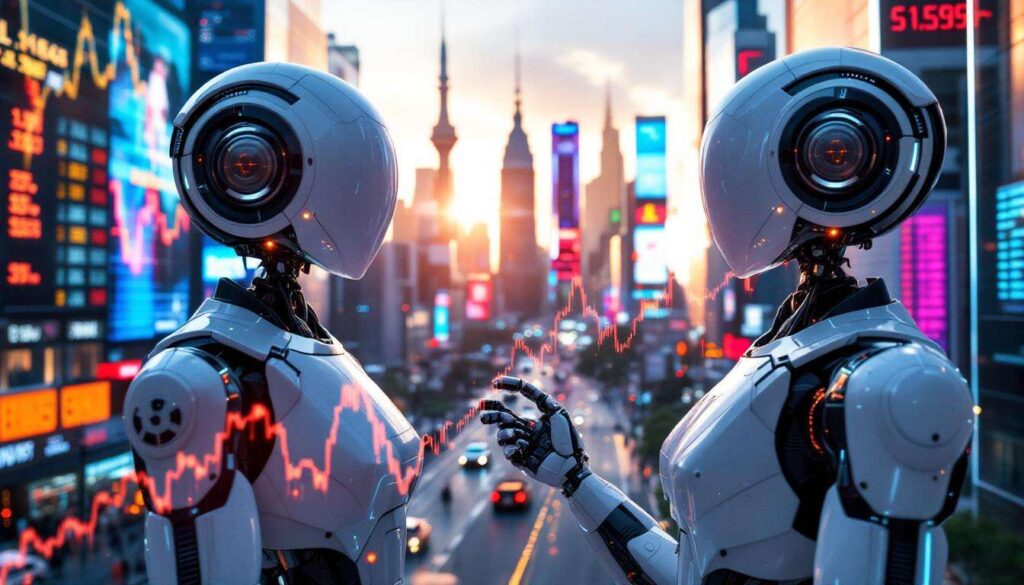
Observe the burgeoning field of humanoid robotics, where staggering valuations and futuristic demonstrations dominate headlines. Tech giants and venture capitalists are pouring billions into startups promising a new era of automated labor. Yet, beneath the surface of this technological optimism, a growing chorus of financial analysts and industry veterans is sounding an alarm. They see not a revolution, but the classic hallmarks of a speculative bubble, one that could leave a trail of financial ruin in its wake. The narrative is compelling, the prototypes are impressive, but the fundamental question remains: is this the dawn of a new economy or a high-stakes gamble built on hype and hope ?
The craze for humanoid robots: a dangerous fad ?
A sudden and intense media focus
In recent months, the public consciousness has been saturated with images of humanoid robots performing tasks once thought exclusive to humans. Companies like Tesla with its Optimus and Figure AI with its Figure 01 have orchestrated high-profile demonstrations showcasing robots making coffee, folding laundry, or working on an assembly line. This media blitz has created a powerful narrative of imminent technological disruption, fueling both public fascination and investor excitement. The appeal is undeniable: a machine in our own image, capable of seamlessly integrating into our world. However, this carefully curated image often masks the significant limitations of the current technology.
Separating demonstration from deployment
It is crucial to distinguish between a controlled demonstration and real-world, autonomous capability. Many of the impressive videos circulating are the result of teleoperation, where a human operator is controlling the robot remotely, or heavily scripted routines that fail under slightly different conditions. The path from a five-minute demo to a reliable, scalable product is incredibly long and fraught with challenges. The current frenzy often overlooks these realities, focusing instead on a future that is, according to many experts, still decades away. This disconnect between perception and reality is a classic ingredient for speculative manias.
This widespread enthusiasm, fueled by selective demonstrations, has attracted a tidal wave of investment, raising critical questions about the valuation of these nascent companies and the sustainability of this financial momentum.
Massive investment: risk or opportunity ?
The flood of venture capital
The financial figures associated with the humanoid robotics sector are staggering for an industry that has yet to deliver a commercially viable, mass-market product. Startups with little more than a promising prototype are achieving billion-dollar valuations. This influx of cash is driven by a potent mix of technological optimism and a palpable fear of missing out (FOMO) among investors. The belief is that the first company to crack the code of general-purpose humanoid robotics will dominate a market worth trillions. This potential for an exponential return on investment justifies, in the eyes of venture capitalists, the enormous risks involved.
Valuations disconnected from revenue
A closer look at the numbers reveals a potential disconnect from market fundamentals. These companies are being valued not on their current revenue or profits, which are often non-existent, but on their projected future dominance. This is a high-risk strategy that relies entirely on the successful execution of an unproven technological roadmap. The table below illustrates the scale of recent investments against the backdrop of a pre-commercialization phase.
| Company | Recent Funding Round | Reported Valuation | Key Investors |
|---|---|---|---|
| Figure AI | $675 million | $2.6 billion | Microsoft, OpenAI, Nvidia, Jeff Bezos |
| 1X Technologies | $100 million | Undisclosed | OpenAI, Tiger Global |
| Sanctuary AI | $30 million | Undisclosed | Bell, Magna, Verizon Ventures |
This massive flow of capital is predicated on the belief that the incredible technological promises being made are not just achievable, but imminent.
Technological promises that captivate
The vision of a ubiquitous robotic workforce
The sales pitch for humanoid robots is undeniably powerful. Proponents envision a future where these machines handle the “dull, dirty, and dangerous” jobs that humans no longer want or are unable to do. They promise to solve labor shortages in key sectors like manufacturing, logistics, elder care, and agriculture. The potential benefits are immense: increased productivity, enhanced safety in hazardous environments, and the liberation of human potential for more creative and strategic endeavors. This vision of a world seamlessly augmented by robotic labor is what captivates both investors and the public imagination, painting a picture of a utopian future powered by artificial intelligence and engineering.
The immense technical hurdles remaining
While the vision is compelling, the reality is that the core technology is still in its infancy. Creating a truly autonomous, general-purpose humanoid robot is one of the most complex engineering challenges ever undertaken. Experts point to a long list of fundamental problems that remain unsolved, each representing a potential point of failure for the entire enterprise. These challenges include:
- Energy efficiency: Current battery technology severely limits the operational time of a complex humanoid robot, with most prototypes lasting only a few hours.
- Dynamic balancing and locomotion: While walking on two legs has improved, navigating cluttered, unpredictable human environments remains an unsolved problem.
- Fine motor skills and dexterity: Replicating the sensitivity and adaptability of the human hand is extraordinarily difficult, limiting the range of tasks a robot can perform.
- General artificial intelligence: The robot’s “brain” must be able to understand abstract commands, reason about its environment, and adapt to novel situations, a feat far beyond current AI capabilities.
- Cost of manufacturing: The components required for these robots are extremely expensive, making mass-market adoption economically unfeasible at present.
The tendency to invest heavily in a captivating technological vision while underestimating the fundamental hurdles is not a new phenomenon; it echoes the patterns of past financial bubbles that have cautionary tales to tell.
Historical precedents of financial bubbles
Echoes of the dot-com bubble
The current excitement surrounding humanoid robots bears a striking resemblance to the dot-com mania of the late 1990s. During that period, investors poured capital into internet-based companies with no clear path to profitability, driven by the belief that the “new economy” rendered traditional valuation metrics obsolete. Companies were valued on “eyeballs” and “market share” rather than revenue or earnings. Similarly, robotics companies today are being valued on the perceived size of their future market and the elegance of their demonstrations. The narrative is the same: a revolutionary technology that will change everything. The risk is also the same: when the hype outpaces reality, the bubble inevitably bursts, wiping out immense amounts of capital.
A recurring pattern of technological speculation
History is littered with examples of promising technologies that sparked speculative bubbles long before they were commercially viable. From the railway mania of the 1840s to the more recent crazes for 3D printing and early-stage autonomous driving, the pattern is consistent. A breakthrough technology captures the public’s imagination, leading to irrational exuberance and a speculative investment frenzy. While the underlying technology may eventually become transformative, the initial wave of investment often ends in a painful market correction.
| Bubble | Core Technology | Key Narrative | Outcome |
|---|---|---|---|
| Dot-com Bubble (1997-2001) | The Internet | “The new economy changes everything” | Massive crash, but the internet eventually thrived |
| 3D Printing Craze (2012-2014) | Additive Manufacturing | “A 3D printer in every home” | Stock collapse, industry consolidation |
| Humanoid Robots (Present) | AI and Robotics | “Solving labor shortages with AI” | To be determined |
These historical precedents amplify the weight of the warnings now being issued by seasoned financial experts and robotics industry insiders.
Experts’ warnings that should not be ignored
A chorus of caution from financial analysts
A growing number of financial analysts are urging extreme caution. They argue that the humanoid robotics sector is exhibiting all the classic signs of a bubble: sky-high valuations untethered from fundamentals, a market driven by narrative rather than results, and a rush of retail and institutional investors fearful of being left behind. The core of their argument is that the timeline to profitability is being grossly underestimated. They warn that it could take more than a decade for these companies to generate significant revenue, a period during which many will likely burn through their cash reserves and fail, leading to massive losses for their backers.
Sober perspectives from the robotics community
Perhaps the most compelling warnings come from within the field of robotics itself. Many seasoned roboticists and AI researchers, while optimistic about the long-term potential, are deeply skeptical of the current hype cycle. They understand the profound difficulty of the problems that need to be solved. These experts often point out that progress in the physical world of hardware and mechanics is far slower and more expensive than progress in the digital world of software. Their primary concerns include:
- The oversimplification of complex tasks in public demonstrations.
- The underestimation of safety and reliability challenges for machines operating near humans.
- The immense gap between current AI models and the general-purpose reasoning needed for true autonomy.
- The risk that a market crash could trigger a “robotics winter,” cutting funding for legitimate, long-term research.
Ignoring these expert warnings and continuing on the current trajectory of speculative investment could have severe consequences not just for the investors involved, but for the entire global economy.
The potential impact on the global economy
The promise of a productivity boom
In the most optimistic scenario, the current wave of investment successfully accelerates technological development, and humanoid robots deliver on their promises. If these machines can be produced affordably and deployed at scale, they could unleash a productivity revolution unlike any seen since the industrial age. By automating a vast range of physical tasks, they could boost economic output, mitigate the effects of aging populations and shrinking workforces, and drive down the cost of goods and services. This would represent a fundamental positive shift for the global economy, validating the high-risk bets being made today.
The risk of a devastating market correction
Conversely, if the technology fails to mature as quickly as investors expect, the bubble will burst. The consequences could be severe. A collapse in the valuations of robotics companies would trigger a fire sale of assets and widespread bankruptcies. Billions of dollars of invested capital would be wiped out, impacting venture capital funds, corporate investors, and pension funds. Such a significant financial shock could have a chilling effect on investment across the entire tech sector, leading to a “tech winter” that stifles innovation. If the bubble grows large enough, its collapse could even contribute to a broader economic recession, as confidence evaporates and credit markets tighten. The fallout would be a stark reminder that even the most compelling technological visions are not immune to the laws of financial gravity.
Examine the evidence presented. The allure of a robotic future is powerful, driving unprecedented investment into a nascent industry. Yet, this optimism is shadowed by the stark lessons of history and the sober warnings of experts who see a dangerous disconnect between hype and reality. The path forward requires a critical assessment, balancing the transformative potential of the technology against the very real risk of a speculative collapse that could set the field back for years.