



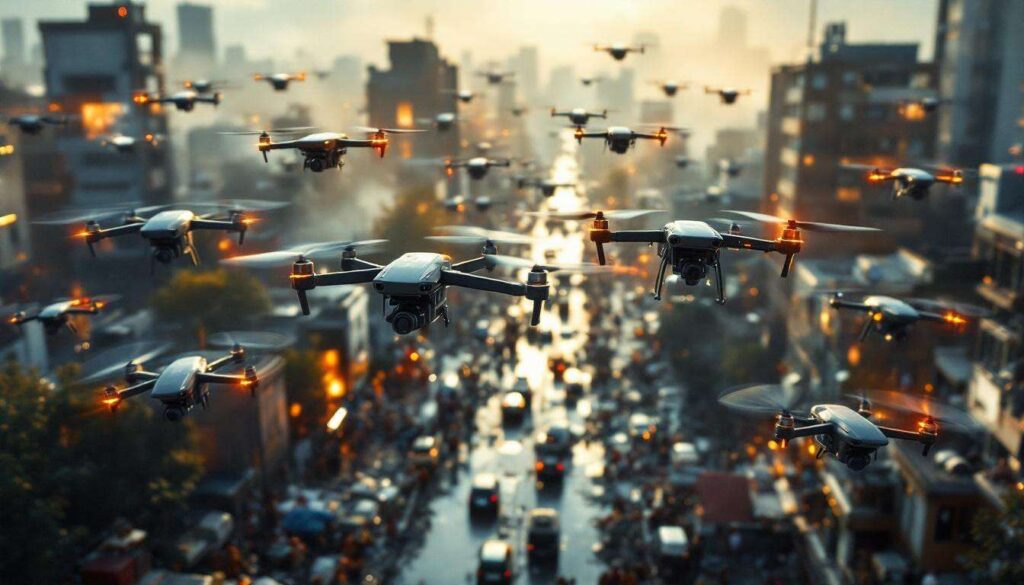
In the immediate aftermath of a natural disaster, the first casualty is often communication. When earthquakes topple cell towers, hurricanes flood infrastructure, and wildfires melt fiber optic cables, first responders are plunged into an information blackout. This critical communication gap can mean the difference between life and death. Now, a concept once confined to the esoteric realm of theoretical physics, quantum entanglement, is emerging as a potential solution, promising to create unjammable, infrastructure-independent communication networks for disaster relief drones.
Understanding quantum entanglement
The essence of a quantum connection
At its core, quantum entanglement is a phenomenon where two or more particles become linked in such a way that their fates are intertwined, regardless of the distance separating them. Albert Einstein famously called it “spooky action at a distance.” Imagine you have two coins that are quantumly entangled. If you flip one and it lands on heads, you instantly know the other, even if it’s miles away, will land on tails. The state of one particle instantaneously influences the state of the other. This isn’t communication in the traditional sense of sending data, but rather a way of sharing a correlated state, which can be used to establish an incredibly secure key or channel.
From theory to communication tool
Harnessing this property for communication involves distributing entangled particles, such as photons, to two different locations. By measuring the properties of their respective particles, users at each end can generate a shared, secret random key. This key can then be used to encrypt data sent over a conventional channel, like a laser beam. The beauty of this system, known as quantum key distribution (QKD), is its inherent security. Any attempt to eavesdrop on the quantum channel would disturb the entangled state, immediately alerting the users to the presence of an intruder. For disaster relief, this means a communication link that is not only secure but also fundamentally private.
This foundational principle of instant correlation and inherent security is what makes quantum entanglement a revolutionary candidate for solving communication challenges in environments where traditional systems fail. With this understanding, we can better appreciate the current role of drones in humanitarian efforts and where this new technology might fit in.
The role of drones in humanitarian aid
Eyes in the sky for search and rescue
Unmanned aerial vehicles (UAVs), or drones, have become indispensable tools in modern humanitarian aid. Their primary function is to provide rapid situational awareness. Equipped with high-resolution cameras, thermal imaging sensors, and LiDAR, they can survey vast and inaccessible areas quickly. First responders can use this aerial data to:
- Map the extent of damage to infrastructure like roads and bridges.
- Identify safe routes for rescue teams to access affected populations.
- Locate survivors in collapsed buildings or remote landscapes using thermal signatures.
- Assess the risk of secondary disasters, such as landslides or dam breaches.
This bird’s-eye view is critical during the golden hours following a disaster, when information is scarce and time is of the essence. A single drone can often accomplish in minutes what would take a ground team hours or days to achieve.
Delivering hope from above
Beyond reconnaissance, drones are increasingly used for direct intervention. They can be outfitted to carry and deliver small, critical payloads to stranded individuals or isolated communities. These deliveries often include life-saving supplies such as:
- Medical kits and vaccines.
- Food and clean water.
- Temporary communication devices like satellite phones.
The ability to bypass impassable terrain makes drones a vital logistical asset. However, the effectiveness of both reconnaissance and delivery missions hinges on a drone’s ability to communicate reliably with its operators and with other drones.
| Application | Primary Function | Key Benefit |
|---|---|---|
| Reconnaissance & Mapping | Data collection and situational awareness | Rapid assessment of large, inaccessible areas |
| Search & Rescue | Locating survivors using thermal/optical sensors | Reduces search time and risk to human rescuers |
| Supply Delivery | Transporting small, critical payloads | Bypasses damaged ground infrastructure |
| Communication Relay | Acting as a temporary mobile cell tower | Restores localized connectivity for survivors and responders |
While these capabilities are transformative, their full potential is often curtailed by the very problem they are trying to solve: the collapse of the communication networks they depend on to operate and transmit data.
The limitations of traditional networks
Infrastructure vulnerability
Modern communication is built upon a vast and complex physical infrastructure. Cellular networks rely on towers, fiber optic cables run underground, and even satellite communications require ground stations. In a major disaster, this infrastructure is exceedingly fragile. Earthquakes can shatter fiber lines, hurricanes can level cell towers, and power grids that support them can fail completely. When these systems go down, they create vast communication deserts, isolating both victims and the rescue teams trying to reach them. The command and control of a fleet of drones, which require constant data links for video feeds and flight instructions, becomes nearly impossible.
Congestion and interference
Even when parts of a network survive, they are often overwhelmed. In the aftermath of an incident, a massive surge in traffic from civilians trying to contact loved ones and responders coordinating their efforts can cripple the remaining bandwidth. This congestion makes it difficult to transmit the high-volume data streams, like real-time video, that are essential for effective drone operations. Furthermore, the chaotic environment of a disaster zone, with debris and atmospheric conditions, can cause signal interference and degradation, leading to dropped connections and lost data. These networks are simply not designed for the extreme conditions and demands of a large-scale emergency.
| Network Type | Infrastructure Dependency | Susceptibility to Congestion | Security Level |
|---|---|---|---|
| Cellular (4G/5G) | High (Towers, Power Grid) | Very High | Moderate |
| Satellite | Medium (Ground Stations, Clear Sky) | High | Moderate to High |
| Wi-Fi/Radio | Low (Local Routers/Repeaters) | High | Low to Moderate |
| Quantum (Proposed) | None (Direct Drone-to-Drone) | None | Extremely High |
This fundamental fragility of our current communication systems highlights the urgent need for a new paradigm, one that can function independently of any ground-based hardware and provide a secure, reliable link when it is needed most. This is precisely the gap that quantum entanglement promises to fill.
Quantum entanglement in aid of rescue operations
Forging an unbreakable communication chain
Imagine a swarm of drones arriving at a disaster zone. Instead of trying to connect to a damaged cell tower or a congested satellite link, each drone is equipped with a source of entangled photons. One drone can send one half of an entangled pair to another drone via a laser beam, while keeping the other half. By doing this in a chain, they establish a peer-to-peer network that requires no external infrastructure. The communication link exists purely between the drones themselves. This creates a resilient, self-healing mesh network. If one drone is lost, the others can instantly reroute the quantum link to maintain the integrity of the network, ensuring that the flow of information is never broken.
Secure, real-time data sharing
The data shared across this quantum-secured network would be virtually untappable. For humanitarian missions, this ensures that sensitive information, such as the location of vulnerable survivors or the strategic plans of rescue teams, cannot be intercepted by malicious actors. More importantly, the instant correlation of entangled particles allows for perfect synchronization and data sharing among the drones. A drone identifying a survivor on the ground could share that precise location data with a nearby delivery drone instantaneously and securely, allowing for a coordinated and immediate response. This eliminates the lag and potential for data corruption inherent in traditional radio-frequency communications, enabling a swarm of drones to act as a single, cohesive intelligent unit.
The application of this technology would fundamentally alter the dynamics of emergency response, leading to a future where interventions are faster, more coordinated, and significantly more effective.
Prospects for improving emergency interventions
The intelligent drone swarm
With a quantum communication backbone, a group of drones can be transformed from a collection of individual units into a true swarm intelligence. This allows for unprecedented levels of collaboration. For example, a swarm could perform a complex, distributed search of a disaster area.
- Mapping drones would create a high-resolution 3D map of the terrain.
- Search drones would use this map to autonomously divide the area, with each drone covering a specific sector.
- Upon finding a point of interest, a search drone could instantly summon specialized drones, such as one equipped with a medical payload or another with a loudspeaker to communicate with a survivor.
This level of seamless coordination, powered by instantaneous and secure communication, would drastically reduce the time it takes to locate and assist those in need. The entire swarm operates as a single, adaptive organism, reacting to the dynamic environment of the disaster zone in real time.
Enhanced situational awareness for command centers
The data collected by the drone swarm, from live video feeds to thermal imagery and structural integrity assessments, could be streamed back to a mobile command center through a secure quantum link. This provides decision-makers with a complete and unalterable operational picture. They would see what the drones see, as they see it, without fear of the data being jammed, intercepted, or manipulated. This high-fidelity, real-time intelligence allows for more effective resource allocation, better risk assessment for human rescue teams, and ultimately, a more strategic and successful overall relief effort. The reliability of the data would be guaranteed by the fundamental laws of physics.
While the potential is immense, transforming this futuristic vision into a practical, field-deployable reality involves overcoming significant scientific and engineering hurdles.
Challenges and opportunities of quantum technology
The fragility of the quantum state
The greatest challenge in harnessing quantum entanglement is its delicate nature. The entangled state is easily disturbed by interactions with the environment, a phenomenon known as decoherence. Vibrations, temperature fluctuations, and atmospheric interference can all break the fragile quantum link. Miniaturizing the necessary equipment—photon sources, detectors, and stabilization systems—to fit on a mobile drone while also shielding it from these environmental factors is a monumental engineering task. Maintaining a stable entangled link between two fast-moving drones through a turbulent atmosphere remains a significant scientific frontier.
The path from laboratory to disaster zone
Beyond the technical hurdles, there are practical considerations for deployment. The cost of quantum hardware is currently prohibitive for widespread use. Furthermore, developing the software and protocols to manage a quantum communication network for a dynamic drone swarm is a complex challenge in itself. However, the opportunity is equally vast. Success in this area would not only revolutionize disaster relief but also have profound implications for secure military communications, financial transactions, and the future of the internet.
| Strengths | Weaknesses |
|---|---|
| Unjammable, secure communication | Extreme sensitivity to environment (decoherence) |
| Infrastructure-independent operation | High cost and complexity of hardware |
| Opportunities | Threats |
| Revolutionize disaster response and military comms | Technological immaturity and long development cycle |
| Enable true autonomous swarm intelligence | Competition for resources and funding |
The research and development in this field represent a high-risk, high-reward endeavor, pushing the boundaries of both physics and robotics.
The journey from a “spooky” physical phenomenon to a life-saving tool is a testament to technological ambition. By creating communication networks that are not dependent on vulnerable ground infrastructure, quantum-linked drones could ensure that even in the face of catastrophic failure, the lines of communication remain open. This would empower first responders with the real-time, secure, and resilient data streams they need to coordinate efforts, locate survivors, and deliver aid more effectively. While significant challenges remain, the prospect of using the fundamental laws of the universe to save lives offers a powerful glimpse into the future of humanitarian aid.