

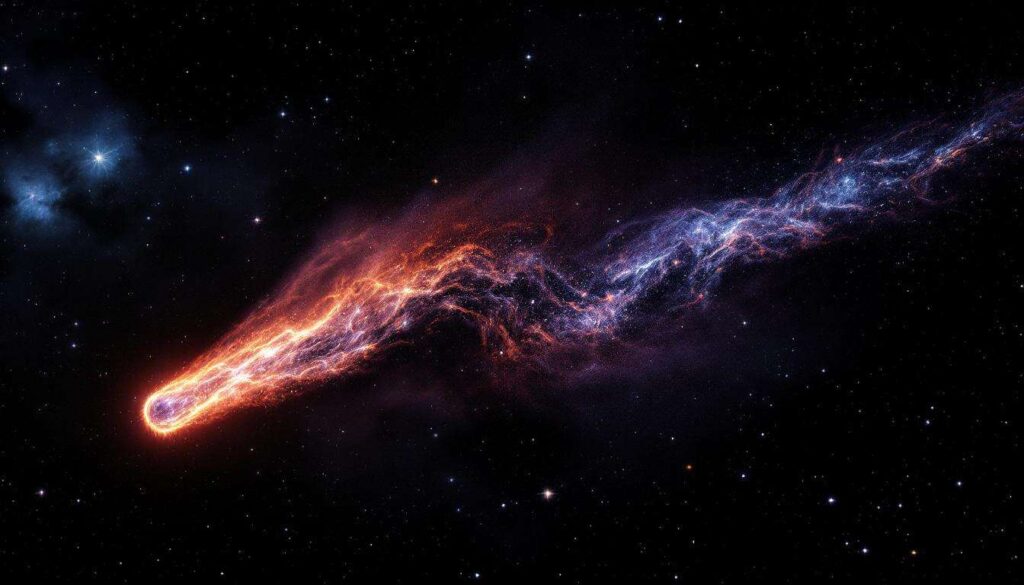
A visitor from another star system has been captured in unprecedented detail by two of humanity’s most capable space observatories. The interstellar comet, designated 3I/ATLAS, was imaged by both the venerable Hubble Space Telescope and the Jupiter-bound JUICE probe, providing astronomers with a rare, multi-perspective view of an object forged in a planetary system far from our own. These observations offer a crucial glimpse into the chemical makeup and physical behavior of a body that has traveled through the vast emptiness of interstellar space for millions of years before its brief passage through our solar neighborhood.
Discovery and origin of comet 3I/ATLAS
Initial detection and naming
Comet 3I/ATLAS was first spotted as a faint, fuzzy smudge by the Asteroid Terrestrial-impact Last Alert System (ATLAS), a robotic astronomical survey based in Hawaii. The system is designed to scan the sky for near-Earth objects, but its wide field of view makes it exceptionally good at finding new comets and asteroids. Upon initial detection, its trajectory was immediately flagged as unusual. Following the naming convention for interstellar objects, it was designated ‘3I’, signifying it as the third confirmed interstellar visitor after 1I/’Oumuamua and 2I/Borisov.
Tracing its interstellar path
Astronomers at the Minor Planet Center and other institutions around the world quickly began calculating the object’s orbit. The data confirmed what the initial observations suggested: the comet was not bound by the sun’s gravity. It was moving at an incredibly high velocity on a pronounced hyperbolic trajectory, a telltale sign that it did not originate from our solar system’s Oort cloud or Kuiper belt. Its path indicated that it had entered our solar system from the direction of the constellation Lyra, traveled on a sweeping arc around the sun, and was now heading back out into the interstellar medium, never to return.
Hypotheses on its home system
Pinpointing the exact star system from which 3I/ATLAS was ejected is a near-impossible task. The journey through the galaxy scrambles its trajectory, and the motion of stars over millions of years makes backtracking its path highly uncertain. However, scientists can speculate on the type of system it may have come from. Its composition, rich in certain volatile ices, suggests it likely formed in the outer regions of a young star system, where a large gas giant planet, similar to our Jupiter, could have gravitationally ejected it into deep space.
This initial discovery and orbital analysis set the stage for a coordinated campaign to study the object with more powerful instruments before it faded from view.
Characteristics observed by the Hubble Telescope
High-resolution imaging
With its keen eye positioned above the blurring effects of Earth’s atmosphere, the Hubble Space Telescope provided the most detailed images of 3I/ATLAS. The pictures revealed a distinct, albeit small, nucleus surrounded by a vast, diffuse cloud of dust and gas known as a coma. Unlike the enigmatic ‘Oumuamua, 3I/ATLAS clearly displayed the classic characteristics of a comet, actively releasing material as it was heated by the sun. Hubble’s observations also detected evidence of minor fragmentation events, with small chunks breaking off the main nucleus, a behavior common in comets but fascinating to witness in an interstellar one.
Spectroscopic analysis
Beyond simple imaging, Hubble’s spectrographs dissected the sunlight reflecting off the comet’s coma, breaking it down into its constituent chemical signatures. This analysis provided a direct measurement of the materials sublimating from the comet’s icy core. The findings were both familiar and exotic. Key components identified include:
- Water (H2O): The primary constituent, confirming its nature as a water-ice body.
- Carbon monoxide (CO): Present in unusually high abundance compared to typical solar system comets.
- Cyanogen (CN): A common cometary molecule.
- Diatomic carbon (C2): Another standard component of cometary comas.
The elevated level of carbon monoxide suggests that 3I/ATLAS may have formed in a particularly cold region of its home planetary system.
Measuring activity and dust production
Hubble’s sustained monitoring allowed astronomers to track the comet’s activity over time. They measured the rate at which dust and gas were being expelled from the nucleus, finding that its output was fluctuating, likely due to the rotation of the nucleus exposing different active regions to sunlight. The data showed a steady production of fine-grained dust, which formed a long, sweeping tail stretching for tens of thousands of kilometers, pushed away from the sun by the pressure of solar radiation.
While Hubble provided a sharp, detailed view from Earth’s orbit, another spacecraft offered a completely different and valuable point of view from much deeper in space.
Details of the images captured by the JUICE probe
A serendipitous encounter
In a stroke of cosmic luck, the European Space Agency’s JUICE (Jupiter Icy Moons Explorer) probe was in the right place at the right time. While on its long cruise phase toward Jupiter, its trajectory brought it to a position that offered a unique side-on view of comet 3I/ATLAS. Mission planners seized the opportunity, reorienting the spacecraft to use its high-resolution Janus optical camera system to capture a series of images. This was an entirely unplanned scientific bonus for the mission.
Unique perspective from deep space
The images from JUICE, while not as sharp as Hubble’s, were scientifically invaluable. By observing the comet from a different angle simultaneously with Hubble, astronomers could build a three-dimensional model of the coma and tail structure. This parallax effect, similar to how our two eyes provide depth perception, allowed for a much better understanding of the distribution of dust and gas around the nucleus. The JUICE data revealed complex streamers and filaments within the comet’s tail that were not as clearly visible from Hubble’s perspective.
Complementary scientific data
The Janus instrument on JUICE was designed to study the geology of Jupiter’s moons, but it proved perfectly capable of cometary science. It captured images in multiple color filters, providing information on the composition and properties of the dust particles in the tail. When combined with Hubble’s spectroscopic data on the gas, this gave scientists a more complete picture of the materials that made up this interstellar traveler, separating the properties of its dust from its gas.
The wealth of data gathered from these two very different observatories has profound implications for our understanding of the universe beyond our sun.
Impact of the observation on modern astronomy
Validating theories of planetary formation
Studying an interstellar comet is like receiving a package from another star. The composition of 3I/ATLAS provides a physical sample of the building blocks of planets from a completely different stellar neighborhood. The high carbon monoxide content, for example, supports theories that suggest planet-forming disks can have vastly different chemical compositions depending on their host star and location within the galaxy. Each such visitor helps astronomers refine their models of how planetary systems form and evolve.
Understanding interstellar object populations
The discovery of a third interstellar object in just a few years suggests that these visitors may be more common than previously thought. This has significant implications for estimating the number of rogue comets and asteroids drifting through the Milky Way. It implies that the process of ejecting planetary building blocks from young solar systems is a robust and frequent phenomenon across the galaxy, seeding interstellar space with these wandering bodies.
Advancements in observational techniques
The successful coordination of observations between the Hubble Space Telescope and the JUICE probe marks a significant operational achievement. It demonstrates a new capability for “target of opportunity” science, where assets across the solar system can be rapidly retasked to study a transient event. This flexible, multi-point approach represents a powerful new paradigm for astronomical research, allowing for a more holistic understanding of dynamic celestial events.
By analyzing 3I/ATLAS in such detail, scientists can now place it in context with its interstellar predecessors.
Comparison with other interstellar comets
1I/’Oumuamua: the first visitor
‘Oumuamua, the first interstellar object detected, remains an enigma. It was a small, reddish, and highly elongated object that showed no visible signs of a coma or tail, which is unusual for a comet. Furthermore, it exhibited a slight non-gravitational acceleration, a push that could not be explained by the sun’s gravity alone. This led to much speculation, from outgassing of unseen volatiles to more exotic theories. 3I/ATLAS, by contrast, behaved exactly as a comet is expected to, making it a much more familiar, though no less important, object.
2I/Borisov: a more familiar comet
The second visitor, 2I/Borisov, was, like 3I/ATLAS, clearly a comet. It had a large, active coma and a prominent tail. Its composition was found to be remarkably similar to that of comets from our own solar system, though with its own distinct chemical fingerprint, including a high abundance of carbon monoxide, a trait it shares with 3I/ATLAS. Borisov provided the first proof that comets from other stars could look and behave much like our own.
A tale of three visitors
The three confirmed interstellar visitors paint a diverse picture of the small bodies that populate the galaxy. Each one has provided a unique piece of the puzzle. A comparison of their key features highlights their differences and similarities.
| Feature | 1I/’Oumuamua | 2I/Borisov | 3I/ATLAS |
|---|---|---|---|
| Object Type | Uncertain (asteroid-like) | Active Comet | Active Comet |
| Observed Coma | No | Yes, extensive | Yes, with fragmentation |
| Key Compositional Note | Unknown | High CO abundance | Very high CO abundance |
| Defining Characteristic | Unusual shape, non-gravitational acceleration | Looked like a typical solar system comet | Observed by two space telescopes simultaneously |
This growing catalog of interstellar objects is shaping the direction of future astronomical surveys and mission concepts.
Implications for future research
The promise of upcoming sky surveys
The next generation of astronomical observatories, most notably the Vera C. Rubin Observatory, is poised to revolutionize the study of interstellar objects. With its massive mirror and camera, the Rubin Observatory will survey the entire visible sky every few nights. It is expected to discover not just a handful, but potentially dozens of interstellar visitors every year. This will transform the field from the study of rare curiosities into a statistical science, allowing astronomers to classify different populations of interstellar objects.
Developing rapid response protocols
The brief and fast-moving nature of these objects means that time is of the essence. The astronomical community is developing more streamlined protocols to quickly trigger follow-up observations with the world’s most powerful telescopes as soon as a promising candidate is identified. The success of the Hubble and JUICE campaign for 3I/ATLAS serves as a model for future rapid response efforts, ensuring that no opportunity is missed to study these fleeting visitors in detail.
The prospect of intercept missions
While challenging, the ultimate goal for many planetary scientists is to send a robotic probe to rendezvous with and study an interstellar object up close. Concepts like the “Comet Interceptor” mission by the European Space Agency are already in development. Such a mission would wait in space for a suitable long-period comet or a newly discovered interstellar object to be found, and then travel to meet it. An intercept mission would provide ground-truth data on the composition and structure of these objects that is impossible to obtain from Earth-based telescopes.
The comprehensive study of 3I/ATLAS, made possible by the combined power of the Hubble and JUICE observatories, has provided a remarkable new data point in our exploration of the galaxy. It confirms the cometary nature of some interstellar visitors and reveals key details about the chemical diversity of other planetary systems. Each new object, from the strange ‘Oumuamua to the more familiar Borisov and ATLAS, adds another chapter to the story of how solar systems form and evolve across the cosmos, hinting at a galaxy teeming with the wandering remnants of planetary creation.