



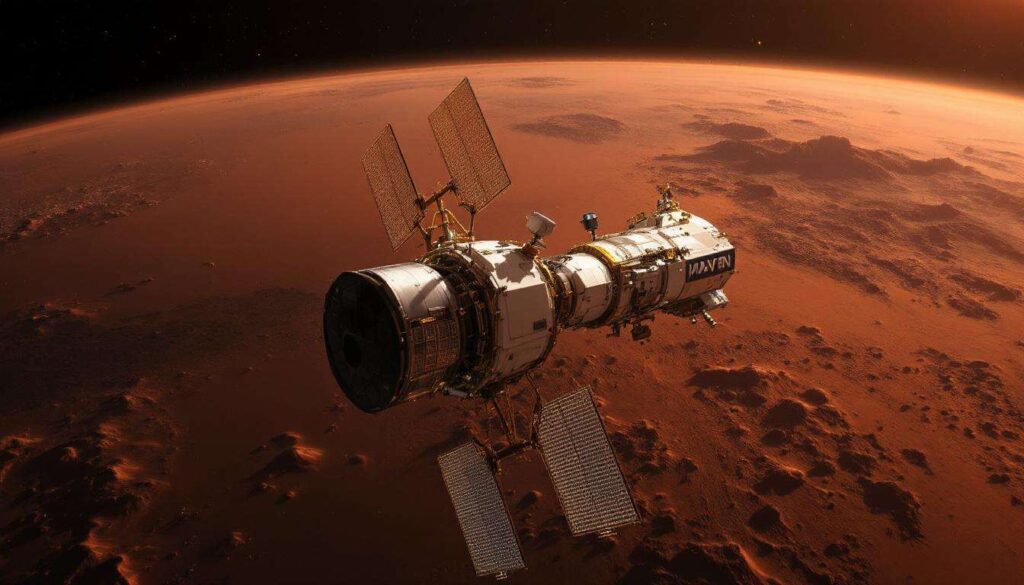
In the silent void surrounding Mars, a critical NASA science orbiter has fallen quiet. The Mars Atmosphere and Volatile EvolutioN (MAVEN) spacecraft, a key asset in studying the red planet’s thin atmosphere, is not responding to commands from Earth. Mission controllers at NASA’s Jet Propulsion Laboratory are facing a dual crisis: not only has the line of communication been severed, but evidence suggests the spacecraft is also tumbling uncontrollably through space, compounding the difficulty of what is already a monumental recovery effort.
The latest news on MAVEN
A sudden and unexpected silence
Contact with the MAVEN orbiter was lost during a routine systems update. The spacecraft was in the process of transitioning from its primary navigation system, which relies on Inertial Measurement Units (IMUs), to a backup system using star trackers. This procedure was planned due to the age and degradation of the IMUs. However, during this critical maneuver, MAVEN ceased all transmissions. The silence was abrupt and total, leaving the mission team with only the last telemetry data to piece together what might have gone wrong. It represents a significant and alarming turn of events for a mission that has been successfully operating since 2014.
The current operational status
As of the last update from mission control, the spacecraft remains unresponsive. Engineers believe it has entered a protective “safe mode”, a pre-programmed state designed to protect the spacecraft during unexpected events by shutting down non-essential systems and awaiting instructions. The problem, however, is that its main antenna is likely not pointed at Earth, making those instructions impossible to receive. The current known status can be summarized as follows:
- Communication: No data is being received from the spacecraft.
- Power: The state of the solar panels and battery charge is unknown, but an uncontrolled tumble would lead to intermittent and insufficient power generation.
- Orientation: The spacecraft is believed to be in an uncontrolled spin or tumble.
- Health: Presumed to be in safe mode, but overall system health is a complete unknown.
MAVEN’s vital mission context
MAVEN’s primary scientific objective is to determine how Mars lost most of its atmosphere and water, transforming it from a world that could have supported life to the cold, arid planet it is today. By studying the interaction of the solar wind with the upper Martian atmosphere, MAVEN provides crucial data for understanding planetary habitability. Furthermore, it serves as a vital communications relay for rovers on the surface, including Curiosity and Perseverance, making its health essential for the broader Mars exploration program.
The sudden loss of this dual-purpose asset creates a significant gap not only in our scientific understanding but also in the operational infrastructure supporting surface missions. The focus now shifts from science gathering to a complex and uncertain recovery operation, a stark reminder of the unforgiving nature of interplanetary exploration.
Communication issues with the spacecraft
The critical failure of the Inertial Measurement Units
At the heart of MAVEN’s current predicament are its Inertial Measurement Units, or IMUs. These devices are essentially sophisticated gyroscopes that allow the spacecraft to know its orientation in space, a fundamental requirement for keeping its solar panels pointed at the sun and, most importantly, its high-gain antenna pointed at Earth. MAVEN is equipped with two IMUs for redundancy, but both have degraded over years of operation in the harsh environment of space. The recent attempt to power them down and switch to an all-stellar navigation mode appears to have been the trigger for the current crisis. Without a reliable IMU, MAVEN is effectively flying blind.
A problematic switch to stellar navigation
The transition to using star trackers for navigation was a planned procedure designed to extend the spacecraft’s life. Star trackers are cameras that identify patterns of stars to determine the spacecraft’s orientation. While effective, this system is slower to provide orientation data than an IMU. The leading theory is that an anomaly occurred during this handoff, causing the onboard computer to become disoriented. This loss of situational awareness would have triggered the spacecraft’s fault protection software, placing it into the unresponsive safe mode. The switch, meant to save the mission, may have inadvertently jeopardized it.
A cascade of technical problems
The sequence of events likely unfolded in a rapid cascade. First, the aging IMUs were powered down. During the subsequent boot-up of the star tracker navigation software, an error may have occurred, preventing the spacecraft from getting a proper fix on its location. The onboard computer, lacking reliable attitude information, would have declared an emergency. This would immediately trigger a safe mode, shutting down science instruments and non-essential systems. The final, and most critical, step in this cascade would be the loss of a stable orientation, preventing the high-gain antenna from locking onto Earth’s signal and leaving mission control in the dark.
This complex chain of failures highlights the intricate dance of hardware and software that must perform flawlessly millions of miles from home. The recovery now depends on breaking this chain by re-establishing some form of basic communication.
MAVEN spinning: an additional challenge
The physics of an uncontrolled rotation
A spinning spacecraft presents a formidable challenge for recovery teams. An uncontrolled tumble means MAVEN is rotating on one or more axes without stabilization. This has two immediate and severe consequences. First, the solar panels cannot maintain a consistent lock on the sun, leading to a critical power shortage as the batteries cannot fully recharge. Second, the high-gain antenna, which needs to be pointed at Earth with pinpoint accuracy, is now sweeping across the sky. It may only face Earth for a few seconds or minutes during each rotation, drastically shrinking the window for communication. It is a truly worst-case scenario for engineers.
Diagnosing the spin from afar
Even without direct telemetry, engineers can infer a spin. By using the powerful dishes of the Deep Space Network (DSN), they can listen for any faint whisper from MAVEN. If they detect a signal, however brief, that appears and disappears at a regular interval, it strongly suggests a rotation. The characteristics of this signal, such as its Doppler shift, can even help them estimate the speed and axis of the spin. This diagnostic work is painstaking and relies on catching fleeting moments when the antenna happens to align with Earth, turning a recovery effort into a search for a needle in a cosmic haystack.
Comparing stable vs. spinning recovery scenarios
The difference between recovering a stable spacecraft in safe mode and a spinning one is immense. The table below illustrates the stark contrast in challenges faced by the mission control team.
| Challenge | Stable Safe Mode | Spinning Safe Mode |
|---|---|---|
| Communication Window | Continuous (if antenna is pointed correctly) | Intermittent and very brief |
| Power Status | Generally stable and positive | Negative power balance, draining batteries |
| Commanding Strategy | Send commands with high confidence of receipt | “Shouting into the void”, timing commands to coincide with brief windows |
| Recovery Complexity | Moderate | Extremely high |
The spin transforms the situation from a software problem into a complex physical and logistical one. Before any software fix can be uploaded, the team must first find a way to arrest the tumble, a task that is nearly impossible without stable communication.
NASA’s efforts to regain control
The Deep Space Network on high alert
NASA’s primary tool in this recovery effort is the Deep Space Network (DSN), a global system of massive radio antennas in California, Spain, and Australia. These powerful dishes are being used to constantly listen for any signal from MAVEN. The DSN is also being used for a technique known as “commanding in the blind”. Engineers are sending repeated command sequences to the spacecraft on the chance that its antenna sweeps past Earth at the exact moment a command is arriving. It is a low-probability strategy, but it is one of the few options available.
A strategy of commanding in the blind
The commands being sent are simple but critical. The primary goal is to instruct the spacecraft’s computer to reboot or to fire its thrusters in a specific sequence designed to counteract the spin. This is exceptionally difficult. The team must first model the spacecraft’s spin and then time the transmission of the command so that it arrives precisely when the antenna is oriented toward Earth. The commands themselves must be robust enough to be understood even if only a fragment is received. The list of priority commands likely includes:
- Forcing a full reboot of the main flight computer.
- Switching to a backup transmitter or receiver.
- Executing a pre-programmed thruster fire sequence to de-spin the spacecraft.
- Powering down all non-essential hardware to conserve battery life.
The long wait for a signal
Patience is the most critical tool for the MAVEN recovery team right now. The process of sending blind commands and listening for a response can take weeks or even months with no guarantee of success. Each command sequence is carefully crafted and transmitted, followed by long listening sessions with the DSN. The team must remain persistent, working through every possible failure scenario and crafting a corresponding command sequence. It is a high-stakes, methodical process where success is measured not in days, but in the faint hope of a single, returned packet of data confirming MAVEN is listening.
This long and arduous process underscores the immense difficulties of operating complex robotic explorers across interplanetary distances, where every problem must be solved with ingenuity and perseverance.
Implications for future missions
Learning hard lessons in redundancy
The MAVEN anomaly serves as a stark reminder that redundancy is not infallible. While the spacecraft had backup IMUs and a secondary navigation system, a failure during the transition between them created a new, unforeseen problem. Future mission designs will need to incorporate not just redundant hardware but also more robust software logic for handling the handoff between primary and backup systems. The goal is to create systems that can fail gracefully, maintaining stability even when a key component goes offline. The key takeaway is that the transition itself is a point of high risk that must be managed with extreme care.
The case for enhanced spacecraft autonomy
This incident strengthens the argument for developing more autonomous spacecraft. A future orbiter equipped with more advanced artificial intelligence might have been able to diagnose the loss of orientation on its own. It could have independently analyzed star tracker data, identified the uncontrolled spin, and calculated the correct thruster firings to stabilize itself without any input from Earth. As humanity pushes farther into the solar system, where communication delays can be hours long, such autonomy will shift from a desirable feature to an absolute necessity for mission survival.
A history of daring space recoveries
While MAVEN’s situation is dire, it is not without precedent. Space exploration is filled with stories of near-disasters and incredible recoveries. The table below places the current effort in historical context.
| Spacecraft | Incident | Outcome |
|---|---|---|
| Apollo 13 | In-flight explosion of an oxygen tank | Successful recovery and safe return of crew |
| SOHO | Lost control and entered a spin, losing power and communication | Successful recovery after several weeks of effort |
| Kepler | Failure of two reaction wheels, ending primary mission | Re-purposed for a new “K2” mission using solar pressure for stability |
These past successes provide a glimmer of hope for MAVEN. They demonstrate that with ingenuity, persistence, and a bit of luck, it is sometimes possible to rescue a mission from the brink of failure.
Significance for the exploration of Mars
The loss of a critical data relay
Beyond its scientific mission, MAVEN plays a crucial operational role as a communications relay for NASA’s surface assets. The Perseverance and Curiosity rovers periodically transmit large volumes of data up to the orbiters, which then relay that information back to Earth at much higher speeds than the rovers could manage on their own. While other orbiters, like the Mars Reconnaissance Orbiter (MRO), can handle this task, the loss of MAVEN reduces redundancy and flexibility. A long-term outage could potentially constrain the amount of data that can be sent home from the surface, impacting the pace of discovery for those missions.
A gap in our understanding of the Martian atmosphere
MAVEN’s primary purpose is to provide a continuous, detailed look at the structure and dynamics of the upper Martian atmosphere and its interaction with the sun. This data is vital for building a complete picture of how Mars evolved from a potentially habitable planet with a thicker atmosphere and liquid water to the barren desert it is today. Losing MAVEN means losing the only spacecraft specifically designed for this task. It creates a significant gap in a dataset that has been collected for nearly a decade, hampering our ability to model the planet’s climate and its history of atmospheric loss.
Setbacks for future human exploration
The data collected by MAVEN is not just of historical scientific interest; it has direct implications for future human missions to Mars. Understanding the upper atmosphere is critical for several aspects of mission planning:
- Aerobraking: Safely using the atmosphere to slow down and enter orbit.
- Radiation shielding: Characterizing the radiation environment that astronauts will be exposed to both in orbit and on the surface.
- Resource utilization: Assessing atmospheric composition for potential use in generating oxygen or fuel.
The loss of MAVEN represents a setback in gathering the long-term data needed to plan these future missions safely and effectively. It is a reminder that our robotic explorers are the essential precursors paving the way for human footsteps on the red planet.
The silence from MAVEN is a tense moment for NASA and the global scientific community. The spacecraft is more than a machine; it is a crucial eye on the Martian atmosphere, a vital link to the surface, and a key tool in planning for the future of exploration. Engineers continue their painstaking efforts to awaken the silent orbiter, hoping to restore a voice that is essential to our ongoing quest to understand Mars. The outcome of this recovery effort will have lasting consequences for science and our journey to the red planet.