

In the vast, cold expanse of our solar system, Jupiter’s moon Europa has long captivated the imagination of scientists and space enthusiasts alike. Beneath its fractured, icy shell lies a saltwater ocean, a prime candidate in the search for extraterrestrial life. Recent analysis of decades-old data has unveiled a startling new feature on this enigmatic world: a sprawling, spider-like scar that suggests a dynamic and ongoing connection between the hidden ocean and the frozen surface, offering tantalizing new clues about the moon’s inner workings.
The strange scar on Europa
A one-of-a-kind formation
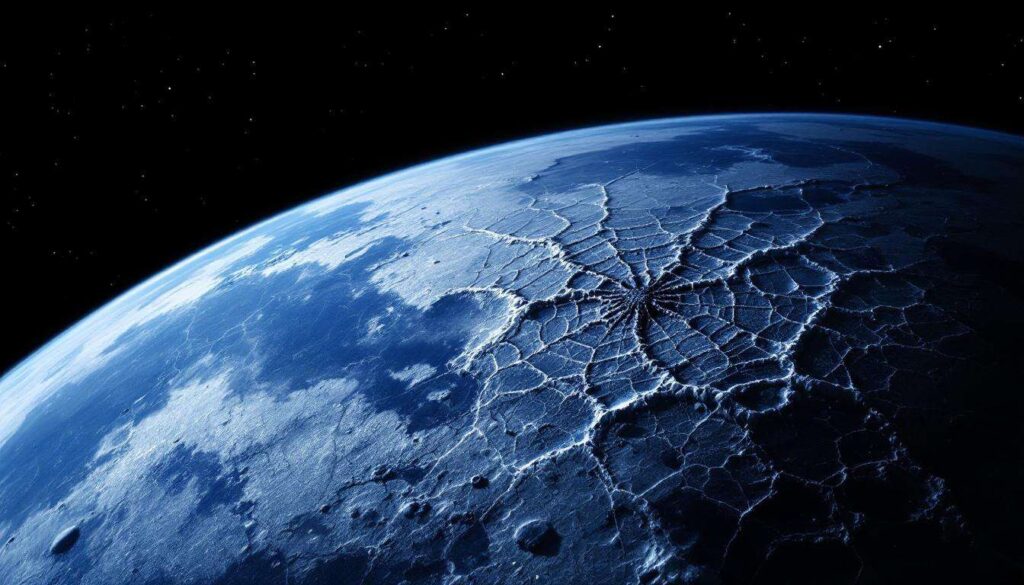
This remarkable geological feature, unofficially named ‘the spider’ by some researchers, is unlike anything else observed on Europa or other icy moons. Located in a region of chaotic terrain, it consists of a central, slightly raised mound surrounded by a web of radiating fractures that stretch for hundreds of kilometers. These cracks, or lineae, slice through the surrounding ice plains, creating a pattern reminiscent of a colossal arachnid etched into the moon’s crust. The sheer scale and unique morphology of the structure immediately set it apart, demanding a scientific explanation beyond the usual geological processes of impacts or tidal stresses.
Distinguishing characteristics
Several key aspects make this formation particularly intriguing. First, the fractures are not random; they emanate from a central point, suggesting a localized, powerful event from below. Second, the central region is not a crater, lacking the characteristic raised rim and bowl shape of an impact event. Instead, it appears to be a dome of uplifted, disrupted ice. Finally, the terrain surrounding the feature is a mix of older, ridged plains and younger, more chaotic blocks of ice, indicating a complex geological history. It is the combination of these elements—radial fractures, a central uplift, and the absence of an impact signature—that makes this scar a compelling puzzle for planetary scientists to solve.
Analysis of satellite images
Revisiting Galileo’s legacy
The images that revealed this feature were not new. They were captured by NASA’s Galileo spacecraft during its mission to Jupiter in the late 1990s. For years, these images were part of a vast archive of data, waiting for fresh eyes and new analytical techniques. Scientists at Stanford University and the University of Arizona recently re-examined this data, applying modern image processing and geological modeling to the old observations. By digitally enhancing the images and creating 3D models of the surface topography, they were able to piece together the structure’s true nature, which had been previously overlooked due to the images’ resolution and the complexity of the surrounding terrain.
Terrestrial analogs as a guide
To understand what could form such a structure on an icy moon, the research team looked for similar patterns on Earth. They found a striking parallel in the ice sheets of Greenland. Here, massive domes of ice are sometimes formed by subsurface lakes or pockets of less dense material pushing upward. While the scale and composition are different, the underlying physics of how a fluid or semi-fluid body interacts with an overlying solid crust provided a powerful model. This comparison was crucial, suggesting that a similar process, driven by a plume of liquid from Europa’s ocean, could be at play. The table below highlights the key similarities between the Europan feature and its terrestrial analog.
| Characteristic | Europan “Spider” Feature | Greenland Ice Dome |
|---|---|---|
| Central feature | Uplifted, chaotic ice dome | Raised ice dome over a subglacial lake |
| Surrounding features | Long, radial fractures (lineae) | Radial and concentric crevasses |
| Formation driver | Hypothesized ocean water plume (diapir) | Subsurface water pressure or geothermal heat |
| Scale | Fractures extend over 300 km | Features are typically smaller, a few kilometers |
The analysis of these terrestrial analogs provided a strong foundation for a new hypothesis about the forces shaping Europa’s surface. This line of reasoning shifted the focus from external events, like asteroid impacts, to internal processes originating deep within the moon.
The scientists’ hypotheses
The rising plume theory
The leading hypothesis posits that the spider-like scar is the surface expression of a diapir, a large plume of warm, buoyant ice or salty water (brine) rising from the subsurface ocean. According to this model, this plume slowly pushed its way up through the colder, denser overlying ice shell. As it neared the surface, the immense pressure it exerted caused the brittle upper crust to dome upward and crack in a radial pattern, much like a stone hitting a frozen pond. The central mound of the feature would be the very top of this stalled plume, now frozen in place. This theory elegantly explains both the central uplift and the radiating fractures without requiring an external impact.
Ruling out other possibilities
Before settling on the plume theory, scientists had to consider and dismiss other potential causes. An impact from a comet or asteroid was an obvious first thought, but the feature lacks the key signatures of a crater. Other possibilities included cryovolcanism, where slushy ice erupts onto the surface. However, a typical cryovolcano would likely produce a more conical structure and associated flow fields, which are not observed here. The primary reasons for ruling out an impact event include:
- The absence of a distinct, raised crater rim.
- The lack of a deep, bowl-shaped depression in the center.
- The presence of a central uplift rather than a depression.
- The sheer length and linearity of the fractures, which are more extensive than typical impact-related cracks.
By eliminating these alternatives, the diapir or rising plume hypothesis emerged as the most plausible explanation for this unique structure.
Formation of the mysterious structure
A multi-stage geological process
The formation of the spider feature is believed to have occurred in several distinct stages. First, a plume of relatively warm, less dense material—likely a mix of water and salts from the ocean—began its slow ascent through the moon’s ice shell, which is estimated to be 15 to 25 kilometers thick. Over thousands of years, this diapir pushed upward, deforming the ice layers above it. As the plume reached the upper, more brittle part of the crust, the stress became too great. The surface domed upward and then fractured catastrophically, creating the long radial cracks. Finally, as the plume lost its thermal energy, it froze in place, preserving the chaotic, uplifted terrain seen today in the center of the scar.
The crucial role of brine
The composition of the rising plume is a key factor in this model. Scientists believe it wasn’t pure water but a salty brine. This is important because brines have a lower freezing point and different density than pure water ice. A salty plume would remain mobile for longer and could travel farther up into the cold ice shell before freezing solid. Furthermore, when this brine eventually reached the surface or near-surface, it could interact with the existing ice, causing further disruption and creating the chaotic terrain observed at the feature’s center. The presence of these brines is a critical component for understanding the dynamic geology of Europa.
The impact of the discovery on our understanding
A direct link to the subsurface ocean
Perhaps the most profound implication of this discovery is that it suggests a mechanism for material from the deep ocean to reach the near-surface environment. For a long time, scientists have debated how isolated Europa’s ocean is from its surface. If features like this are formed by rising plumes, it means there is a direct, albeit slow, transport system connecting the two realms. This has massive implications for the moon’s potential habitability. It means that chemical nutrients and energy sources from the rocky seafloor could be transported upwards, while oxidants created on the surface by radiation could be transported down, creating a chemical gradient that could potentially support life.
Implications for habitability and life detection
The existence of these plumes fundamentally changes how we might search for life on Europa. Instead of needing to drill tens of kilometers through solid ice to reach the ocean, we might find evidence of that ocean’s composition frozen right into the surface. These spider-like features, and others like them, become prime targets for future missions. By sampling the ice in and around these structures, we could be analyzing material that was once liquid water in the ocean below. This makes the search for biosignatures—chemical traces of life—significantly more feasible. The spider scar is not just a geological curiosity; it is a potential treasure map for astrobiologists.
Future research on Europa
The Europa Clipper mission
The timing of this discovery is fortuitous, as NASA is preparing to launch the Europa Clipper mission. Scheduled to arrive at Jupiter in the next decade, Clipper is specifically designed to investigate Europa’s habitability. It will not land, but it will perform dozens of close flybys, scrutinizing the moon’s surface with a suite of powerful instruments. The mission’s primary goals are to confirm the existence of the ocean, measure the thickness of the ice shell, and characterize the moon’s geology and composition. This newfound spider feature will undoubtedly become a high-priority target for detailed observation.
What we hope to find
Europa Clipper’s instruments will be able to map the feature’s topography with unprecedented detail and use ice-penetrating radar to peer beneath the surface. This could confirm the presence of a stalled, frozen plume or a pocket of brine deep below the scar. Spectrometers will analyze the chemical composition of the surface ice, searching for salts and organic molecules that may have originated in the ocean. The table below outlines some of Clipper’s key instruments and their role in studying features like the spider scar.
| Instrument | Objective | Potential Finding at the “Spider” |
|---|---|---|
| REASON (Radar for Europa Assessment and Sounding) | Probe the ice shell structure | Detect a frozen brine pocket or diapir structure below the surface |
| MISE (Mapping Imaging Spectrometer for Europa) | Map surface composition | Identify salts, organics, or other ocean-derived materials |
| EIS (Europa Imaging System) | Provide high-resolution images | Create detailed topographic maps to refine formation models |
The data returned by Clipper could definitively solve the mystery of this strange scar and, in doing so, revolutionize our understanding of this fascinating ocean world.
The discovery of this massive, spider-like feature on Europa transforms our view of the moon from a static, frozen ball to a geologically dynamic world. The leading theory, involving a rising plume of ocean brine, provides a compelling link between the hidden ocean and the visible surface. This not only explains a perplexing geological puzzle but also highlights promising new locations to search for signs of life beyond Earth, turning a strange scar into a beacon of scientific hope for future exploration.