

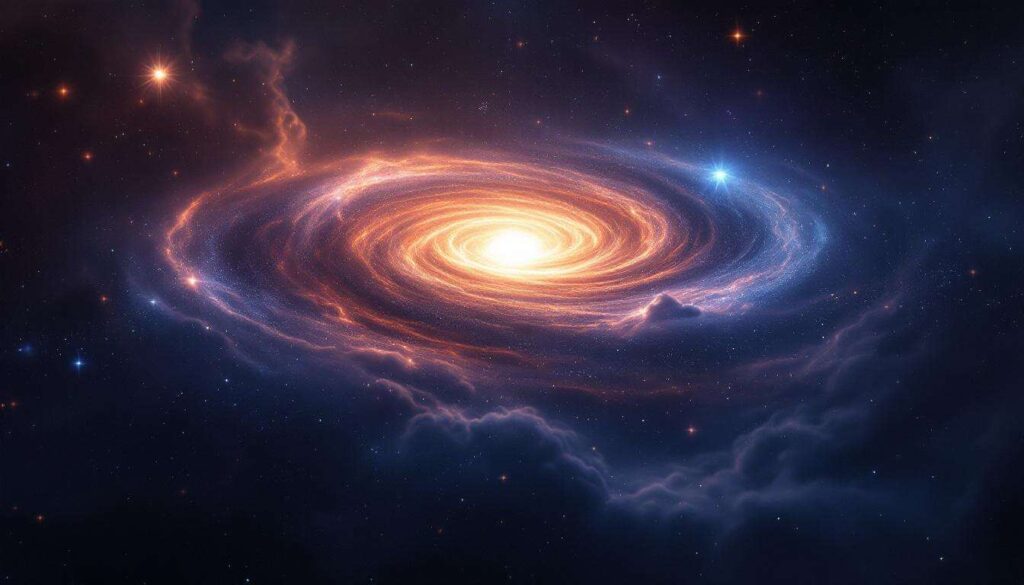
Look to the cosmic dawn, to a time just after the universe began, and imagine the very first lights to pierce the primordial darkness. For decades, astronomers assumed these were stars like our own, powered by nuclear fusion. A groundbreaking theory, however, suggests a far more exotic possibility: colossal, luminous orbs powered not by the atom, but by the annihilation of dark matter. These are not the cold, dead cinders of science fiction, but brilliant, massive objects known as dark stars. Their potential existence challenges our fundamental understanding of cosmic evolution and offers a tantalizing key to unlocking some of the universe’s most profound secrets, forcing us to reconsider the very nature of the first stellar objects.
Understanding dark stars: a new perspective on the universe
What defines a dark star ?
The name “dark star” is something of a misnomer. These theoretical objects are not dark; in fact, they would have been extraordinarily luminous. The term refers to their power source: dark matter. Unlike a conventional star such as our sun, which generates energy through the nuclear fusion of hydrogen into helium in its core, a dark star is powered by the heat produced from the annihilation of dark matter particles. The leading theory proposes that these particles, known as Weakly Interacting Massive Particles (WIMPs), would have been captured by the gravity of collapsing clouds of primordial gas. As their density increased within the nascent star’s core, they would annihilate each other, releasing a steady stream of energy that would heat the gas cloud, causing it to glow brightly.
Distinguishing dark stars from traditional stars
The fundamental difference in their energy source leads to vastly different physical characteristics. A dark star represents a unique phase of stellar evolution, distinct from the main-sequence stars we are familiar with. They are much larger, puffier, and cooler at the surface than a fusion-powered star of similar mass. This unique profile makes them, in theory, distinguishable from the first generation of normal stars, known as Population III stars. The contrast between these two stellar types is stark and highlights the exotic nature of these early cosmic inhabitants.
| Feature | Dark Star | Traditional Star (Population III) |
|---|---|---|
| Power Source | Dark matter annihilation | Nuclear fusion |
| Composition | Hydrogen, helium, and a high concentration of dark matter | Primarily hydrogen and helium |
| Size | Extremely large and diffuse, potentially millions of times the sun’s radius | Massive, but far more compact |
| Surface Temperature | Relatively cool (less than 10,000 Kelvin) | Extremely hot (over 100,000 Kelvin) |
| Lifespan | Potentially millions of years, dependent on dark matter fuel | A few million years |
These profound differences in their basic properties mean that dark stars, if they existed, would have played a very different role in the early cosmos, potentially solving puzzles that traditional stellar models cannot.
Dark stars: keys to unlocking the mysteries of the cosmos
Solving the dark matter puzzle
The search for dark matter has been one of the most significant endeavors in modern physics. Despite comprising an estimated 27% of the universe’s mass-energy content, its nature remains elusive. The discovery of a dark star would provide the first semi-direct evidence of the particle nature of dark matter. Specifically, it would validate the theory that dark matter is composed of WIMPs capable of self-annihilation. Such an observation would be revolutionary for particle physics, offering insights into properties that cannot be measured in terrestrial laboratories. The implications would be immense:
- It would confirm the existence and annihilating properties of WIMPs, a leading dark matter candidate.
- It would allow scientists to place constraints on the mass and interaction strength of dark matter particles.
- It would open an entirely new field of stellar astrophysics based on dark matter physics.
Explaining supermassive black holes
Another enduring cosmic mystery is the existence of supermassive black holes (SMBHs) in the early universe. Observations have revealed black holes billions of times the mass of our sun at a time when the universe was less than a billion years old. Standard models of black hole growth struggle to explain how they could have become so massive so quickly. Dark stars offer a compelling solution. Because they are not supported by the intense radiation pressure of nuclear fusion, they can continue to accrete matter and grow to truly enormous sizes, potentially reaching millions of solar masses. Once a dark star exhausts its dark matter fuel, its immense gravity would cause it to collapse directly into a massive black hole, providing the perfect “seed” for the rapid growth of an SMBH. This process neatly sidesteps the time constraints faced by conventional models.
The potential for dark stars to solve such fundamental problems has made understanding their origins a critical area of cosmological research.
Origin of dark stars: first witnesses of the Big Bang
The primordial soup: conditions for formation
The birth of a dark star requires a unique set of circumstances only present in the very early universe. Shortly after the Big Bang, matter was distributed in vast, sprawling halos composed primarily of dark matter. Within these halos, the first primordial gas clouds of hydrogen and helium began to cool and collapse under their own gravity. The crucial factor is that the highest density of dark matter was located precisely at the center of these halos, exactly where the first protostars would begin to form. This co-location of dense gas and dense dark matter set the stage for a new kind of stellar object to emerge, one that would hijack the standard process of star formation.
The process of birth: from protostar to stellar giant
The formation of a dark star follows a distinct pathway, diverging from the birth of a normal star at a critical moment. The sequence of events is thought to have unfolded as follows:
- A primordial gas cloud at the center of a dark matter halo begins to collapse under gravity.
- As the cloud’s density increases, it gravitationally pulls in more dark matter particles from the surrounding halo.
- The density of WIMPs in the protostellar core reaches a threshold where their rate of annihilation becomes significant.
- This annihilation process releases a powerful stream of energy in the form of photons and neutrinos.
- Crucially, this energy output heats the gas cloud, halting its gravitational collapse before the core becomes hot and dense enough to ignite nuclear fusion.
The result is not a compact, fusion-powered star but a vastly larger, cooler, and more diffuse object: a dark star, shining brightly from the energy of annihilated matter. The challenge, then, becomes finding evidence of these long-vanished giants in the distant universe.
Observing dark stars: challenges and technological breakthroughs
The signature of a dark star
Detecting an object that may have existed over 13 billion years ago is an astronomical feat of the highest order. Fortunately, dark stars are predicted to have a unique spectral fingerprint that distinguishes them from their fusion-powered cousins. While they would be incredibly bright, their cooler surfaces mean their light would be redder than that of the first conventional stars. An observatory looking for a dark star would search for an object with the luminosity of a massive star but without the spectral signatures of one. Specifically, astronomers would look for the absence of certain high-energy spectral lines associated with the extreme temperatures of Population III stars. The presence of a strong He II 1640 Å emission line without corresponding metal lines could also be a telltale sign, indicating a massive, hot object that is not powered by standard fusion.
Telescopes on the hunt
The search for these cosmic relics was largely theoretical until the advent of the James Webb Space Telescope (JWST). With its unparalleled sensitivity to infrared light, JWST is uniquely equipped to peer back to the cosmic dawn. Light from the earliest stars has been traveling for billions of years, and due to the expansion of the universe, its wavelength has been stretched into the infrared part of the spectrum. JWST is essentially a time machine, capable of capturing this ancient light and analyzing it for the telltale signatures of dark stars. Several candidate objects have already been identified in JWST data, sparking intense debate and follow-up observations. This powerful observatory gives humanity its first real chance to turn a fascinating theory into an observable reality, potentially confirming the existence of these dark matter-powered behemoths.
If these candidates are confirmed, the discovery will reverberate through cosmology, fundamentally altering our models of the early universe.
Implications of dark stars on our understanding of the cosmos
Rewriting the cosmic timeline
Our current model of the early universe includes a period known as the “Dark Ages,” after the cosmos cooled from the Big Bang but before the first stars ignited to illuminate the darkness. The existence of dark stars would force a revision of this timeline. These massive, luminous objects could have been the very first sources of light, appearing earlier than previously thought possible and influencing the thermal history of the universe. Their radiation could have delayed the formation of later stars or influenced the process of cosmic reionization, the era when light from the first objects stripped electrons from neutral hydrogen atoms, making the universe transparent. In essence, dark stars could be the missing link in our understanding of how the universe transitioned from a simple, dark state to the complex, light-filled cosmos we see today.
A new chapter in stellar evolution
The confirmation of dark stars would add an entirely new and unexpected branch to the field of stellar evolution. For over a century, our understanding of stars has been rooted in the principles of gravity and nuclear physics. Dark stars introduce a third, fundamental pillar: particle physics. It would mean that in the earliest moments of the universe, nature had two distinct ways of building a star, one powered by baryonic matter and the other by dark matter. This would represent a paradigm shift, forcing a complete reevaluation of the processes that governed the formation of the first structures in the cosmos and adding a rich new layer of complexity to our cosmic story.
This potential shift from a fringe theory to a cornerstone of astrophysics marks a true turning point in our quest to understand the universe.
Dark stars: a revolution in modern astrophysics
From theoretical concept to observational target
For years, the idea of dark stars remained a compelling but purely theoretical construct, born from the intersection of cosmology and particle physics. It was a clever solution to several outstanding problems, but it lacked a viable path to confirmation. The launch of the James Webb Space Telescope changed everything. It transformed the dark star from a theoretical curiosity into a concrete, observable target. The synergy between the theorists who first proposed the idea and the observational astronomers now hunting for candidates represents science at its best. We are witnessing in real time a hypothesis being put to the ultimate test, with data from the edge of the observable universe holding the answer.
The next frontier in cosmology
The search for dark stars is more than just a hunt for a new type of object; it is a quest for the very soul of the early universe. Their discovery would be a monumental achievement, providing a direct window into the era of first light and confirming the nature of dark matter in a single stroke. The potential outcomes of this search, whether successful or not, will profoundly shape the future of astrophysics.
| Potential Discovery | Scientific Impact |
|---|---|
| Confirmation of dark star candidates | Validates WIMP dark matter models and revolutionizes theories of early structure formation. |
| Link established to SMBH seeds | Solves the long-standing problem of rapid supermassive black hole growth. |
| Absence of confirmed dark stars | Places strong constraints on dark matter properties, forcing a reevaluation of WIMP models. |
This endeavor stands as one of the great scientific adventures of our time. The possibility that the first lights in the universe were not powered by the familiar fire of fusion but by the mysterious annihilation of dark matter represents a profound shift in our cosmic perspective.
Embrace the paradigm shift that dark stars represent. These theoretical objects, powered by dark matter annihilation, offer elegant solutions to some of cosmology’s most persistent mysteries, including the nature of dark matter itself and the origin of supermassive black holes. The ongoing search with cutting-edge instruments like the James Webb Space Telescope is not merely an academic exercise; it is a direct probe into the cosmic dawn. The coming years may prove that to understand the first light, we must first understand the darkness that powered it, forever changing our view of the universe’s first chapter.