

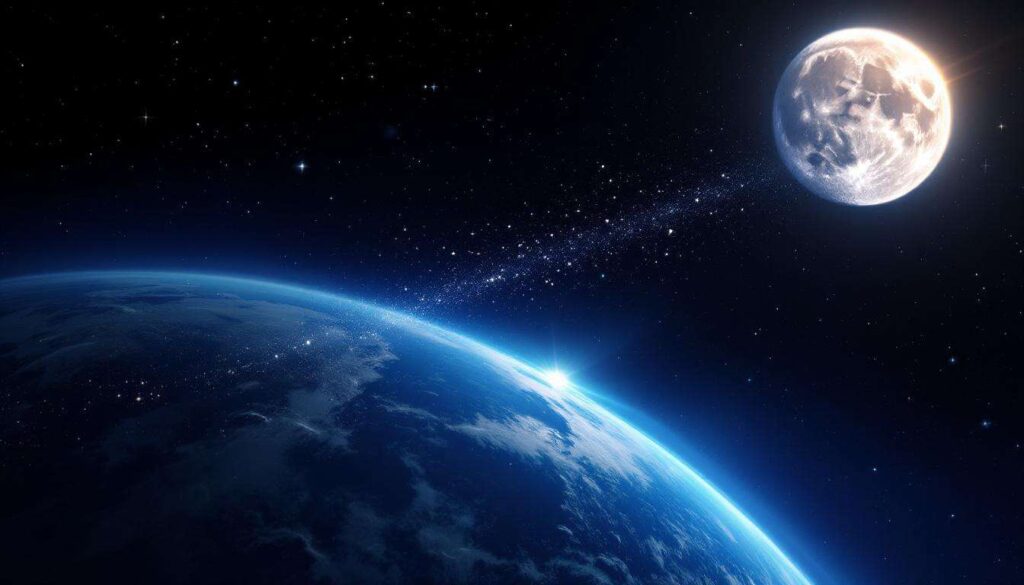
The long-held image of the moon as a body traveling through the perfect vacuum of space has been fundamentally altered. Recent analysis of decades-old data reveals a startling truth: Earth’s atmosphere does not simply end a few hundred miles up but extends far beyond, enveloping the moon in a tenuous, invisible veil. This gaseous envelope, known as the geocorona, is a vast, wispy cloud of hydrogen atoms that stretches up to 390,000 miles (630,000 kilometers) into space, well past the lunar orbit. This discovery redefines the boundaries of our own planet and opens up a surprising new conversation about the resources potentially available for future lunar explorers.
What is Earth’s atmosphere ?
A Multi-Layered Shield
Our planet’s atmosphere is not a uniform entity but a complex system of layers, each with distinct characteristics. Most of the weather and life we know exists in the lowest layer, the troposphere. Above it lie the stratosphere, which contains the ozone layer, followed by the mesosphere and the thermosphere. The composition is predominantly nitrogen and oxygen, but this mix changes dramatically with altitude.
- Troposphere: 0 to 12 km, where weather occurs.
- Stratosphere: 12 to 50 km, home to the ozone layer.
- Mesosphere: 50 to 85 km, where meteors burn up.
- Thermosphere: 85 to 600 km, where auroras happen and the International Space Station orbits.
- Exosphere: Above 600 km, the outermost layer.
The Exosphere: Gateway to Space
The exosphere is the final frontier of our atmosphere. Here, the air is extraordinarily thin, and gas particles are so far apart they rarely collide. Lighter atoms, such as hydrogen, can gain enough velocity from solar energy to escape Earth’s gravitational pull entirely. It is from this layer that the atmosphere “leaks” into space, a process that was once thought to be a one-way ticket into the void. We now understand this leakage forms a far more extensive structure than previously imagined.
This new understanding of the atmosphere’s true scale forces us to reconsider the environment in which our natural satellite resides. The leakage isn’t just a loss of gas into the cosmos; it’s a dynamic extension of our planet’s influence.
The phenomenon of atmospheric leakage
The Geocorona Rediscovered
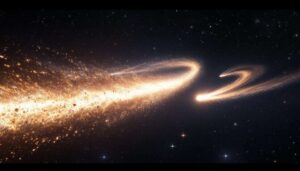
The geocorona is a cloud of neutral hydrogen atoms that glows in far-ultraviolet light. While its existence has been known for some time, its true extent was confirmed by analyzing data from the Solar and Heliospheric Observatory (SOHO), a joint NASA and ESA spacecraft. Its instruments, designed to study the sun, inadvertently captured the faint signature of Earth’s extended atmosphere. The data showed that this hydrogen halo is denser on Earth’s dayside due to compression by solar radiation, and it produces a region of enhanced density on the nightside, a “hydrogen tail” trailing the planet.
A Long Journey for Hydrogen Atoms
The source of this vast hydrogen cloud is primarily water vapor in the upper atmosphere. Solar ultraviolet radiation is powerful enough to break water molecules (H₂O) apart, a process called photodissociation. This releases lightweight hydrogen atoms. Being the lightest element, hydrogen is the most likely to achieve escape velocity and travel far from Earth. These atoms journey outward, forming the tenuous but immense geocorona that bathes the moon in a constant, albeit extremely thin, stream of Earth-origin particles.
| Location | Density (atoms per cubic centimeter) |
|---|---|
| Sea Level | 2.5 x 10¹⁹ |
| Geocorona (60,000 km) | 70 |
| Lunar Orbit (384,000 km) | 0.2 |
The discovery that these terrestrial particles reach the moon in any measurable quantity has significant implications for those planning to build a permanent human presence there.
The impact on lunar bases
Tapping into a Terrestrial Stream
For future lunar inhabitants, the principle of in-situ resource utilization (ISRU) is paramount. Living off the land, or in this case, the moon, is critical to reducing the immense cost and logistical complexity of shipping supplies from Earth. The geocorona presents a novel, if challenging, potential resource. While incredibly diffuse, it represents a continuous supply of hydrogen, and potentially other elements, delivered directly to the moon’s doorstep.
Hydrogen for Fuel and Water
Hydrogen is a cornerstone of space exploration. It is a powerful rocket propellant when combined with oxygen and a key ingredient for creating water (H₂O). A lunar base capable of harvesting hydrogen from the geocorona could, in theory, produce its own fuel for lunar ascent vehicles or deep-space missions. Furthermore, combining this harvested hydrogen with oxygen extracted from lunar regolith (the moon’s soil) could generate a sustainable source of water for drinking, sanitation, and agriculture.
A Source of Oxygen and Other Volatiles
While the geocorona is overwhelmingly composed of hydrogen, it is plausible that trace amounts of other elements from Earth’s exosphere, such as oxygen and helium, are also carried along. Capturing these would be even more challenging due to their lower abundance, but the potential payoff is enormous. A reliable source of oxygen would be a game-changer for life support systems, making a lunar outpost far more self-sufficient. This atmospheric leakage, once seen as a simple curiosity, could become a vital component in the architecture of long-term space settlement.
Harnessing this ethereal resource transforms the conversation from simply surviving on the moon to thriving there, but it also broadens our perspective on the entire Earth-moon system.
Implications for space exploration
The Cislunar Environment is Not Empty
The realization that the moon is inside Earth’s atmosphere fundamentally changes our model of the cislunar environment. Spacecraft traveling between the Earth and the moon are not moving through a pure vacuum. They are passing through a variable medium that, while extremely thin, can affect sensitive instruments. This has direct consequences for both robotic and human missions.
Calibrating a New Reality
Astronomical observations are particularly affected. Space telescopes operating in near-Earth or lunar orbit must now account for the faint ultraviolet glow of the geocorona, which can interfere with observations of distant galaxies and stars. For example, instruments on the Hubble Space Telescope must have their data corrected for this atmospheric “noise.” Future lunar-based observatories, planned to take advantage of the moon’s lack of a thick atmosphere, will need to be designed with this terrestrial interference in mind.
A New Frontier for ISRU
This discovery adds another layer to the strategy of in-situ resource utilization. The focus has historically been on mining solid materials, but “atmospheric mining” is now a theoretical possibility. This could complement other ISRU activities, creating a more robust and resilient resource pipeline for a lunar settlement.
- Regolith Mining: Extracting oxygen, silicon, and metals like aluminum and titanium from lunar soil.
- Ice Mining: Harvesting water ice from permanently shadowed craters at the lunar poles.
- Atmospheric Harvesting: Capturing hydrogen and other volatiles from the geocorona.
This expanded understanding prompts new scientific questions and drives the need for innovative technologies to capitalize on these newfound possibilities.
Scientific and technological perspectives
A Unique Laboratory for Earth Science
Observing the geocorona from the vantage point of the moon provides an unprecedented opportunity to study Earth’s outermost atmospheric layers. By measuring the density and composition of the particle stream reaching the moon, scientists can learn more about the complex interactions between our atmosphere, the solar wind, and the planet’s magnetic field. The moon effectively becomes a remote sensing platform for our own planet.
Designing the Harvesting Technology
The primary technological hurdle is developing a method to efficiently capture and concentrate atoms from such an extreme vacuum. Current concepts are speculative but grounded in physics. One idea involves large, orbiting collectors, perhaps kilometers in size, that use electrostatic fields to attract and funnel charged particles (ions). Another might involve cooling surfaces to extremely low temperatures to trap neutral atoms that strike them. These are not simple engineering tasks; they represent a major technological leap that must be made before atmospheric harvesting becomes viable.
Sensors and Probes for the Future
Before any harvesting can be attempted, a more detailed survey is required. Future lunar missions, both robotic and crewed, should be equipped with highly sensitive mass spectrometers and particle detectors. These instruments would map the geocorona’s density and flow around the moon with high precision, identifying the most promising locations and times for potential collection efforts. This data is essential for determining the feasibility and designing the necessary hardware.
Even with promising scientific avenues and technological concepts, the practical challenges of establishing a permanent foothold on the moon remain immense.
Future challenges for moon settlement
The Question of Yield
The most significant challenge is the sheer sparseness of the resource. With a density of only about 0.2 atoms per cubic centimeter at the moon’s orbit, collecting a useful quantity of hydrogen would require processing an immense volume of space. An orbital collector would need to be extraordinarily large and operate for a long time to gather even a few kilograms of material. The energy and resources required to build and operate such a system might outweigh the benefits it provides.
| Collector Area | Assumed Efficiency | Estimated Hydrogen Collected per Year |
|---|---|---|
| 1 square kilometer | 10% | ~100 grams |
| 100 square kilometers | 25% | ~25 kilograms |
The Energy Cost of Collection
Any viable collection technology will be incredibly energy-intensive. Whether using powerful electrostatic fields or advanced cryocoolers, the process will demand a constant and substantial power supply. A lunar base would need to deploy extensive solar arrays or, more likely, a dedicated nuclear fission power source to support such an operation. This energy infrastructure represents a massive upfront investment and a significant engineering project in its own right.
A Complement, Not a Silver Bullet
Ultimately, harvesting resources from the geocorona cannot be viewed as a standalone solution. It must be seen as one potential piece of a much larger puzzle. Its success will depend on how well it can be integrated with more traditional ISRU methods like mining lunar ice. For instance, hydrogen from the geocorona could supplement water produced from polar ice, providing redundancy and increasing the overall resilience of a lunar settlement. The path forward requires a multi-pronged approach, leveraging every available resource, no matter how unconventional.
The discovery that Earth’s atmosphere touches the moon is a profound scientific revelation. It reshapes our understanding of our planet’s place in the solar system and presents both tantalizing opportunities and formidable challenges for future explorers. While the dream of harvesting terrestrial air from the lunar surface remains a distant technological goal, it underscores the ingenuity and persistence that will be required to make humanity a multi-planetary species. The journey to the moon is not just about leaving Earth behind, but about understanding the deep and surprising connections that will always link our world with our nearest celestial neighbor.