



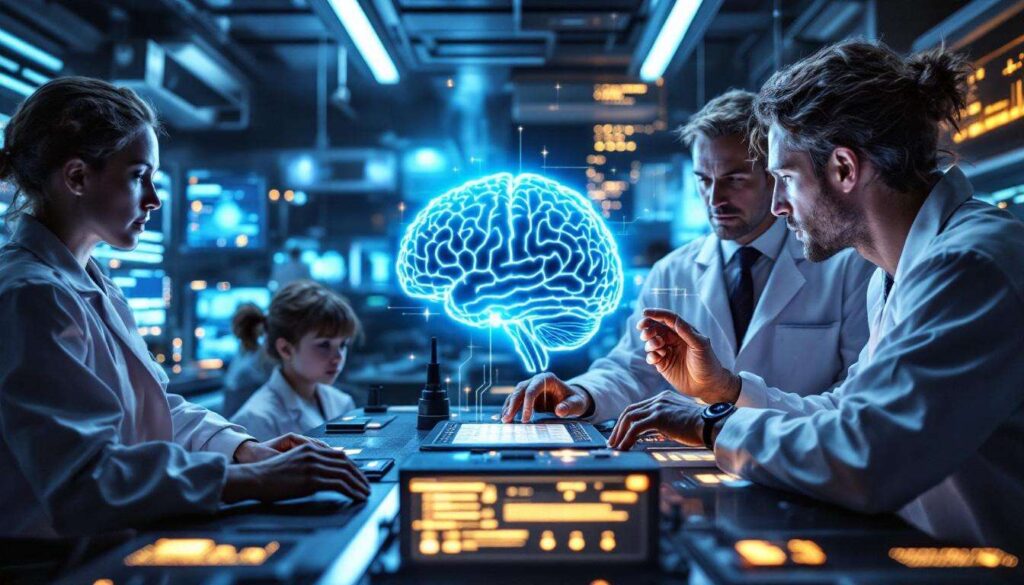
The boundary between biological life and digital machinery is rapidly dissolving. In laboratories around the world, scientists are cultivating clusters of human brain cells, known as organoids, and integrating them with electronic hardware to create a new form of biocomputer. This emerging field, termed “organoid intelligence” or OI, promises to harness the brain’s unparalleled learning capacity and energy efficiency. While the prospect of computers that can learn and process information like a human brain is tantalizing, it propels society into uncharted territory, raising profound questions about the nature of intelligence, consciousness, and the very definition of humanity.
Understanding the fusion between computing and brain tissue
What is organoid intelligence ?
Organoid intelligence is a multidisciplinary field that seeks to create a new type of computer by coupling lab-grown brain organoids with computational devices. Brain organoids are three-dimensional, self-organizing cultures derived from human stem cells. These miniature brain models, typically no larger than a pinhead, develop various types of brain cells and form complex neural connections, mimicking the early stages of human brain development. Scientists place these organoids on microelectrode arrays that can both record their electrical activity and deliver targeted electrical stimuli. This two-way communication forms the basis of a biological computing unit, where the organoid functions as the processor and the hardware serves as the input/output interface.
How does it differ from traditional AI ?
Unlike traditional artificial intelligence, which runs on silicon chips and relies on algorithms to simulate neural processes, organoid intelligence uses actual biological neurons. This fundamental difference leads to distinct operational characteristics. The learning process in OI is not merely an execution of code; it is a genuine biological adaptation, where neural pathways physically change and strengthen in response to stimuli, a phenomenon known as neuroplasticity. This allows for a more organic and potentially more efficient form of learning than what is currently achievable with even the most advanced AI models.
| Feature | Traditional AI (Silicon-based) | Organoid Intelligence (Biological) |
|---|---|---|
| Processing Unit | Transistors and logic gates | Living neurons and synapses |
| Learning Mechanism | Algorithmic (e.g., backpropagation) | Neuroplasticity and synaptic adaptation |
| Energy Consumption | High (e.g., data centers) | Extremely low (mimics brain efficiency) |
| Data Processing | Linear and structured | Parallel and associative |
The profound differences in their underlying architecture highlight why OI is not just an incremental improvement but a potential paradigm shift. While the science is still in its infancy, these foundational distinctions are driving the research forward, fueled by the immense potential of biological computation.
The scientific breakthroughs behind biological computers
From stem cells to functional neural networks
The creation of a biocomputer begins with human pluripotent stem cells. These remarkable cells have the ability to develop into any type of cell in the body. Through a carefully orchestrated process, scientists guide them to differentiate into various neural cell types, including neurons and glial cells. This process involves several key stages:
- Induction: Stem cells are treated with a specific cocktail of growth factors that signal them to become neural precursor cells.
- Self-Assembly: These precursor cells are then allowed to grow in a three-dimensional culture, where they spontaneously organize themselves into structures resembling different regions of the developing brain.
- Maturation: Over weeks and months, the neurons within the organoid mature, extending axons and dendrites to form complex synaptic connections and functional neural circuits.
The result is a miniature organ that, while lacking the full structure of a human brain, possesses the fundamental cellular machinery for processing information.
The role of machine learning and data feedback
A brain organoid on its own is a biological system without purpose. To transform it into a computer, researchers have developed sophisticated feedback loops powered by machine learning. In pioneering experiments, scientists have successfully taught organoids to perform simple tasks. For example, in a demonstration reminiscent of the classic video game Pong, an organoid was taught to control a paddle to hit a ball. This was achieved by converting the ball’s location into electrical stimulation patterns delivered to the organoid. The organoid’s resulting neural activity was then read by electrodes, interpreted by a machine learning algorithm, and used to move the paddle. When the paddle hit the ball, a predictable, structured electrical stimulus was sent as a reward. When it missed, a random, chaotic stimulus was sent. Over time, the organoid’s neural network learned to generate the correct activity patterns to hit the ball more consistently, demonstrating a rudimentary form of goal-directed learning.
These early successes in creating functional learning systems are paving the way for more complex applications, moving the technology from a scientific curiosity to a tool with real-world potential.
Potential applications of brain tissue-based computers
Revolutionizing medical research
One of the most immediate and impactful applications of organoid intelligence lies in medicine. These biocomputers serve as unparalleled models for studying the human brain and its diseases. By growing organoids from the cells of patients with neurological or psychiatric conditions, researchers can create personalized “disease-in-a-dish” models. This allows them to:
- Observe the cellular mechanisms of diseases like Alzheimer’s, Parkinson’s, or autism in a dynamic, functional human brain model.
- Test the efficacy and toxicity of new drugs on human neural tissue without risking harm to a living person.
- Develop personalized treatments by identifying which drugs work best for an individual’s specific genetic makeup.
This approach could drastically accelerate the pace of neuroscience research and drug discovery, offering new hope for conditions that are currently difficult to study and treat.
Next-generation computing power
Beyond medicine, OI holds the potential to redefine the limits of computation itself. The human brain is the most efficient information processing system known, performing trillions of operations per second while consuming only about 20 watts of power. In comparison, a supercomputer performing a similar number of calculations can require megawatts of power. By harnessing the brain’s biological hardware, biocomputers could offer a path toward incredibly powerful and energy-efficient computing. Potential applications include solving complex problems that stump conventional computers, such as designing novel molecules, optimizing global logistics networks, or creating more sophisticated and adaptive artificial intelligence systems that learn from experience rather than just data sets.
However, the very power that makes this technology so promising also introduces a host of complex ethical and regulatory questions that society must confront.
Ethical and regulatory challenges linked to the use of human tissue
The question of consciousness and sensation
As brain organoids become larger and more complex, they will inevitably approach a gray area where their moral status becomes ambiguous. The central ethical question is whether these constructs could ever achieve some form of consciousness, self-awareness, or the ability to experience sensations like pain or suffering. While current organoids are far from this level of sophistication, researchers cannot definitively rule out the possibility for future, more advanced systems. This raises profound dilemmas: if an organoid is conscious, does it have rights ? Would it be ethical to use it for computation or to terminate an experiment ? The lack of clear biological markers for consciousness makes this an incredibly difficult problem to address, requiring a deep and ongoing dialogue between scientists and ethicists.
Consent and tissue sourcing
The biological material used to create organoids must come from a human source, which introduces critical issues of consent and ownership. Stem cells can be derived from various sources, including donated embryos, aborted fetal tissue, or reprogrammed adult cells like skin or blood. Each source carries its own ethical baggage. Clear guidelines are needed to ensure that donors provide fully informed consent, understanding that their cells will be used to create a functional neural entity. Questions also arise about the donor’s rights over the biocomputer created from their tissue. Should they have a say in its use, or do they relinquish all claims upon donation ? Establishing a robust framework for ethical sourcing and consent is a foundational requirement for the field to advance responsibly.
The novelty of this technology means that our existing legal and social structures are ill-equipped to handle it, underscoring the urgent need for new thinking about its broader societal effects.
Impacts on society and existing technologies
Redefining intelligence and life
The advent of biocomputing forces a fundamental re-evaluation of what we consider to be “life” and “intelligence.” If a machine is powered by living human neurons, where is the line between a tool and an organism ? This technology blurs the long-held distinction between the born and the made. The societal implications are vast, potentially altering our philosophical understanding of ourselves and our place in the world. As these systems become more capable, they will challenge legal definitions of personhood and could lead to new social classes of biological-digital hybrids, raising questions of rights and responsibilities that we are unprepared to answer.
Economic and industrial disruption
The rise of organoid intelligence could trigger significant disruption across multiple industries, most notably in pharmaceuticals and information technology. While it presents enormous opportunities, it also poses a threat to established business models. The semiconductor industry, built on silicon, could face a long-term competitor in biological hardware. Similarly, the current AI landscape, dominated by companies developing massive, energy-intensive machine learning models, could be upended by a more efficient and adaptive computing paradigm.
| Current Sector | Potential Impact of Organoid Intelligence |
|---|---|
| Pharmaceutical Research | Shift from animal models to more accurate human organoid testing, accelerating drug development. |
| AI Development | A move away from brute-force data processing toward systems with genuine learning capabilities. |
| Data Centers | Potential reduction in energy consumption as hyper-efficient biological processors replace silicon. |
Navigating this transition will require careful planning to manage economic shifts and ensure that the benefits of this new technology are distributed equitably. The path forward is filled with both immense promise and significant peril.
The future of biological computing: opportunities and risks
The path to scalable biocomputers
Despite the rapid progress, significant technical hurdles remain before biocomputers become a mainstream technology. Current brain organoids are limited in size and lifespan due to the lack of a vascular system to supply nutrients and remove waste. They also exhibit a high degree of variability, making experimental results difficult to replicate. Overcoming these challenges will require breakthroughs in bioengineering, such as developing methods to vascularize organoids and standardizing culture protocols to ensure consistency. Furthermore, the interfaces between the biological tissue and the electronic hardware need to become more sophisticated to allow for higher-bandwidth communication. Solving these engineering problems is the critical next step toward creating scalable and reliable biocomputing systems.
Balancing innovation with caution
The trajectory of organoid intelligence presents a classic dilemma of technological advancement: a race between innovation and wisdom. The opportunities are undeniable, from curing devastating brain diseases to unlocking new frontiers in computation. However, the risks are equally profound, touching on the essence of what it means to be human. Moving forward requires a delicate balance. It demands an open and proactive public discourse involving scientists, ethicists, policymakers, and citizens to establish clear ethical guardrails and regulatory frameworks. Rushing ahead without careful consideration could lead to unintended and irreversible consequences, while excessive caution could stifle research that holds the key to alleviating immense human suffering. This technology is a test of our ability to innovate responsibly.
The fusion of human brain tissue and computing is no longer a matter of science fiction. It is a scientific reality that promises to reshape our world. While this technology offers unprecedented opportunities for medicine and information science, it simultaneously confronts us with profound ethical challenges regarding consciousness, consent, and the very definition of life. Navigating this future successfully will depend on our collective ability to foster responsible innovation guided by a deep and shared understanding of the humanistic implications.