
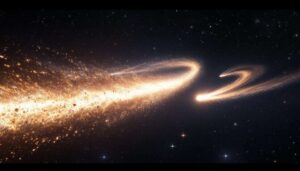


In the silent, vast expanse of space, objects from other star systems occasionally drift through our own, offering fleeting glimpses into the cosmos beyond. These interstellar visitors are rare, and our chances to study them are brief. Recently, however, a new, high-resolution image of the latest such traveler, designated IS-03, has sent ripples of astonishment and debate through the astronomical community. A senior scientist, poring over the data, has identified features so unexpected they challenge our fundamental understanding of what these cosmic wanderers can be. The photograph, captured by the Atacama Large Millimeter/submillimeter Array, is not just another data point; it is a profound enigma that has astronomers scrambling for answers.
Discovery of an intriguing image of the interstellar object
The journey to capture this groundbreaking image was a race against time. Interstellar objects, by their very nature, are on a hyperbolic trajectory, meaning they enter our solar system once and never return. The window for observation is often measured in weeks or months, demanding a rapid and coordinated response from observatories worldwide. The image of IS-03 represents a triumph of this rapid-response astronomy, but it has revealed more questions than answers.
The observation campaign
Once IS-03 was detected by the Pan-STARRS survey telescope, a global alert was issued. Major observatories pivoted their instruments to track the faint point of light. The primary goal was to gather as much data as possible across the electromagnetic spectrum. It was the team at the Atacama Large Millimeter/submillimeter Array (ALMA) in Chile that ultimately secured the most detailed image. By combining the signals from 66 high-precision antennas, ALMA achieved an unparalleled resolution, piercing through the faint coma of gas and dust to reveal the object’s core with startling clarity. The observation was particularly challenging due to the object’s speed and distance, requiring precise calculations and a bit of luck with atmospheric conditions.
Technical specifications of the capture
The success of the observation hinged on leveraging ALMA’s unique capabilities. The team used the array’s highest frequency bands to achieve the sharpest possible view. This allowed them to resolve features on the object’s surface that would be invisible to optical telescopes. The data collected was not just a simple picture but a complex set of measurements that provided information on temperature, composition, and structure. Here are some key parameters of the observation:
| Parameter | Value |
|---|---|
| Observation Frequency | 650 GHz |
| Angular Resolution | 0.02 arcseconds |
| Integration Time | 8.5 hours |
| Distance to Object | 1.8 AU |
This level of detail was simply unprecedented for an object of this type. The initial data was processed over several days, and as the final image resolved on their screens, the research team knew they had found something extraordinary. The initial excitement over the technical achievement of capturing the image quickly gave way to a deeper analysis of what it actually showed.
Initial analyses and hypotheses of the researchers
As the image of IS-03 circulated among the core research team, a flurry of initial analyses began. The first step was to compare the object to known celestial bodies, such as comets and asteroids from our own solar system. However, it quickly became apparent that IS-03 did not fit neatly into any existing category. This discrepancy sparked a wide range of hypotheses, from the mundane to the highly speculative, as scientists tried to make sense of the data.
Comparing IS-03 to known objects
The first point of comparison was ‘Oumuamua, the first interstellar object ever detected. While ‘Oumuamua was known for its highly elongated shape and unusual acceleration, IS-03 presented a different set of puzzles. Its overall shape was not as extreme, but its surface features and thermal properties were deeply perplexing. Unlike typical comets, which show a relatively uniform outgassing pattern as they are heated by the sun, IS-03 displayed highly localized jets of material erupting from specific points. Furthermore, its rotational pattern seemed to be inconsistent with a solid, monolithic body, leading to intense debate among team members.
Emerging theories
Faced with these anomalies, researchers proposed several competing hypotheses to explain IS-03’s behavior. These theories represent the first attempts to build a coherent model that fits all the observational data. The primary lines of thought include:
- A nitrogen iceberg: One leading theory suggests IS-03 could be a fragment of a Pluto-like planet from another star system. This would explain the localized jets as pockets of frozen nitrogen sublimating into space, a phenomenon seen on Pluto’s moon, Triton.
- A highly porous agglomerate: Another hypothesis posits that the object is not a solid body but a loose collection of ice and dust, barely held together by gravity. This “cosmic dust bunny” model could account for its strange rotational dynamics and low density.
- An exhausted cometary nucleus: Some researchers argue for a more conservative explanation, suggesting IS-03 is the ancient, inactive core of an interstellar comet whose surface has been weathered in unusual ways over its journey through the galaxy.
- An artificial object: While remaining a fringe but persistent idea, the possibility of an artificial origin is mentioned in internal discussions, primarily due to the object’s complex thermal signature and non-uniform surface reflectivity, which are difficult to explain through purely natural processes.
Each of these hypotheses carries its own set of implications and challenges. The raw data from the ALMA image, while incredibly detailed, was not yet sufficient to definitively confirm or refute any single theory, revealing just how peculiar the object truly was.
Unusual features revealed by the image
The high-resolution data from ALMA did more than just provide a sharper picture; it unveiled specific, quantifiable features that defy easy explanation. These anomalies are at the heart of the current scientific fervor surrounding IS-03. The object is not just strange in a general sense; it is strange in very specific ways that challenge established models of planetesimal formation and evolution.
Anomalous surface reflectivity
One of the most striking features is the object’s albedo, or its surface reflectivity. The data shows extreme variations across its surface. Some areas are darker than asphalt, absorbing nearly all incoming sunlight, while adjacent regions are highly reflective, shining as brightly as fresh ice. This patchwork pattern is extremely unusual. In our solar system, celestial bodies tend to have surfaces that are more uniformly weathered by micrometeoroids and solar radiation over time. The sharp, distinct boundaries between light and dark patches on IS-03 suggest a geologically or compositionally complex surface that has not undergone typical space weathering.
A complex thermal signature
The thermal data is perhaps even more puzzling. ALMA’s measurements revealed that the dark, light-absorbing regions of IS-03 are not significantly warmer than the bright, reflective areas. This finding violates basic physics, as darker surfaces should heat up more under solar radiation. Dr. Elena Vance, lead radio astronomer on the project, noted, “It’s as if there is an internal mechanism redistributing heat across the surface, or the material itself has thermal properties we have never encountered before.” This thermal equilibrium across a non-uniform surface is a major enigma. A comparison with a typical comet highlights the difference.
| Feature | Typical Comet (e.g., 67P) | Interstellar Object IS-03 |
|---|---|---|
| Albedo Variation | Relatively uniform, generally low | Extreme, with sharp boundaries |
| Surface Temperature | Correlates with albedo (dark is hot) | Largely uniform despite albedo variation |
| Outgassing | Broad, diffuse jets | Highly localized, collimated jets |
These discrepancies are not minor statistical noise; they are fundamental characteristics that set IS-03 apart from any known natural object. The scientific community, upon seeing this data, was immediately thrown into a state of both excitement and profound confusion.
Reactions and implications for the scientific community
The release of the initial findings on IS-03 has sent shockwaves through the fields of astronomy, astrophysics, and planetary science. The data, particularly the thermal and albedo anomalies, has been met with a mixture of awe, disbelief, and intense academic scrutiny. The object is no longer just a curiosity; it has become a critical test case for our theories about how planetary systems form and what kinds of objects populate the galaxy.
A catalyst for debate
Scientific forums and academic journals are now buzzing with discussions about IS-03. The initial hypotheses are being vigorously debated, with proponents of each theory presenting models and simulations to support their claims. The “nitrogen iceberg” theory, for example, has gained traction, but critics point out that such an object would likely not survive the long journey through interstellar space without significant erosion. The more conservative “exhausted comet” explanation is struggling to account for the bizarre thermal properties. This intense debate is healthy for science, pushing researchers to think beyond conventional frameworks. It forces the community to confront the possibility that our sample of one solar system has given us a biased view of the cosmos.
Rethinking our models of the cosmos
Beyond the immediate debate, IS-03 has broader implications. It suggests that the diversity of small bodies in the galaxy could be far greater than previously imagined. If objects with such strange properties are traversing the space between stars, it challenges our models of planet formation.
- Formation environments: The existence of IS-03 might imply that other star systems have vastly different chemical compositions or formation dynamics than our own.
- Interstellar chemistry: The object’s unique surface could be the result of chemical processes that occur in the cold, dark void of interstellar space over millions of years, processes we have yet to understand.
- The prevalence of life: While still highly speculative, any object that defies easy natural explanation inevitably raises questions about technosignatures. Even if IS-03 is entirely natural, its unique composition could provide new insights into the transport of organic molecules between star systems, a key component of panspermia theories.
IS-03 has effectively opened a new window into the galaxy, and the view is proving to be more complex and fascinating than anyone anticipated. The challenge now is to gather more data before this visitor disappears forever into the darkness.
Perspectives and future research on the interstellar object
With IS-03 speeding away from the sun, the window for observation is closing rapidly. The scientific community is now in a frantic race to gather as much follow-up data as possible and to plan for the future. The legacy of this mysterious visitor will not be in the answers it provided, but in the new questions it has forced us to ask and the innovative research pathways it has opened.
Immediate follow-up observations
The top priority is to observe IS-03 with every available instrument. The James Webb Space Telescope (JWST) has been tasked with conducting spectroscopic analysis to determine the precise chemical composition of the outgassing jets and the surface materials. This data will be crucial for testing the “nitrogen iceberg” hypothesis. Simultaneously, radio astronomers are using arrays like the Very Large Array (VLA) to listen for any radio emissions, a long-shot effort to rule out any possibility of artificial technology. Time is of the essence, as the object will become too faint for even our most powerful telescopes within a few months.
Planning for future visitors
The encounters with ‘Oumuamua and now IS-03 have highlighted our reactive approach to interstellar objects. This has sparked serious discussions about developing a more proactive strategy. Proposals are being drafted for new survey telescopes, like the Vera C. Rubin Observatory, which will be able to detect these objects earlier and with greater precision. There is also growing momentum for a rapid-response space mission. The European Space Agency’s “Comet Interceptor” mission is one such example, designed to be launched and parked in space, ready to be directed toward a pristine, long-period comet or, ideally, a future interstellar visitor. The goal is to move from remote observation to in-situ analysis, getting an up-close look at one of these enigmatic travelers. The data from IS-03 will be instrumental in designing the scientific payloads for such a mission.
The study of IS-03 has ignited a new sense of urgency and purpose in the search for and characterization of interstellar objects. Its strange properties have underscored the limits of our current knowledge and provided a compelling reason to invest in the next generation of astronomical tools and missions. What we learn from this object will undoubtedly shape the course of planetary science for decades to come.
The discovery of IS-03 and its perplexing features marks a pivotal moment in astronomy. A single, detailed image has challenged long-held assumptions about the nature of objects that drift between the stars. The unusual patchwork of its surface, combined with a thermal signature that defies simple physical explanation, has launched a global scientific debate. As researchers race to collect final observations before it fades from view, this interstellar messenger leaves behind a profound legacy. It serves as a stark reminder that the universe is filled with wonders far stranger than we have yet imagined and has invigorated the quest to explore these cosmic nomads.