



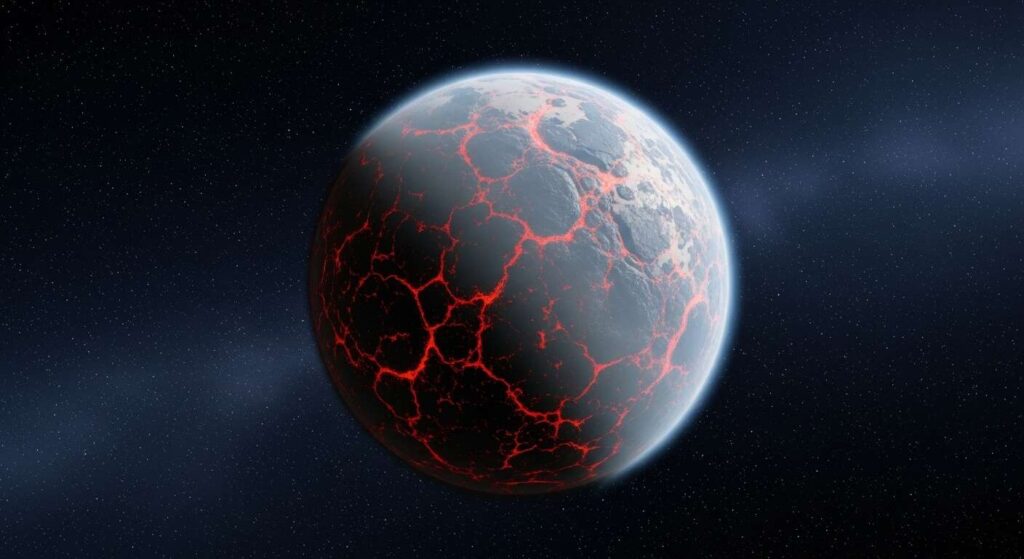
In a landmark observation that pushes the boundaries of planetary science, astronomers using the James Webb Space Telescope have found the strongest evidence to date for an atmosphere surrounding a rocky exoplanet. The planet, a searingly hot super-Earth known as 55 Cancri e, has long been a subject of intense scientific curiosity. Previous studies have been inconclusive, but Webb’s powerful infrared instruments have peeled back the veil on this alien world, revealing telltale signs of a substantial gaseous envelope, potentially rich in carbon dioxide or carbon monoxide. This groundbreaking discovery not only provides a new window into the nature of rocky planets outside our solar system but also demonstrates a crucial capability that could one day be used to search for habitable worlds.
Major discovery by the James Webb telescope
A technological leap in exoplanet observation
The James Webb Space Telescope (JWST) represents a paradigm shift in our ability to study distant worlds. Its unparalleled sensitivity to infrared light allows it to perform analyses that were previously impossible. In the case of 55 Cancri e, astronomers leveraged this power to measure subtle changes in the planet’s thermal brightness as it orbited its star. This technique, known as secondary eclipse photometry, involves observing the combined light of the star and planet just before the planet disappears behind the star. The subsequent dip in total light as the planet is eclipsed reveals the amount of infrared light emitted by the planet’s dayside alone. This data is crucial for determining surface temperature and, by extension, the presence of an atmosphere that would distribute heat.
Confirming a long-suspected atmosphere
For years, scientists have debated whether 55 Cancri e could retain an atmosphere given its extreme proximity to its host star. The star’s intense radiation and stellar winds were thought to be powerful enough to strip away any primordial atmosphere. However, the latest JWST data suggests the planet is not a bare rock. The observed dayside temperature was significantly lower than what would be expected for an airless body with a molten surface, indicating that some process, likely a gaseous envelope, is redistributing thermal energy from the intensely heated dayside to the nightside. This finding points toward the existence of what scientists call a secondary atmosphere, one that is not original to the planet’s formation but has been replenished over time by volcanic outgassing from its molten interior.
The discovery on 55 Cancri e is a testament to the telescope’s capabilities, proving it can detect and characterize atmospheres on even the most challenging targets. This success on a super-hot, rocky super-Earth lays the groundwork for future investigations of more temperate, Earth-sized planets. This new insight into the planet’s gaseous envelope moves us closer to understanding the dynamic processes that shape rocky worlds across the galaxy.
Characteristics of the rocky exoplanet
Meet 55 Cancri e: the ‘diamond planet’
The exoplanet at the center of this discovery, 55 Cancri e, is anything but ordinary. It orbits a sun-like star located just 41 light-years away in the constellation Cancer. This proximity makes it a prime target for detailed study. It is classified as a super-Earth, meaning it is larger and more massive than our own planet but still primarily rocky in composition. Some of its key characteristics include:
- Diameter: Approximately twice that of Earth.
- Mass: About eight times that of Earth.
- Orbital Period: An incredibly short 18 hours.
- Proximity: It orbits its star at a distance roughly 70 times closer than Earth orbits the sun.
Due to this tight orbit, the planet is tidally locked, meaning one side, the dayside, perpetually faces the blistering heat of its star, while the nightside remains in permanent darkness. Early theories, based on its density, suggested it could be a carbon-rich world, leading to the speculative nickname “diamond planet,” where extreme pressures could form vast quantities of diamond. While a fascinating idea, recent observations point to a more dynamic and volatile environment.
A world covered in a magma ocean
The surface of 55 Cancri e is a vision of a planetary inferno. With dayside temperatures hot enough to melt rock, scientists believe the planet is covered by a global ocean of molten lava. The star-facing side is a roiling sea of magma, while the nightside may feature partially solidified rock crusts. It is from this vast magma ocean that the planet’s atmosphere is thought to originate. Constant volcanic activity would release gases trapped within the planet’s mantle, a process known as outgassing. As one researcher vividly described the theoretical environment, “It’s really like a wet lava ball.” This continuous replenishment is likely the only reason an atmosphere can persist against the relentless stripping force of the nearby star’s stellar wind.
Understanding the physical properties of this extreme world is essential for interpreting the data from the James Webb telescope. Its molten surface and volcanic activity provide the perfect mechanism for creating the secondary atmosphere that scientists now have strong evidence for.
Evidence of an atmosphere detected
The thermal emission signature
The primary piece of evidence for an atmosphere on 55 Cancri e comes from precise temperature measurements. An airless, tidally locked rocky body would exhibit an extreme temperature difference between its star-facing side and its dark side. The dayside would absorb and radiate heat directly into space, reaching scorching temperatures. The JWST’s instruments, however, measured a dayside temperature of approximately 2,800 degrees Fahrenheit (about 1,540 degrees Celsius). While incredibly hot, this is significantly cooler than the more than 4,000 degrees Fahrenheit (2,200 degrees Celsius) predicted for a bare, non-reflective rock surface at that distance from its star. This discrepancy strongly implies that energy is being transported from the dayside to the nightside, a process that is most efficiently accomplished by a circulating atmosphere.
A secondary atmosphere from a molten world
The detected atmosphere is not believed to be a primordial one left over from the planet’s formation. A hydrogen-and-helium-rich primary atmosphere would have been blown away long ago by the intense radiation from the host star. Instead, scientists theorize that 55 Cancri e possesses a secondary atmosphere. This type of atmosphere is created later in a planet’s life, sourced from its own geological activity. On 55 Cancri e, the global magma ocean would constantly release dissolved gases from the mantle into the air. These gases, likely rich in carbon and oxygen, would form a thick, vaporized rock atmosphere. This outgassing process would be robust enough to continually replenish the atmosphere, creating a stable, albeit dynamic, equilibrium where atmospheric loss to space is balanced by volcanic replenishment from below.
The presence of this secondary atmosphere is a monumental finding. It suggests that even planets in the most hostile environments can generate and maintain gaseous envelopes, dramatically expanding the range of conditions under which atmospheres can exist. This evidence shifts our understanding of planetary evolution and sets the stage for a more detailed chemical analysis of this alien air.
Analysis of the telescope data
Precision instruments for a challenging task
Detecting the faint signals from an exoplanet’s atmosphere requires extraordinary technology. The James Webb Space Telescope utilized two of its key instruments for the observation of 55 Cancri e: the Near-Infrared Camera (NIRCam) and the Mid-Infrared Instrument (MIRI). These instruments are designed to capture different wavelengths of infrared light, which is essentially heat radiation. By observing the planet as it passed behind its star, JWST could isolate the light coming from the planet itself. This method allowed scientists to construct a thermal emission spectrum, a measurement of the planet’s brightness at different infrared wavelengths. It’s this spectrum that holds the clues to the planet’s temperature and atmospheric composition.
Interpreting the infrared spectrum
The data from NIRCam and MIRI provided a detailed look at the planet’s thermal profile. The overall lower-than-expected temperature pointed to heat redistribution, but the spectrum revealed more. Different molecules absorb and emit light at specific, characteristic wavelengths. The shape of the spectrum obtained by JWST is consistent with the presence of an atmosphere rich in volatile molecules like carbon monoxide or carbon dioxide, which would be expected to outgas from a magma ocean. These molecules would create a sort of “blanket” that traps heat and circulates it around the planet. The table below compares the expected model for an airless body with the actual JWST observations.
| Metric | Airless Body Model | JWST Observation | Implication |
|---|---|---|---|
| Expected Dayside Temperature | >4,000°F (2,200°C) | ~2,800°F (1,540°C) | Heat is being redistributed, likely by an atmosphere. |
| Thermal Emission Spectrum | Matches a simple blackbody curve of bare rock. | Shows features consistent with molecular absorption. | Suggests a carbon-rich (CO or CO2) atmosphere. |
| Heat Recirculation Efficiency | 0% (no mechanism to move heat) | Greater than 0% | An active transport mechanism, such as wind, is present. |
This careful analysis, comparing theoretical models with the hard data from the telescope, provides the most compelling case yet for an atmosphere around this super-Earth. The results transform 55 Cancri e from a static, bare rock into a dynamic world with weather and geology. The precision of this data is what elevates the finding from speculation to strong scientific evidence.
Significance of the discovery for astronomy
A crucial proof of concept
The successful detection of an atmosphere around 55 Cancri e is a landmark achievement, not just for what it tells us about this specific planet, but for what it proves about our technological capabilities. It serves as a vital proof of concept for the James Webb Space Telescope’s ability to study the atmospheres of rocky exoplanets. Before this, atmospheric characterization was largely limited to gas giants, which are much larger and have more extensive, easier-to-detect atmospheres. Proving that JWST can successfully parse the much more subtle signals from a rocky world opens a new frontier in exoplanet science. It demonstrates that the tools and methods are now in place to begin a systematic survey of rocky planet atmospheres across the galaxy.
Expanding the definition of atmosphere-bearing worlds
This discovery forces a recalibration of our understanding of where atmospheres can exist. The extreme environment of 55 Cancri e, with its intense stellar radiation and magma ocean surface, would have once been considered too hostile to support a stable atmosphere. The evidence of a robust, volcanically sustained atmosphere suggests that planetary systems are more resilient and diverse than previously thought. It implies that a wide variety of geological and atmospheric processes, far different from those on Earth, can lead to the formation of a gaseous envelope. This broadens the search parameters for planets with atmospheres and encourages scientists to look for them in previously overlooked places. It underscores a key theme in modern astronomy: the more we look, the more we find that nature is more imaginative than we are.
This finding is a critical stepping stone. While 55 Cancri e is far from habitable, the techniques honed here will be directly applied to the search for life elsewhere. Understanding how atmospheres form and persist on hellish worlds like this one provides essential context for identifying and interpreting the signs of a more clement, and potentially life-bearing, atmosphere around an Earth-like planet in the future.
Future implications for exoplanet research
Targeting temperate, Earth-like worlds
The ultimate goal for many exoplanet researchers is to find a true Earth analog: a rocky planet orbiting within its star’s habitable zone, where liquid water could exist on its surface. The success at 55 Cancri e is a direct dress rehearsal for that grand challenge. The methods used to measure the thermal emission and spectral features of its atmosphere can now be applied with greater confidence to smaller, cooler, and more distant targets. Scientists are already planning to use JWST to observe planets in systems like TRAPPIST-1, which hosts several Earth-sized rocky planets in or near the habitable zone. The ability to distinguish a planet with a thin, Earth-like atmosphere from one with a runaway greenhouse Venus-like atmosphere, or from one with no atmosphere at all, is now within reach. This capability is the first step in the search for biosignatures, the chemical fingerprints of life.
Unraveling the mysteries of planet formation
Beyond the search for life, this discovery has profound implications for our understanding of how planets form and evolve. Studying the composition of 55 Cancri e’s secondary atmosphere will provide direct clues about the chemical makeup of its interior. By analyzing the types and abundances of gases being released from its magma ocean, scientists can infer the composition of the planet’s mantle. This offers a unique way to study planetary geology from light-years away. Comparing the interiors of different rocky planets will help refine models of planetary formation, explaining why some planets turn out like Earth while others become hostile worlds like 55 Cancri e. It will help answer fundamental questions, such as:
- How diverse are the compositions of rocky planets in the galaxy ?
- What is the relationship between a planet’s initial formation and its long-term geological activity ?
- Under what conditions can a planet generate and sustain a secondary atmosphere ?
The era of simply detecting exoplanets is giving way to an era of characterizing them in detail. Each new observation brings us closer to placing our own solar system into a galactic context and understanding the full spectrum of what a planet can be.
The discovery of a likely atmosphere on the super-Earth 55 Cancri e marks a pivotal moment in astronomy. By leveraging the unparalleled power of the James Webb Space Telescope, scientists have moved beyond speculation and have provided strong, data-driven evidence for a gaseous envelope on a rocky exoplanet. This finding not only redefines our understanding of this molten lava world but also serves as a crucial proof of concept. The techniques successfully demonstrated here are now poised to be aimed at more temperate, Earth-sized worlds, opening a new and exciting chapter in the search for planets that might harbor atmospheres, and perhaps, life.