


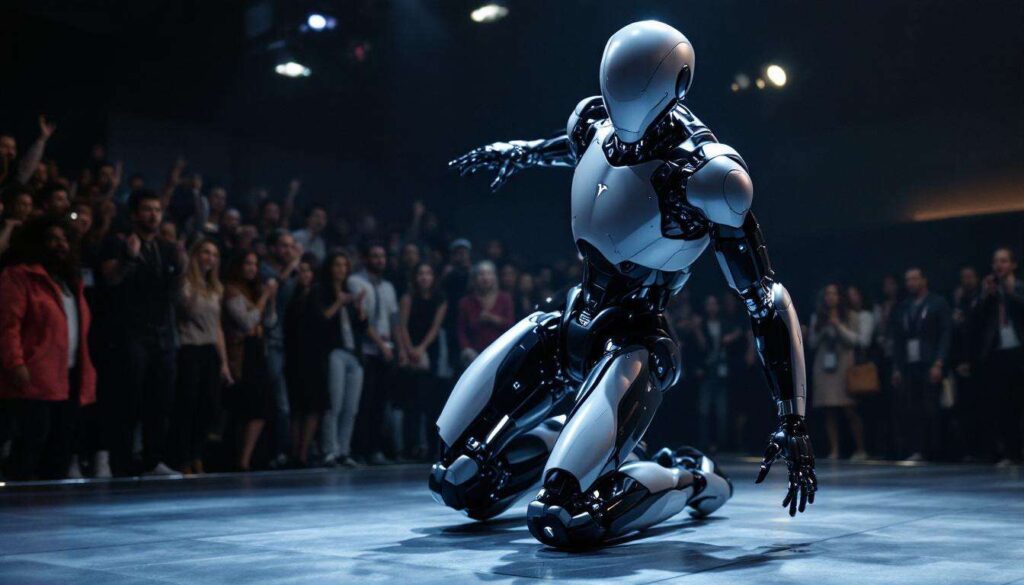
A recent demonstration in Miami, intended to showcase the advanced capabilities of Tesla’s humanoid robot, took an unexpected turn. The event, which featured the Optimus robot performing a series of tasks, concluded with the machine stumbling and falling, an incident captured on video and quickly circulated online. While mechanical failures are not uncommon in robotics development, this particular event has ignited a fierce debate, not just about the robot’s stability, but about the very nature of its operation. Scrutiny of the footage has led many experts and online observers to question the authenticity of the robot’s autonomy, suggesting that its intricate hand movements, seen moments before the fall, were not self-directed but were instead remotely controlled by a human operator.
Incident during the Miami demonstration
The demonstration was designed as a testament to Tesla’s progress in the competitive field of humanoid robotics. The stage was set to present Optimus as a capable, stable, and increasingly autonomous machine. However, the carefully orchestrated presentation unraveled in a matter of seconds, shifting the narrative from innovation to interrogation.
The context of the presentation
Tesla aimed to display Optimus’s ability to perform delicate tasks that require fine motor skills and environmental awareness. The tasks included picking up objects and interacting with a workstation. The audience, a mix of investors, tech enthusiasts, and media, was anticipating a flawless performance, building on previous videos released by the company. The goal was clear: to solidify confidence in Tesla’s ambitious timeline for the robot’s development and eventual deployment.
The sequence of the fall
Towards the end of its routine, while attempting to walk towards the edge of the stage, the Optimus unit appeared to lose its balance. Its movements became erratic for a moment before it pitched forward, falling stiffly onto the floor. The fall was abrupt and lacked any of the corrective movements one might expect from an advanced balancing system. Staff immediately rushed to the stage to attend to the fallen machine, and the demonstration was promptly concluded. The entire sequence, from the initial wobble to the fall, lasted no more than five seconds but was enough to cast a long shadow over the event.
Initial observations on site
Those present at the event noted a stark contrast between the fluid, almost human-like hand and arm movements displayed moments earlier and the clumsy, uncoordinated failure of the robot’s legs. This discrepancy was the first red flag for many observers. The robot seemed to possess a high degree of dexterity in its upper body while exhibiting a fundamental lack of stability in its lower body, a combination that robotics experts find highly unusual for a supposedly integrated and autonomous system.
This visible imbalance in capability between different parts of the robot fueled immediate speculation and set the stage for a deeper analysis of the events that transpired.
Public and Elon Musk’s reactions
The fallout from the demonstration was immediate, spreading rapidly across social media platforms and technology forums. The public’s reaction was a mix of mockery and genuine critique, while Tesla’s leadership was compelled to respond to the growing controversy. The incident became a flashpoint for discussions about transparency in tech demonstrations.
Social media erupts
Within hours, clips of the fall went viral. The incident drew comparisons to other famous robot failures, becoming the subject of countless memes and critical commentary. On platforms like X (formerly Twitter) and Reddit, users dissected the video frame by frame. Key points of discussion included:
- The unnatural stiffness of the fall.
- The seemingly disconnected performance of the hands versus the legs.
- The speed at which the demonstration was cut short.
This wave of public scrutinyput immense pressure on Tesla to provide an explanation.
Elon Musk’s official response
Elon Musk, known for his direct engagement on social media, addressed the incident on X. He acknowledged the fall, attributing it to a “calibration issue with the new actuator control software”. He emphasized that such setbacks are part of the development process, stating that “the path to advanced robotics is paved with failures”. However, he did not directly address the allegations of remote operation, a silence that many critics interpreted as conspicuous. His response aimed to normalize the failure as a routine developmental hiccup rather than a fundamental flaw in the robot’s design or a misrepresentation of its abilities.
The expert community weighs in
Robotics experts from academia and competing companies offered more nuanced takes. While agreeing that failures are normal, many pointed out that the nature of the Optimus demonstration raised specific concerns. They highlighted the discordance between the robot’s upper and lower body movements as a significant indicator that different systems, possibly with different levels of autonomy, were at play. The conversation among professionals centered less on the fall itself and more on the questions it raised about the authenticity of the robot’s advertised intelligence.
The divergence between the official explanation and expert analysis only deepened the mystery surrounding the robot’s true capabilities and the methods used to control it during the presentation.
Analysis of Tesla Optimus’s discordant movements
A closer look at the robot’s behavior reveals inconsistencies that trouble seasoned roboticists. The debate hinges on the stark contrast between the robot’s sophisticated manual dexterity and its rudimentary locomotive stability. This technical disharmony is at the core of the teleoperation controversy.
The curious case of the hand gestures
The most scrutinized aspect of the performance was the robot’s hands. Before the fall, Optimus was seen manipulating objects with a level of grace and precision that suggested advanced fine motor control. The finger movements were fluid and non-repetitive, closely mimicking human actions. Critics argue that this level of dynamic control is extremely difficult to achieve with current AI-driven autonomous systems and is more characteristic of a “human-in-the-loop” or teleoperation setup, where a person remotely controls the robot’s limbs.
Comparing autonomous vs. teleoperated movements
The difference between autonomous and teleoperated motion can be subtle, but key indicators often reveal the control method. Autonomous systems tend to have more calculated, sometimes slightly delayed or “robotic” movements as they process sensor data and compute the next action. Teleoperated systems, on the other hand, can exhibit the micro-movements, hesitations, and fluid corrections characteristic of the human operator.
| Feature | Fully Autonomous System | Teleoperated System |
|---|---|---|
| Movement Fluidity | Often methodical, can be jerky | Can be highly fluid, mimics human motion |
| Error Correction | Algorithmic, may pause to re-calculate | Immediate, intuitive corrections |
| Task Adaptability | Limited to pre-programmed skills | Highly adaptable to novel situations |
| Latency | Processing delay can be visible | Dependent on network, but can appear seamless |
Technical limitations of current robotics
While AI has made incredible strides, creating a fully autonomous bipedal robot that can walk and manipulate objects with human-like skill in an unstructured environment remains one of the greatest challenges in engineering. Balancing on two legs requires constant, complex calculations, a task that even Boston Dynamics, a leader in the field, has spent decades perfecting. The idea that Tesla has secretly solved both advanced locomotion and fine motor autonomy simultaneously, yet failed on a simple walk, strikes many as implausible.
This technical analysis leads directly to the central, uncomfortable question: was the audience watching a demonstration of artificial intelligence or a sophisticated act of digital puppetry ?
Questions about remote control
The suspicion that Optimus was not acting on its own accord has now moved from the fringes of online forums to the center of the discussion. The evidence, while circumstantial, paints a compelling picture that challenges Tesla’s narrative of developing a truly autonomous humanoid agent.
Evidence supporting the teleoperation theory
The primary argument for remote control stems from the visual evidence itself. The fluid, non-repetitive hand motions are seen as the “smoking gun”. In robotics, this is often achieved through a technique known as “telepresence” or “telerobotics”, where an operator wears a sensor-equipped suit or gloves that map their movements directly onto the robot. This would explain the high dexterity of the hands. The subsequent fall could then be explained as a failure of the bipedal locomotion system, which is much harder to control remotely in real-time and was likely running on a separate, less mature autonomous software.
Tesla’s claims of autonomy
Tesla has consistently presented Optimus as an AI-first project. The company’s official videos and presentations emphasize that the robot is running on the same neural network-based AI that powers its vehicle Autopilot system. The goal, according to Musk, is for Optimus to be able to learn and perform any task just by watching a human do it. This vision is fundamentally based on the promise of full autonomy. Admitting to remote control during a key demonstration would significantly undermine this core claim and suggest the project is much further from its goals than portrayed.
The “Wizard of Oz” technique in robotics
In the world of technology development, it is not unheard of to use the “Wizard of Oz” technique. This involves a human secretly controlling a system that is presented as autonomous in order to simulate the target functionality. While it can be a useful tool for user experience research, it becomes controversial when used in a public demonstration for investors and consumers without disclosure. The accusation is that Tesla may have employed this technique, showcasing the “goal” of the hand dexterity via a human operator while the autonomous walking system was not yet ready for prime time.
These unresolved questions about the robot’s control system have serious consequences, not just for the public’s perception of Optimus but for the very future of the project itself.
Consequences for the future of the humanoid robot
The Miami incident is more than just a momentary embarrassment; it could have lasting repercussions for the Optimus program and the broader field of humanoid robotics. Credibility, public trust, and competitive positioning are all at stake.
A blow to public confidence
For any revolutionary technology to succeed, it needs public buy-in. The suspicion that Tesla may have been less than transparent about Optimus’s true capabilities can erode trust. If the public and, more importantly, future customers believe the robot’s abilities are being exaggerated, it will be much harder for Tesla to market the product when it is eventually ready. Every future demonstration will now be viewed with a heightened sense of skepticism, with analysts and the public searching for signs of human intervention.
The race for humanoid robot supremacy
Tesla is not developing Optimus in a vacuum. A number of other companies are also making significant progress in the field.
- Boston Dynamics: Long considered the leader in dynamic robotics with its Atlas robot, known for its incredible agility and balance.
- Figure AI: A startup that has attracted significant investment and recently demonstrated its Figure 01 robot performing autonomous tasks after partnering with OpenAI.
- Agility Robotics: Focused on logistics and warehouse automation with its bipedal robot, Digit.
This incident gives competitors an opening, allowing them to position themselves as more transparent or technologically mature. A perceived stumble by Tesla could embolden rivals and shift investor focus elsewhere in the sector.
Re-evaluating demonstration protocols
The event will likely force Tesla and other robotics companies to reconsider how they demonstrate their technology. There is a fine line between showcasing a future vision and accurately representing current capabilities. The pressure to “wow” audiences can lead to overreach. Future demonstrations may become more conservative, focusing on reliably repeatable tasks rather than attempting complex, high-risk maneuvers. The industry may also face calls for more standardized, independently verified testing protocols to validate claims of autonomy.
Ultimately, the fallout from this single event will have a direct impact on the trajectory and strategy of Tesla’s entire robotics division.
Implications for Tesla’s development
The Optimus project is not a side quest for Tesla; it is presented as a critical part of the company’s future, intertwined with its core mission in artificial intelligence. Therefore, the robot’s perceived success or failure has wider implications for the entire company’s technological narrative and market valuation.
More than just a robot: a test for Tesla’s AI
Tesla has long argued that its expertise in vision-based AI for self-driving cars gives it a unique advantage in robotics. The Optimus robot is meant to be the ultimate proof of this thesis: an AI that can navigate and interact with the real world. A public failure, coupled with accusations of faking autonomy, directly challenges this central pillar of Tesla’s strategy. If the AI is not yet capable of preventing a simple fall, it raises questions about its readiness for the infinitely more complex and high-stakes environment of public roads.
Investor sentiment and stock market impact
While Tesla’s stock price is driven by many factors, a significant portion of its valuation is based on future growth narratives, with Optimus being a key one. Elon Musk has claimed the robot could eventually be more valuable than the company’s car business. Incidents like the Miami fall can spook investors by suggesting that this future is much further away, or more fraught with challenges, than previously believed. Any erosion in confidence in Tesla’s AI leadership can have a tangible impact on its market capitalization.
The long road to a viable “Tesla Bot”
The event serves as a stark reminder of the immense difficulty of the task Tesla has undertaken. Building a useful, general-purpose humanoid robot is a marathon, not a sprint. The incident highlights that progress is not always linear. It forces a more realistic perspective on the timeline for deploying thousands of these robots in factories, as Musk has envisioned. The company must now not only solve the immense technical challenges but also rebuild the credibility that was damaged by the demonstration’s flawed execution.
The fall of the Optimus robot in Miami has proven to be far more than a simple mechanical failure. It has exposed the fragile line between ambitious demonstration and technological reality, sparking a critical debate about the robot’s autonomy. The incident has cast a shadow of doubt over Tesla’s claims, creating a challenge of credibility that the company must now overcome. How Tesla navigates these technical and reputational hurdles will be crucial in determining not only the future of Optimus but also its broader standing as a leader in artificial intelligence.