



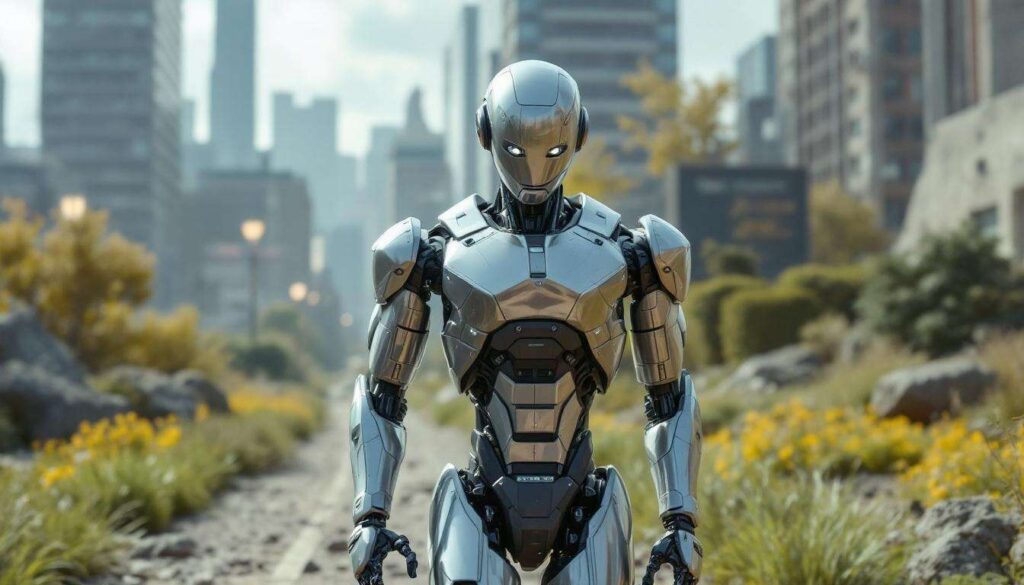
In a stunning display of robotic endurance, a bipedal robot has successfully completed a continuous walk lasting over three days, setting a new world record. The machine, named ‘Endurance-Bot’, traversed more than 100 kilometers without a single pause in its stride, thanks to an innovative system that allowed it to swap its own batteries while in motion. This breakthrough pushes the boundaries of autonomous systems, demonstrating a level of persistence previously thought to be years away and opening a new chapter in the quest for truly independent machines.
New achievement for robotics: an uninterrupted walk
Shattering previous records
The world of robotics is often measured by milestones, and this is a significant one. The previous record for a continuous robotic walk was a fraction of what Endurance-Bot achieved. This new accomplishment is not just an incremental improvement; it represents a paradigm shift in what is considered possible for autonomous mobility. The robot maintained a steady walking pace for 73 consecutive hours, a feat that tested the limits of its mechanical components, software, and power management systems. The project, a collaboration between a university research lab and a private tech firm, aimed specifically to solve the problem of limited operational time for mobile robots.
The importance of perpetual motion
Why is an uninterrupted walk so important ? For robots to become truly useful in real-world scenarios, they need to operate for extended periods without human intervention. Imagine search and rescue robots that can scour a disaster zone for days, not hours, or logistics robots that can operate 24/7 in a warehouse without needing to stop for a recharge. This achievement is a proof-of-concept for perpetual operation, a cornerstone for the future of automation. The ability to self-sustain is what separates a simple machine from a truly autonomous agent. The key metrics of this record-breaking walk highlight the scale of the achievement.
| Metric | Previous Record Holder | Endurance-Bot (New Record) |
|---|---|---|
| Continuous Operation Time | 18 hours | 73 hours |
| Total Distance Covered | 42 km | 105 km |
| Number of Battery Swaps | 0 (single charge) | 35 (automated) |
| Average Speed | 2.3 km/h | 1.4 km/h (conservative pace) |
Achieving this level of endurance was far from simple. It relied on overcoming one of the most fundamental engineering problems in mobile robotics: how to refuel without stopping, a process that involved intricate technical solutions.
The technical challenges of battery hotswapping
The mechanics of an in-motion swap
The core innovation behind the record is the hotswapping mechanism. This term refers to the ability to replace a component, in this case a battery, while the system is still running. For a walking robot, this is an immense challenge. The robot had to maintain its balance on one leg while a robotic arm, integrated into a mobile charging station, approached it, removed the depleted battery, and inserted a fully charged one. The entire process had to be completed in under 60 seconds to prevent the robot’s onboard capacitors from running out of their backup power. The precision required is immense, with tolerances of less than a millimeter for the docking and swapping procedure.
Software and hardware synchronization
Making the hotswap possible required a perfect symphony between hardware and software. A complex suite of sensors was necessary to orchestrate the maneuver. These included:
- Lidar and depth cameras: For the robot and charging station to locate each other with precision.
- Inertial measurement units (IMUs): To monitor the robot’s balance and stability throughout the swap.
- Force-torque sensors: On the robotic arm to ensure the battery was inserted and removed with the correct amount of pressure, avoiding damage.
This hardware was governed by a control system that had to predict the robot’s subtle movements and adjust the charging station’s arm in real-time. A single miscalculation in timing or position could have resulted in a fall, ending the record attempt instantly. This intricate dance between machines was not just pre-programmed; it was managed by an adaptive artificial intelligence.
Artificial intelligence at the heart of the performance
Learning to walk efficiently
Endurance-Bot’s journey was not just a physical marathon but also a computational one. The robot’s gait was not static; it was constantly being optimized by a reinforcement learning algorithm. This AI model adjusted the robot’s walking style in real-time to maximize energy efficiency. It learned, for instance, to take slightly shorter, quicker steps when the battery level was low to conserve power, and to adopt a more stable, flat-footed posture in preparation for a hotswap. This adaptive locomotion was crucial for extending the time between each battery change, thereby minimizing the number of high-risk swap maneuvers needed to complete the journey.
Predictive maintenance and error correction
Beyond walking, the AI was responsible for the robot’s self-preservation. It monitored hundreds of internal sensors, tracking motor temperature, joint strain, and battery health. The system used a predictive model to anticipate potential failures. For example, if a motor in the left leg began to overheat, the AI would subtly alter the robot’s gait to put less strain on that specific component, allowing it to cool down while continuing to walk. It could also detect anomalies during the hotswapping process and make micro-adjustments to ensure a successful connection. This proactive self-monitoring is what allowed the hardware to withstand the grueling 73-hour ordeal without a critical failure, a task that would be impossible with simple scripted commands.
While the technological prowess is undeniable, such an energy-intensive operation raises important questions about its broader resource consumption and environmental footprint.
Energy and environmental impacts
Evaluating the overall energy consumption
A robot that can walk for three days straight consumes a significant amount of electricity. The project’s lead engineers reported that the entire operation, including the robot’s movement and the charging of 35 separate batteries, consumed approximately 25 kilowatt-hours (kWh). While this is relatively modest compared to other industrial processes, it’s a non-trivial amount of energy. The efficiency of the system is a key point of focus. The team emphasized that the AI’s energy optimization routines reduced potential consumption by an estimated 15% over the course of the walk. Future iterations will focus on more efficient motors and lighter materials to further reduce the robot’s energy-per-kilometer rating.
The lifecycle of robotic components
The environmental discussion extends beyond just electricity. The production of advanced robots involves rare-earth metals for motors, complex electronics, and high-capacity lithium-ion batteries. The sustainability of such technology depends on the entire lifecycle of these components. Researchers are actively exploring:
- Battery recycling: Developing closed-loop systems to recover valuable materials from depleted batteries.
- Modular design: Creating robots where individual parts can be easily repaired or upgraded, rather than replacing the entire unit.
- Bio-inspired materials: Investigating lightweight, durable, and more sustainable materials to construct robot frames.
Addressing these environmental concerns is crucial for ensuring that the future of robotics is not only technologically advanced but also responsible, especially as these machines begin to integrate into our daily lives.
Future applications in everyday life
Logistics and last-mile delivery
One of the most immediate and promising applications for this technology is in the world of logistics. Imagine a fleet of bipedal robots capable of operating 24/7 within a massive warehouse, sorting packages and loading trucks without breaks. More revolutionary is the potential for last-mile delivery. A robot like Endurance-Bot could, in theory, pick up a package from a local distribution hub and walk it directly to a customer’s doorstep, navigating sidewalks, stairs, and other obstacles that challenge wheeled delivery drones. The ability to hotswap batteries at strategically placed charging stations would make such a network truly autonomous and highly efficient.
Search and rescue and hazardous environments
In scenarios too dangerous for humans, long-endurance robots could be invaluable. After an earthquake or building collapse, a team of these robots could enter the unstable environment and search for survivors for days on end, providing a constant stream of data to first responders. Their ability to operate without interruption is a critical advantage. Similarly, in industrial settings like nuclear power plants or chemical facilities, these robots could perform routine inspection and maintenance tasks in hazardous areas, drastically reducing the risk to human workers. The uninterrupted operational capability means more comprehensive and consistent monitoring of critical infrastructure.
This record-breaking achievement is a clear signal of progress, but it also serves as a stepping stone, prompting the industry to consider what comes next in the evolution of autonomous systems.
What are the next steps for the robotics industry ?
Improving robustness and all-terrain capability
The recent record was set on a flat, controlled surface. The next great challenge is to replicate this endurance in the real world. Future research will focus on enhancing the robot’s ability to navigate unstructured environments. This includes walking on uneven ground, climbing stairs, and adapting to changing weather conditions like rain or wind. Developing more robust hardware and more sophisticated AI perception systems will be key to making these robots practical for outdoor applications. The goal is to create a machine that can not only walk for days but can do so anywhere a human can go.
Miniaturization and cost reduction
For technology to be widely adopted, it must be accessible and affordable. The current prototype is a multi-million dollar piece of equipment. The industry’s next steps will involve a significant push towards miniaturization and cost reduction. This will be achieved through economies of scale in manufacturing, the development of less expensive sensors and actuators, and the simplification of mechanical designs without sacrificing performance. The ultimate aim is to produce robots that are not only capable but also economically viable for a wide range of commercial and even consumer applications, moving them from research labs into our homes and workplaces.
This record-setting walk marks a pivotal moment, transforming the concept of robotic endurance from a theoretical goal into a tangible reality. By solving the critical challenge of continuous power through AI-driven hotswapping, this achievement paves the way for a future where autonomous machines can perform long-duration tasks in logistics, disaster response, and industry. The path forward involves refining this technology for real-world complexity, reducing costs, and ensuring its development is sustainable, bringing us one step closer to a world of truly persistent and helpful robots.