



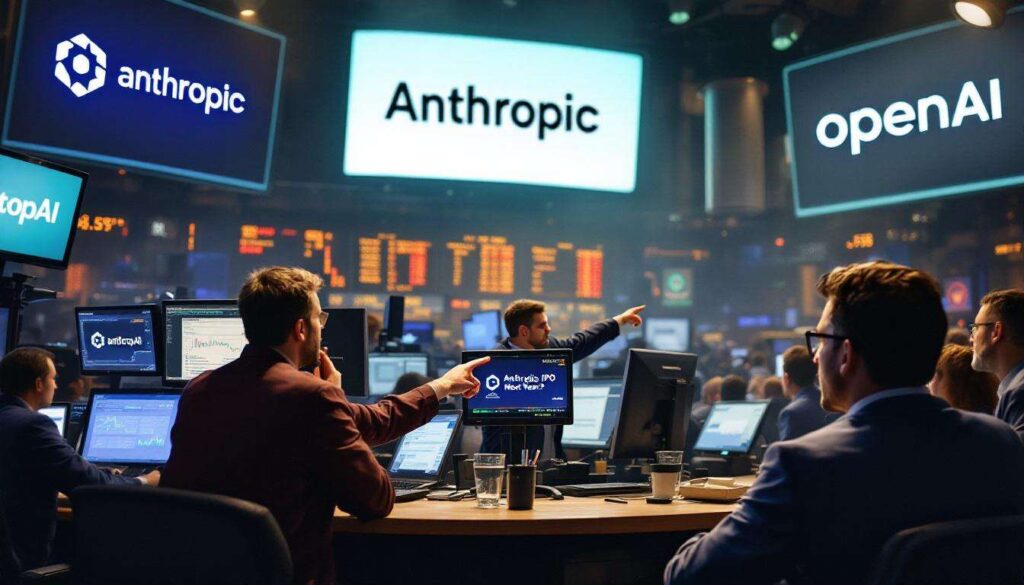
In the high-stakes arena of generative artificial intelligence, the rivalry extends beyond algorithms and processing power into the financial markets. The tech world is buzzing with speculation not just about the next breakthrough model, but about which of the sector’s titans will be the first to go public. At the center of this conversation are two names: the incumbent giant OpenAI and the rapidly ascending challenger, Anthropic. The question of which firm might beat the other to an initial public offering (IPO) as soon as next year is more than just a financial horse race; it’s a barometer for the maturity and commercial viability of the entire AI industry.
Introduction to the competition between Anthropic and OpenAI
The Titans of Generative AI
At the forefront of the AI revolution stand two distinct yet interconnected entities. OpenAI, creator of the globally recognized ChatGPT, has become synonymous with generative AI in the public consciousness. Its products have set the industry standard and driven mainstream adoption at an unprecedented pace. On the other side is Anthropic, a company founded by former OpenAI executives. It has rapidly carved out a significant niche with its family of models, known as Claude, which are lauded for their performance in complex reasoning and a strong emphasis on safety and ethical considerations.
Philosophical and Technical Divides
The competition between these two labs is not merely commercial; it is rooted in differing philosophies about the future of artificial intelligence. OpenAI, while advocating for safe development, has pursued a strategy of rapid scaling and deployment to a massive user base. Anthropic, in contrast, was founded on a principle of AI safety first. This is reflected in its technical approach, such as its “Constitutional AI” framework, a method designed to align AI behavior with a set of explicit principles. This fundamental difference in ideology shapes their product development, corporate structure, and ultimately, their potential paths to the public market. While one prioritizes mass-market penetration, the other builds its brand on trust and reliability, creating a compelling narrative for different sets of customers and investors.
This foundational emphasis on safety and a clear corporate mission has helped Anthropic attract significant attention and capital, fueling its remarkably fast growth in a sector dominated by giants.
The rapid rise of Anthropic
A Fundraising Juggernaut
Anthropic’s ascent has been nothing short of meteoric, largely powered by its ability to secure colossal funding from some of the biggest names in technology. This influx of capital has provided the resources needed to compete directly with established players. The company has successfully raised billions, demonstrating immense investor confidence in its vision and technology. This financial war chest is critical for covering the exorbitant costs of training state-of-the-art AI models and attracting top-tier talent. The backing from cloud giants is particularly strategic, providing not only cash but also the vital computing infrastructure required for AI development.
| Investor | Announced Investment | Year |
|---|---|---|
| Amazon | Up to $4 billion | 2023-2024 |
| Up to $2 billion | 2023 | |
| Menlo Ventures | $750 million (led round) | 2024 |
| Spark Capital | $450 million (led round) | 2023 |
Product Momentum with Claude
Beyond its fundraising success, Anthropic has gained significant traction with its product lineup. The Claude series of large language models has emerged as a formidable competitor to OpenAI’s GPT series. Key differentiators often cited by users and analysts include:
- A larger context window: Allowing for the processing and analysis of much larger documents or codebases in a single prompt.
- Strong performance on safety benchmarks: Claude is often perceived as being less prone to generating harmful or undesirable outputs.
- Advanced reasoning capabilities: The latest models, like Claude 3 Opus, have benchmarked ahead of competitors on several industry-standard evaluations for graduate-level reasoning.
This product strength gives Anthropic a compelling case for enterprise customers who prioritize accuracy, safety, and the ability to handle complex, large-scale tasks.
An IPO-Ready Narrative
Anthropic’s story seems tailor-made for an IPO. The company presents a clear narrative: a safety-conscious AI developer building more reliable and controllable systems. This positioning could resonate strongly with public market investors who may be wary of the reputational and regulatory risks associated with unchecked AI. Its more conventional corporate structure, compared to OpenAI’s complex arrangement, also presents a much clearer and more straightforward path to a traditional public offering, potentially giving it a crucial timing advantage.
However, while Anthropic’s path seems clearer, it is still chasing a rival that benefits from a significant head start and powerful strategic alliances.
OpenAI’s strategic advantages
First-Mover Advantage and Brand Recognition
OpenAI’s greatest asset is arguably its brand. ChatGPT was not just a product launch; it was a global cultural event that introduced millions of people to the power of generative AI. This has given OpenAI unparalleled name recognition and a massive user base that serves as a continuous feedback loop for improving its models. This first-mover advantage creates a powerful network effect, making its products the default choice for many developers, businesses, and individual users. Any competitor, including Anthropic, must fight an uphill battle to capture market share from such an entrenched and well-known leader.
The Microsoft Partnership
The strategic partnership with Microsoft is another cornerstone of OpenAI’s dominance. This alliance is more than just a financial investment; it’s a deep integration of technology and business strategy. Microsoft provides:
- Vast computing resources: Access to Microsoft Azure’s supercomputing infrastructure is essential for training ever-larger models.
- Enterprise distribution channels: OpenAI’s models are integrated into Microsoft’s suite of products, including Azure AI, Microsoft 365 Copilot, and Bing, giving it immediate access to a massive global customer base.
- Financial stability: A multi-billion dollar commitment from Microsoft provides a long-term capital runway, reducing the immediate pressure to seek public funds.
This symbiotic relationship gives OpenAI a level of scale and market access that is extremely difficult for a standalone company to replicate.
A Complex Corporate Structure
One of the most significant hurdles for an OpenAI IPO is its unique corporate structure. OpenAI began as a non-profit organization. It now operates under a “capped-profit” model, where the original non-profit entity still sits atop a for-profit subsidiary. This structure was designed to ensure that the company’s mission to build safe artificial general intelligence (AGI) would not be compromised by purely commercial profit motives. However, this hybrid model is unfamiliar to public market investors and presents challenges in terms of governance, shareholder rights, and profit distribution, making a standard IPO a complicated proposition.
These internal complexities, combined with external market pressures, create a challenging environment for any company considering a public debut.
Challenges of the stock market
The Volatility of Tech IPOs
The market for initial public offerings can be notoriously fickle, especially for technology companies with unproven long-term business models. Investor sentiment can shift rapidly based on macroeconomic factors like interest rates and inflation, as well as sector-specific concerns. An AI company going public would face intense scrutiny over its valuation, which is often based on future potential rather than current profits. A poorly timed IPO could fail to attract sufficient interest or see its stock price plummet shortly after listing, damaging the company’s reputation and financial standing. The pressure to deliver immediate, quarter-over-quarter growth is a stark contrast to the long-term, research-intensive nature of AI development.
Proving a Path to Profitability
For all the excitement surrounding generative AI, the path to sustainable profitability remains a significant challenge. The costs associated with building and running large-scale models are astronomical, driven by the need for massive computing power and top engineering talent. While companies are generating revenue through API access and premium subscriptions, it is unclear if this revenue can consistently outpace the immense operational expenses. Public investors will demand a clear and convincing plan to achieve profitability.
| Factor | Challenge | Potential Solution |
|---|---|---|
| Compute Costs | Training a single flagship model can cost hundreds of millions of dollars. | Model optimization, more efficient hardware, strategic cloud partnerships. |
| Revenue Streams | Heavily reliant on API usage and subscriptions, which can be competitive. | Diversification into enterprise solutions, licensing, and value-added services. |
| R&D Expenses | Constant need for innovation requires massive, ongoing investment in research. | Focus on commercial applications with clear ROI to fund pure research. |
Regulatory Scrutiny
The AI sector is facing a wave of potential regulation from governments around the world. Lawmakers are grappling with issues ranging from data privacy and copyright infringement to algorithmic bias and national security risks. The uncertainty surrounding future regulations creates a major risk for potential investors. A company going public would need to disclose these risks thoroughly, and any new legislation passed post-IPO could have a material impact on its business operations and profitability. This regulatory overhang adds another layer of complexity to the decision of when, or even if, to go public.
Navigating these market and regulatory hurdles will be critical in determining the timeline and success of any potential offering in the coming year.
Outlook for next year
Anthropic’s Potential Timeline
Given its conventional corporate structure and recent massive funding rounds that function like pre-IPO investments, Anthropic appears to be on a more direct path to the public markets. For a 2025 IPO to become a reality, the company would likely need to:
- Demonstrate several quarters of strong, predictable revenue growth from its enterprise customers.
- Solidify its C-suite with executives experienced in managing public companies.
- Begin the formal process of filing confidential paperwork with the Securities and Exchange Commission (SEC).
Its narrative of building safer, more reliable AI could be a significant advantage in winning over public investors concerned about the technology’s risks.
OpenAI’s Alternative Paths
For OpenAI, a traditional IPO in the near term seems less likely due to its capped-profit structure. However, the company has other options to generate liquidity for its employees and early investors. It has already conducted secondary share sales, allowing insiders to cash out some of their equity at a high valuation. Other potential avenues include a direct listing, which avoids some of the complexities of a traditional IPO, or continuing to leverage its partnership with Microsoft and other private investors to fund its growth indefinitely. The pressure to go public may be less intense for OpenAI, given its dominant market position and deep-pocketed backers.
Investor Appetite
The ultimate deciding factor will be the market’s appetite for a pure-play generative AI stock. Investors have shown tremendous excitement for AI, but this has mostly been expressed by investing in established public companies that benefit from the trend, like chipmaker Nvidia or cloud provider Microsoft. The first major AI lab to go public will be a test case. Its performance will signal whether public markets are ready to bet directly on the foundational model builders, with all their long-term promise and short-term financial uncertainties. A successful IPO would likely trigger a wave of similar offerings, while a failure could chill the market for years.
The outcome of this race to the stock market will not only shape the fortunes of the companies involved but will also send ripples across the entire technology landscape.
Potential impact on the artificial intelligence sector
Setting a Market Benchmark
The first major AI lab to go public, whether it be Anthropic or another player, will establish a crucial financial benchmark for the entire industry. Public market valuation will provide a tangible, widely accepted measure of what a leading generative AI company is worth. This will have a profound effect on the valuations of all other private AI startups, influencing future funding rounds, acquisition prices, and strategic planning. A high valuation could fuel even more investment in the sector, while a disappointing one could lead to a painful market correction for other private companies. This IPO will effectively put a price tag on the AI revolution itself.
The Race for Talent and Capital
Going public provides a powerful tool for attracting and retaining top talent: liquid stock options. For the engineers and researchers at the heart of AI development, the ability to cash in on their equity can be a significant draw. The company that goes public first may gain a competitive advantage in the relentless war for talent, able to offer compensation packages that private competitors struggle to match. Furthermore, access to public capital markets provides a vast, ongoing source of funding for the incredibly expensive process of research and development, potentially accelerating the pace of innovation for the public entity.
Increased Transparency and Pressure
Life as a public company comes with a new set of demands. The requirement to file quarterly financial reports and disclose material business information will bring an unprecedented level of transparency to the historically secretive world of AI development. This could reveal crucial details about the true costs of training models and the profitability of AI services. At the same time, the relentless pressure from shareholders to deliver short-term results could influence strategic decisions, potentially shifting focus from long-term, foundational research toward more immediate, commercially viable applications. This could fundamentally alter the research culture that has driven so many of the industry’s breakthroughs.
Ultimately, the race to an IPO is about more than just financial gain; it reflects the differing strategies of the industry’s leaders. Anthropic appears better positioned for a near-term offering due to its straightforward structure and clear investor narrative, while OpenAI’s market dominance is counterbalanced by a complex governance model that complicates a public listing. Whichever company proceeds, it will face a volatile market that demands a clear path to profitability amid intense regulatory scrutiny. The outcome will set a powerful precedent, shaping capital flows, the competition for talent, and the strategic direction of the entire AI sector for years to come.