

While major celestial events like the Perseids or Geminids often steal the cosmic spotlight, the night sky is a stage for countless other, more subtle performances. Among these is the Sigma Hydrids meteor shower, a minor but intriguing display that offers a unique opportunity for dedicated sky-watchers. This faint shower, active during the early winter nights of the Northern Hemisphere, presents a challenge that rewards patience with the quiet spectacle of meteors streaking across the darkness, each one a tiny remnant of a mysterious cosmic journey. Understanding this shower is to appreciate the less heralded, yet scientifically valuable, events that constantly unfold above us.
What are the Sigma Hydrids ?
Origin and discovery
The Sigma Hydrids (σ-Hydrids) are a stream of meteoroids that our planet intersects annually. Unlike many famous meteor showers, the Sigma Hydrids have an enigmatic origin. Astronomers have not yet definitively identified a parent body, such as a comet or asteroid, responsible for leaving this trail of cosmic debris. This mystery makes them a subject of ongoing research, as scientists use observations to calculate the stream’s orbit and trace it back to a potential source. The shower was officially confirmed and listed by the International Astronomical Union through video observations, highlighting the role of modern technology in cataloging even the most diffuse meteor streams. These observations are crucial for understanding the distribution and dynamics of small bodies within our solar system.
Characteristics of the meteors
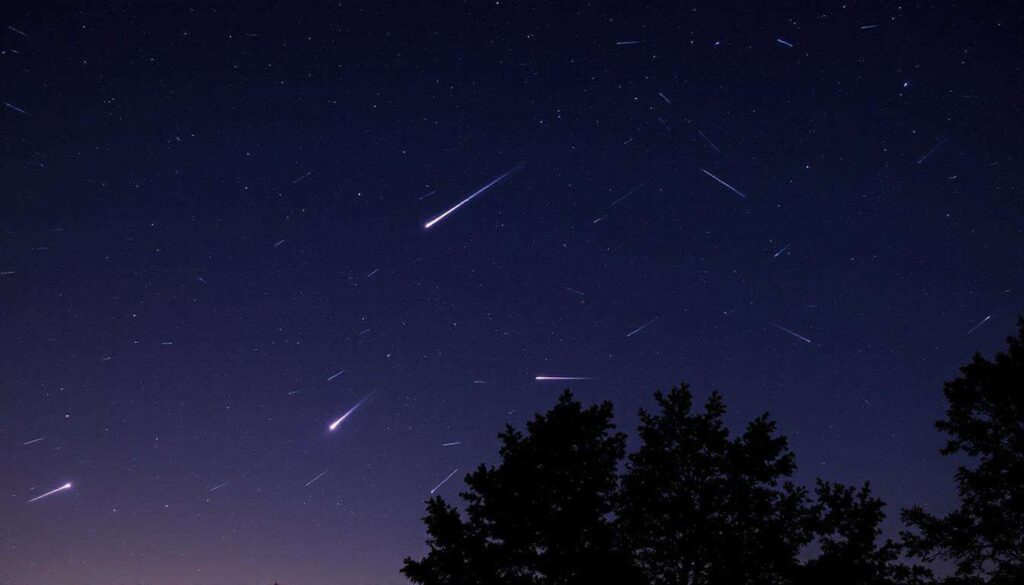
The meteors produced by the Sigma Hydrids are known for their speed. They enter Earth’s atmosphere at a very high velocity, which often results in bright, though fleeting, streaks of light. Despite their faintness as a shower overall, individual meteors can occasionally surprise observers with their brilliance. The composition of these meteoroids is believed to be typical of cometary debris: a fragile mix of ice and dust. When these particles, often no larger than a grain of sand, hit the upper atmosphere at immense speeds, they ablate and ionize the air around them, creating the visible glow we call a shooting star. Below is a comparison of the Sigma Hydrids with two major, more familiar meteor showers.
| Feature | Sigma Hydrids | Geminids | Perseids |
|---|---|---|---|
| Velocity | 58 km/s (fast) | 35 km/s (medium) | 59 km/s (fast) |
| Parent Body | Unknown | Asteroid 3200 Phaethon | Comet 109P/Swift-Tuttle |
| Observed Colors | Typically white or yellowish | Often yellow, can be green or blue | Primarily white or yellow, with fireballs |
Knowing the fundamental nature of these meteors naturally leads to the most practical question for any aspiring observer: when is the best time to witness this celestial event ?
Date and time of the maximum display
The peak activity window
The Sigma Hydrids are active for a relatively brief period, typically from late November through mid-December. However, the shower’s peak activity, the time when the highest number of meteors can be seen, occurs on or around December 4. This is the point when Earth passes through the densest part of the debris stream. Unlike some showers that have a broad peak lasting several nights, the Sigma Hydrids’ maximum is often quite sharp, making it important to target this specific date for the best chance of a successful observation. The number of visible meteors can rise and fall noticeably in the nights just before and after the peak.
Understanding the ZHR
The intensity of a meteor shower is measured by its Zenithal Hourly Rate (ZHR). This theoretical number represents the quantity of meteors an observer would see per hour under perfect conditions: a perfectly dark sky with the radiant, or the shower’s point of origin, directly overhead. For the Sigma Hydrids, the ZHR is quite low, typically estimated at only 3 to 5 meteors per hour. This classifies it as a minor shower and sets a realistic expectation for observers. It is a far cry from the spectacular outbursts of major showers, but it offers a more contemplative and serene viewing experience. The low rate underscores the need for ideal viewing conditions, as even minor interference can easily obscure the few meteors that do appear.
With a clear understanding of when to look, the next step is to determine where in the sky to direct your attention for the best view.
Where to observe the meteor shower
The radiant point
Every meteor shower is named for the constellation from which its meteors appear to originate. This point in the sky is known as the radiant. For the Sigma Hydrids, the radiant is located in the constellation Hydra, the largest of the 88 modern constellations. While the meteors will seem to streak away from this point, they can appear anywhere in the sky. In fact, a common mistake for beginners is to stare only at the radiant. The best technique is to lie back and take in as wide a view of the sky as possible. Meteors appearing farther from the radiant will often have longer, more dramatic trails, making them more impressive to watch.
Best hemispheres for viewing
The constellation Hydra is situated on the celestial equator, making the Sigma Hydrids technically visible from both the Northern and Southern Hemispheres. However, the radiant’s position gives a distinct advantage to observers in the Southern Hemisphere, where Hydra climbs much higher in the sky. A higher radiant means fewer meteors are lost below the horizon, increasing the observable rate. For observers in the Northern Hemisphere, the radiant remains lower in the southern sky, which can limit visibility. Despite this, the shower is still observable from mid-northern latitudes, provided you have an unobstructed view towards the south.
Pinpointing the location in the sky is only part of the equation; creating the right environment on the ground is equally critical for a successful night of meteor watching.
Ideal conditions for observation
Timing your observation
The best time to watch for the Sigma Hydrids is during the late-night and pre-dawn hours, generally after midnight local time. This is because the radiant in Hydra, like most constellations, rises higher in the sky as the night progresses. When the radiant is low on the horizon, many meteors are obscured by the thickness of Earth’s atmosphere. As it climbs higher, the path through the atmosphere is shorter, and more meteors become visible. Patience is key; the hours between 2:00 AM and 4:00 AM often provide the darkest skies and the highest radiant position, maximizing your chances of seeing these faint shooting stars.
Essential equipment
One of the great appeals of meteor watching is that it requires no expensive equipment. In fact, telescopes and binoculars are counterproductive, as they restrict your field of view. The most important tool is your own eyes. However, comfort is crucial for a long night of observation. Consider bringing the following items:
- A reclining lawn chair or a thick blanket to lie on the ground comfortably.
- Warm clothing, even if the evening feels mild. Temperatures can drop significantly overnight.
- A thermos with a warm beverage like coffee or hot chocolate.
- A red-light flashlight to preserve your night vision when you need to check a star chart or move around.
Letting your eyes adapt
Perhaps the most critical factor for seeing faint meteors is dark adaptation. It takes the human eye approximately 20 to 30 minutes to fully adjust to darkness and achieve its maximum sensitivity. During this time, you must avoid all sources of white light, including your phone screen, streetlights, and car headlights. Any brief exposure to bright light can reset the process, forcing you to start over. This period of adjustment is not just a suggestion; it is an absolute necessity for spotting the subtle streaks of the Sigma Hydrids.
Even with perfect preparation and adapted eyes, your viewing location can make or break the experience, with one primary adversary standing in the way of a clear view.
Impact of light pollution
The challenge of urban skies
Light pollution from cities and towns is the single greatest obstacle to observing a minor meteor shower like the Sigma Hydrids. The ambient glow from artificial lighting creates a bright sky-glow that can easily wash out all but the brightest meteors. From a typical suburban location, the already low rate of 3-5 meteors per hour could be reduced to zero. The faintness of this particular shower makes it extremely sensitive to sky conditions. Observing from within city limits is often an exercise in futility. The difference between seeing a handful of meteors and seeing none at all is almost entirely dependent on the darkness of your chosen site.
Finding a dark sky location
To truly appreciate the Sigma Hydrids, you must make an effort to get away from city lights. Seek out a location with a clear, open view of the sky, far from direct sources of light. State parks, national forests, or designated dark sky preserves are ideal choices. Online tools such as dark sky maps can help you identify areas with minimal light pollution near you. Even driving 20 or 30 miles outside of a major metropolitan area can make a dramatic difference, revealing a sky filled with more stars and, consequently, a better chance of catching a glimpse of a fleeting meteor.
The moon’s role
Besides artificial lights, the moon is the most significant source of natural light pollution. A bright, full moon can illuminate the sky almost as effectively as a city, drastically reducing the number of visible meteors. Before planning your observation night, it is essential to check the lunar phase. The ideal time to watch any meteor shower is during the new moon or when the moon is in a thin crescent phase. If the peak of the Sigma Hydrids coincides with a full or gibbous moon, your chances of seeing the shower will be severely hampered. In such cases, it may be better to try observing on a different night within the shower’s activity window when the moon is less prominent.
Beyond the technical aspects of observation, the Sigma Hydrids hold a certain allure rooted in their scientific puzzles and unique place in the celestial calendar.
Anecdotes and interesting facts
The elusive parent body
The most compelling story of the Sigma Hydrids is the one that is not yet finished: the search for its origin. The orbits of most meteor showers have been successfully traced back to a specific comet or, in some cases, an asteroid. For example, the Perseids come from Comet Swift-Tuttle, and the Geminids originate from the asteroid 3200 Phaethon. The Sigma Hydrids, however, remain an orphan stream. Scientists have proposed several candidates over the years, but none have been a definitive match. This ongoing mystery makes every observed Sigma Hydrid meteor a small piece of a larger puzzle, a clue that could one day help astronomers identify the long-lost parent that spawned this faint but persistent stream of cosmic dust.
A shower of many names
While commonly known as the Sigma Hydrids, this shower is also cataloged under the designation SHY by the International Astronomical Union’s Meteor Data Center. Its scientific name is derived directly from its radiant’s proximity to the star Sigma Hydrae. This systematic naming convention helps astronomers differentiate it from other minor showers that also radiate from the massive Hydra constellation throughout the year. It is a quiet member of a family of showers, each with its own unique orbital path and characteristics, painting a complex picture of the debris environment our planet travels through.
Scientific significance
Even a minor shower with a low ZHR holds significant scientific value. By studying the trajectory, speed, and composition of Sigma Hydrid meteors, researchers can refine their models of the solar system’s dust cloud. These observations help map the distribution of matter, understand the decay of comets, and assess potential impact risks from larger meteoroids. Professional and amateur astronomers using video detection networks contribute valuable data, proving that even the faintest of celestial events can provide profound insights into the workings of our cosmic neighborhood.
The Sigma Hydrids offer a quiet spectacle for those willing to seek it out. This minor shower, peaking in early December, challenges observers with its low rate of fast-moving meteors. Its visibility is best from the Southern Hemisphere but possible from the north, demanding a location far from city lights and a moonless sky. Above all, the shower’s unknown parent body adds a layer of scientific mystery, reminding us that even in a well-mapped sky, there are still secrets waiting to be discovered.