



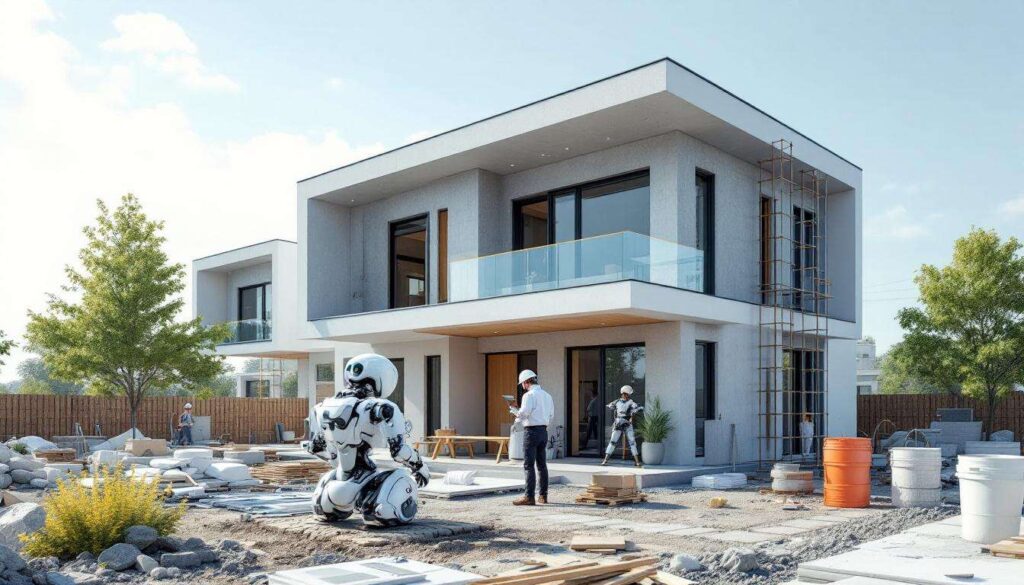
A housing crisis, fueled by soaring costs, labor shortages, and sluggish construction rates, has left millions struggling to find affordable places to live. In the face of this challenge, a technological breakthrough is emerging that promises not just incremental improvement but a paradigm shift. Imagine a complete, 200-square-meter home, not just framed but fully erected, in a single 24-hour cycle. This is no longer science fiction but the tangible result of advanced robotic construction, a development poised to reshape our very concept of building and potentially offer a powerful solution to one of society’s most pressing problems.
Introduction to robotic construction technology
What is robotic construction ?
Robotic construction refers to the use of autonomous or semi-autonomous robots and automated systems to perform construction tasks. This goes far beyond simple machinery; it involves an integration of advanced robotics, artificial intelligence, and digital modeling. The technology encompasses a range of applications, from 3D printing entire building structures with massive robotic arms to the precise placement of bricks and the assembly of prefabricated components. At its core, it is about translating a digital blueprint directly into a physical structure with minimal human intervention, maximizing speed, precision, and efficiency.
The evolution of automation in building
The path to a fully automated construction site has been a gradual one. While automation has been present in manufacturing for decades, the dynamic and often unpredictable environment of a construction site presented unique challenges. The evolution can be seen as a series of steps:
- Prefabrication: The initial step involved building components, like walls or modules, in a controlled factory setting before transporting them to the site for assembly.
- Early robotics: Simple, single-task robots were introduced for activities like welding or material transport.
- Building Information Modeling (BIM): The development of sophisticated 3D modeling software allowed for the creation of detailed digital twins of buildings, laying the groundwork for robotic execution.
- Modern autonomous systems: Today, large-scale 3D printers and multi-axis robotic arms can execute complex construction sequences directly from BIM data, representing a true leap forward in construction technology.
Key technologies involved
Several key technologies converge to make robotic construction possible. The most prominent is additive manufacturing, commonly known as 3D printing. Giant, gantry-mounted or robotic arm-based printers extrude layers of specialized, quick-curing materials like concrete to build walls from the ground up. Alongside this, robotic arms, similar to those in automotive plants, are used for “subtractive” manufacturing and component assembly, such as bricklaying or installing panels. Drones are also utilized for initial site surveying and ongoing progress monitoring, feeding real-time data back into the system to ensure accuracy.
Now that the technological foundations are clear, it is essential to understand the precise sequence of events that allows a robot to erect a home in such a remarkably short timeframe.
How a robot builds a house
The step-by-step process
Building a house with a robot is a highly orchestrated process that begins long before any material is laid. The typical workflow follows a clear, digitally-driven path. First, architects and engineers create a detailed 3D model of the house using BIM software. This digital blueprint is then fed into the construction robot’s control system. On-site, a small human crew prepares the foundation and sets up the robotic equipment, which often involves assembling a gantry or track system for the robot to move along. Once activated, the robot begins its work, typically by extruding the structural walls layer by layer. The process is continuous, often running through the night. The system is programmed to leave spaces for plumbing, electrical conduits, windows, and doors, which are typically installed by human workers after the main structure is complete.
Materials used in robotic construction
Traditional construction materials are often unsuitable for high-speed robotic applications. The most common material used in 3D-printed construction is a proprietary concrete blend, often referred to as ‘ink’ or ‘mortar’. This material is engineered to have specific properties:
- Flowability: It must be fluid enough to be pumped through the machine’s nozzle without clogging.
- Rapid curing: It must harden quickly enough to support the weight of subsequent layers almost immediately.
- Strength: It must meet or exceed the structural integrity standards of conventional concrete.
Beyond concrete, researchers and companies are experimenting with more sustainable materials, including geopolymers made from industrial waste and composites using recycled plastics. The goal is to create a building process that is not only fast but also environmentally responsible.
The role of human oversight
Despite the high level of automation, human expertise remains crucial. A team of technicians and engineers is always present on-site to monitor the robot’s performance, manage the material supply, and troubleshoot any issues that may arise. Furthermore, specialized trades such as electricians, plumbers, and roofers are still required to complete the home. The robot’s role is to erect the core structure with unprecedented speed and precision, freeing up human labor to focus on more complex, finishing tasks. It is a collaborative effort between man and machine.
This highly efficient and collaborative process yields a host of advantages that extend far beyond the construction site and into the broader real estate market.
The benefits of robotic construction for the real estate market
Speed and efficiency
The most dramatic benefit of robotic construction is the radical compression of the building timeline. A process that traditionally takes months can be reduced to days or even hours for the structural phase. This acceleration means properties can be brought to market faster, generating quicker returns for developers and, more importantly, increasing the housing supply at a pace previously thought impossible. The efficiency gains are stark when compared side-by-side.
| Phase | Traditional Construction | Robotic Construction |
|---|---|---|
| Structural Framing/Walls | 4-8 weeks | 24-48 hours |
| Material Waste | 15-20% | |
| On-site Labor (Structural) | 10-15 workers | 2-4 technicians |
Cost reduction
Significant cost savings are realized through several channels. First, the dramatic reduction in construction time leads to lower financing costs and less time paying for on-site labor. Second, robotic systems are incredibly precise, which drastically reduces material waste. Unlike traditional methods where materials are cut to fit on-site, a 3D printer only deposits the exact amount of material needed. Finally, the reduced need for manual labor, especially for the physically demanding framing and masonry stages, directly cuts down on payroll expenses, which constitute a major portion of any construction budget.
Improved safety and precision
Construction is notoriously one of the most dangerous industries. By automating the most hazardous tasks, such as working at height and heavy lifting, robotic construction significantly reduces the risk of on-site accidents and injuries. Moreover, robots operate with a level of precision that is difficult for humans to consistently replicate. They follow the digital blueprint to sub-millimeter accuracy, resulting in higher-quality, more resilient structures with fewer errors that could lead to costly rework or long-term structural issues. This enhances not only the safety of the workers but also the quality and longevity of the final product.
With benefits this profound, the technology is not merely an industry novelty; it stands as a direct and powerful countermeasure to the systemic issues driving the housing crisis.
Potential impact on the housing crisis
Increasing housing supply rapidly
The core of the housing crisis is a simple, yet severe, imbalance between supply and demand. There are not enough homes for the people who need them. Robotic construction directly addresses this bottleneck by enabling the rapid development of new housing units. The ability to erect the structure of a home in 24 hours means that entire communities could potentially be built in the time it traditionally takes to build a handful of houses. This rapid scaling of supply is perhaps the most critical contribution this technology can make to easing market pressures and stabilizing prices.
Making housing more affordable
Cost is the other major barrier to homeownership. By lowering the expenses associated with labor, materials, and construction time, robotic building can significantly reduce the overall cost of a new home. These savings can then be passed on to the buyer, making homeownership attainable for a larger segment of the population. This could be particularly impactful for the development of affordable housing projects, where budget constraints are often the primary obstacle. The technology offers a viable path to creating dignified, low-cost housing at scale.
Addressing labor shortages
The construction industry has been grappling with a chronic shortage of skilled labor for years, a problem that slows down projects and drives up wages and, consequently, housing prices. Robots are not intended to replace the entire workforce but to augment it. They can perform the repetitive, strenuous, and often undesirable tasks, filling a critical gap in the labor market. This allows human workers to focus on higher-value roles that require critical thinking and specialized skills, creating a more efficient and sustainable workforce model for the future.
This potential is not merely theoretical; pioneering companies around the globe are already demonstrating the real-world viability of this technology.
Case studies and concrete examples
The Apis Cor project
A prime example of this technology in action is the work of Apis Cor. The company gained international attention for 3D printing the world’s largest 3D-printed building in Dubai. The two-story administrative building, covering 640 square meters, was printed directly on-site under challenging environmental conditions. This project proved that the technology was not limited to small, single-story structures but could be scaled for larger, more complex commercial applications, showcasing its robustness and versatility.
ICON’s initiatives in the US
In the United States, Texas-based company ICON has been at the forefront of deploying 3D-printed housing. They have partnered with non-profits to create communities of homes for the chronically homeless in Austin, Texas. Furthermore, their ‘Project Olympus’ has received funding from NASA to develop methods for constructing habitats on the Moon and Mars. This demonstrates the technology’s wide range of applications, from providing shelter for the most vulnerable on Earth to enabling exploration in the most extreme environments imaginable. ICON’s work underscores a commitment to using robotic construction for social good and technological advancement.
Mighty Buildings and prefabricated modules
Taking a slightly different approach, Mighty Buildings utilizes robotics and 3D printing within a factory setting. They produce prefabricated panels and modules that are then transported to the construction site for rapid assembly. This hybrid model combines the quality control of a factory environment with the speed of robotic manufacturing. Their focus on creating accessory dwelling units (ADUs) and small homes highlights a strategy to increase housing density in existing urban areas, a key tactic in combating urban sprawl and housing shortages.
| Company | Key Achievement | Primary Method | Notable Project Location |
|---|---|---|---|
| Apis Cor | Largest 3D-printed building | On-site robotic 3D printing | Dubai, UAE |
| ICON | First permitted 3D-printed homes in the US | On-site robotic 3D printing | Austin, Texas, USA |
| Mighty Buildings | UL-certified 3D-printed housing components | Factory-based robotic prefabrication | Oakland, California, USA |
These pioneering efforts are setting the stage for a future where robotic construction becomes a mainstream solution, with even greater integration of intelligence and sustainable practices.
Future prospects for robotic construction
Scaling up production
The next frontier for robotic construction is moving from building individual homes to developing entire neighborhoods. This leap requires overcoming significant logistical challenges, including managing the supply chain for specialized materials at a massive scale and streamlining regulatory approvals across different municipalities. The industry is working on developing mobile “micro-factories” that can be deployed to large construction sites, enabling the continuous, on-demand production of building components and entire structures.
Integration of AI and machine learning
The future of construction robots lies in making them smarter. By integrating artificial intelligence and machine learning, robots will be able to move beyond simply executing pre-programmed instructions. They will be able to analyze their work in real-time, identify and correct errors, and even adapt their building strategy based on environmental conditions like temperature or humidity. An AI-powered system could, for example, slightly alter the concrete mix in real-time to ensure optimal curing, a task that currently requires expert human judgment. This will lead to even greater efficiency and higher-quality builds.
Sustainability and new materials
There is a strong push to make robotic construction a cornerstone of the green building movement. Future developments will focus heavily on innovative, sustainable materials that can be used in robotic printers. Potential materials being researched include:
- Bio-composites: Materials made from organic matter like wood fiber or hemp.
- Recycled polymers: Using plastic waste as a primary ingredient for structural components.
- Earth-based materials: Developing techniques to 3D print with locally sourced soil or clay, dramatically reducing the carbon footprint of construction.
This focus on sustainability will be crucial for the technology’s long-term adoption and its ability to create not just affordable, but also environmentally friendly, housing.
The swift rise of robotic construction represents more than just a technological curiosity; it is a pragmatic and powerful response to the global housing crisis. By drastically reducing construction time, lowering costs, and improving safety and precision, this technology offers a tangible path toward rapidly increasing the supply of affordable and high-quality homes. While challenges in scaling and regulation remain, the successful projects already completed by industry pioneers prove that building a home in 24 hours is not only possible but is likely to become a key feature of our future built environment.