



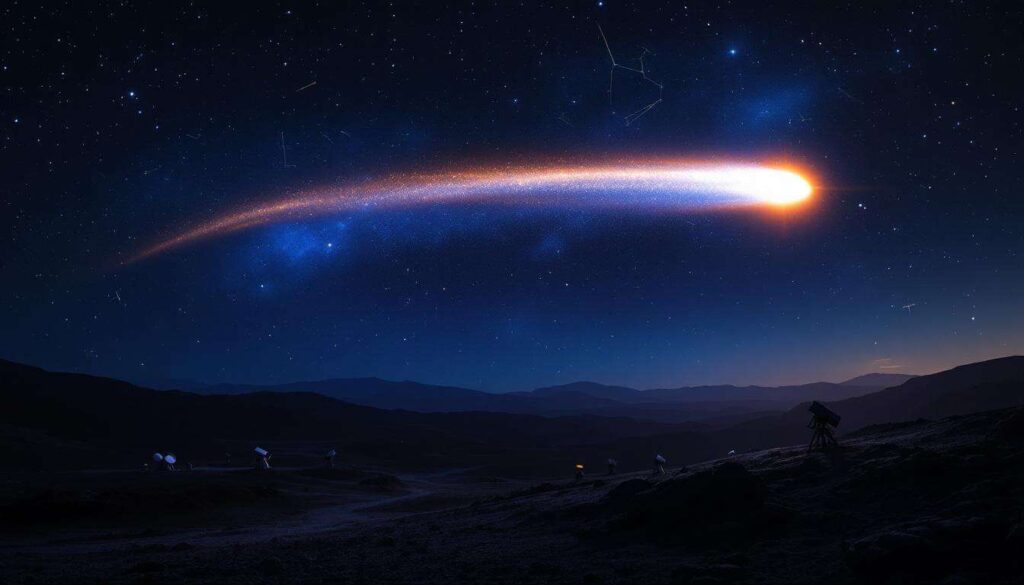
Witness the cosmos in unprecedented detail. A consortium of international astronomers has just unveiled a breathtaking collection of images showcasing 3I ATLAS, a rare visitor from beyond our solar system. These new observations provide a crucial, close-up look at an object forged around another star, offering humanity a direct glimpse into the building blocks of distant worlds. The data gathered promises to reshape our understanding of cometary science and the very nature of interstellar space.
Discovery of the interstellar phenomenon 3I ATLAS
An unexpected visitor
The story of 3I ATLAS began not with a planned search, but with a routine sky survey. The object was first detected by the Asteroid Terrestrial-impact Last Alert System (ATLAS) in Hawaii, a robotic astronomical survey designed to spot near-earth objects that could pose a threat. Initially cataloged as just another comet, its true nature quickly became apparent. Astronomers noticed its trajectory was not the closed ellipse of an object bound to our sun, but a sharp, open-ended hyperbola. This was the tell-tale sign of an object that had journeyed for eons through the vast emptiness between stars before its chance encounter with our solar system.
Initial observations and trajectory
Once the alarm was raised, telescopes around the world pivoted to track the faint celestial traveler. The initial calculations of its path were critical. They confirmed that 3I ATLAS was moving far too fast to be gravitationally bound to the sun, cementing its status as an interstellar object. Its high eccentricity and inclination relative to the plane of our solar system distinguished it sharply from native comets. These early measurements were essential for predicting its path, allowing larger observatories to prepare for detailed follow-up observations as it made its closest approach.
| Parameter | 3I ATLAS | Typical Long-Period Comet |
|---|---|---|
| Orbital Eccentricity | > 1.0 (hyperbolic) | |
| Origin | Interstellar space | Oort cloud |
| Velocity relative to the sun | High (unbound) | Lower (bound) |
Naming and classification
The designation ‘3I’ is significant. The ‘I’ stands for interstellar, and the ‘3’ signifies that this is the third such object ever confirmed by the scientific community, following in the footsteps of ‘Oumuamua (1I) and Borisov (2I). Each new discovery adds a vital data point to a very small set, helping astronomers understand the diversity and population of these interstellar wanderers. The name ‘ATLAS’ simply honors the survey that first discovered it, a common practice in astronomical nomenclature.
The confirmation of a third interstellar visitor galvanized the astronomical community, leading to an unprecedented campaign of coordinated observation involving facilities across the globe.
International observatories at work
A global collaborative effort
The study of 3I ATLAS was not the work of a single institution but a testament to modern scientific collaboration. Major ground-based and space-based observatories pooled their resources to capture every possible detail. The effort included powerhouses like the Hubble Space Telescope, offering unparalleled clarity from above earth’s atmosphere, and the European Southern Observatory’s Very Large Telescope (VLT) in Chile, with its suite of advanced instruments. Observatories in Hawaii, such as the Keck Observatory and the Canada-France-Hawaii Telescope, also played pivotal roles, taking advantage of their prime location for astronomical viewing.
Techniques and instrumentation
A multi-faceted approach was necessary to decode the comet’s secrets. Astronomers deployed a range of sophisticated techniques to study 3I ATLAS from afar. These included:
- High-resolution imaging: Using adaptive optics to correct for atmospheric distortion, ground-based telescopes captured sharp images of the comet’s nucleus and the surrounding cloud of gas and dust known as the coma.
- Spectroscopy: By splitting the comet’s faint light into its constituent colors, spectrographs on telescopes like the VLT could identify the chemical fingerprints of the molecules and elements being released from its surface.
- Polarimetry: This technique measures the orientation of light waves reflecting off the comet’s dust grains, providing clues about their structure, size, and composition.
Overcoming observational challenges
Observing 3I ATLAS was a formidable challenge. The comet was an incredibly faint target, and it was moving rapidly across the sky. This required precise tracking and often long exposure times to gather enough light. Furthermore, coordinating observations between telescopes in different time zones, each with its own weather constraints and schedules, demanded meticulous planning and constant communication among research teams. The success of this campaign highlights the agility and collaborative spirit of the global astronomical community.
This massive observational effort yielded a treasure trove of data, most notably a series of stunning images that brought the distant visitor to life.
The captured images: a visual revelation
High-resolution portraits
The newly released images offer the most detailed view yet of an interstellar comet. Hubble’s images, in particular, resolve the comet’s inner coma with remarkable clarity, revealing jets of gas and dust erupting from the surface of its nucleus. These jets are activated as the sun’s heat vaporizes ices on the comet’s surface. The images show a dynamic and active world, not merely a static rock. The structure of the dust tail, stretching for thousands of kilometers, is also clearly visible, shaped by the pressure of solar radiation.
Multi-wavelength perspective
By observing 3I ATLAS across different wavelengths of light, from ultraviolet to infrared, astronomers pieced together a more complete picture of the object. Infrared observations, for instance, are sensitive to the heat radiated by dust particles, allowing scientists to map the temperature and distribution of dust in the coma. Ultraviolet observations, on the other hand, are ideal for detecting certain types of gas molecules, like hydroxyl (OH), which is a byproduct of water ice. This multi-wavelength approach is crucial for understanding the comet’s complete inventory of materials.
| Wavelength | Primary Target | Key Findings |
|---|---|---|
| Ultraviolet | Gas molecules (e.g., OH) | Revealed water production rate |
| Visible | Dust, reflected sunlight | Mapped coma and tail structure |
| Infrared | Thermal emission from dust | Determined dust temperature and size |
Evidence of fragmentation
Perhaps one of the most exciting revelations from the imaging campaign is the evidence that 3I ATLAS is undergoing fragmentation. A series of images taken over several days shows a smaller piece of the nucleus breaking away and slowly drifting from the main body. This is not uncommon for comets, but observing it happening to an interstellar object provides a unique opportunity to study the structural integrity and internal composition of a body formed in an entirely different star system.
These captivating images are more than just pretty pictures; they are rich datasets that form the basis for rigorous scientific analysis into the comet’s fundamental properties.
Scientific analysis of the 3I ATLAS
Compositional breakdown
Spectroscopic analysis of the light from 3I ATLAS has begun to reveal its chemical makeup. The data indicate the presence of several familiar molecules commonly found in our own solar system’s comets. However, the relative abundances of these substances show intriguing differences. For example, early results suggest an unusual ratio of carbon monoxide to water, which could point to the comet forming in a much colder region of its native protoplanetary disk than where our own comets formed. Detected compounds include:
- Water (H₂O)
- Carbon monoxide (CO)
- Cyanide (CN)
- Diatomic carbon (C₂)
This chemical inventory acts as a direct probe of the chemistry of its birthplace.
Physical characteristics
Based on the brightness and behavior of the comet, scientists have been able to estimate some of its key physical properties. The nucleus is thought to be relatively small, likely no more than a few kilometers in diameter. Analysis of the repeating patterns in its light curve suggests a rotation period of several hours. The outgassing rate, or the amount of material being shed as it nears the sun, provides clues about the mix of ices on its surface and its thermal properties. These data points are vital for building a complete physical model of the object.
Unraveling its origin
The ultimate goal of this analysis is to trace 3I ATLAS back to its home. While pinpointing the exact parent star is nearly impossible due to the chaotic nature of galactic orbits over millions of years, its composition offers clues. A high abundance of volatile ices like carbon monoxide might suggest it originated from a system around a cool, red dwarf star, or perhaps from the outer fringes of a sun-like star’s system. Every piece of data, from its chemistry to its trajectory, helps astronomers constrain the type of stellar environment that gives birth to such objects.
Understanding the properties of this single object has profound implications for our broader understanding of how planetary systems form and evolve throughout the galaxy.
Implications for modern astronomy
A window into other solar systems
Interstellar objects like 3I ATLAS are revolutionary for astronomy. For centuries, our study of extrasolar systems has been indirect, relying on the faint light from distant stars. These visitors are physical artifacts from those systems, delivered directly to our doorstep. By studying them, we can analyze the raw materials of another solar system up close, in a way that is impossible with telescopes alone. They are, in essence, free sample-return missions from other stars.
Testing theories of planet formation
The dominant theories of how planets form are based almost exclusively on observations of our own solar system. 3I ATLAS provides a critical test case. Does its composition match what our models would predict for a comet from another system ? Do its physical properties align with our understanding of how planetesimals—the building blocks of planets—accrete and evolve ? If it shows significant differences, it may force a re-evaluation of some fundamental aspects of planet formation theory, suggesting that the process may be more diverse across the galaxy than previously thought.
The frequency of interstellar visitors
The discovery of three interstellar objects in just a few years, after centuries of none being detected, is not a coincidence. It is a direct result of new, more powerful sky surveys like ATLAS and Pan-STARRS. This suggests that these interstellar wanderers may be far more common than once believed. Statistical analysis based on these detections indicates that the space between stars might be teeming with trillions of such objects. This has significant implications for understanding how much mass is ejected from developing solar systems and how these objects might transport materials between stars.
The discovery and analysis of 3I ATLAS not only answer old questions but also pave the way for new avenues of research and motivate the development of future missions.
Future perspectives and upcoming missions
Continued monitoring of 3I ATLAS
As 3I ATLAS continues its journey back out of the solar system, astronomers will keep a close watch. Observing how its activity changes as it moves away from the sun and cools down can provide further insights into its composition and structure. The object will be tracked by our most powerful telescopes for as long as it remains detectable, wringing every last drop of information from this fleeting visit before it disappears once more into the interstellar void.
Upcoming sky surveys
The future of interstellar object detection is bright. The Vera C. Rubin Observatory, currently under construction in Chile, is set to revolutionize the field. When it comes online, its deep and wide survey of the entire southern sky every few nights is expected to discover dozens of interstellar objects every year. This will transform the field from the study of rare, individual curiosities into a statistical science, allowing astronomers to classify different populations of interstellar visitors and truly map the distribution of these objects throughout our corner of the galaxy.
The promise of intercept missions
The ultimate dream is to visit one of these objects up close. While it is too late to catch 3I ATLAS, space agencies are already planning for the next opportunity. The European Space Agency’s ‘Comet Interceptor’ mission is designed to do just that. It will be parked in space, waiting for the discovery of a suitable interstellar object on a reachable trajectory. Once a target is identified, the spacecraft would be sent on a high-speed chase to fly by the object, capturing images and data of a truly pristine body that has never been altered by a close pass to a star. Potential goals for such a mission would be:
- High-resolution imaging of the nucleus’s surface features.
- In-situ analysis of the gas and dust in the coma.
- Precise measurement of the object’s mass and density.
Examine the legacy of 3I ATLAS. Its brief passage through our solar system, captured in these stunning new images, has provided an invaluable piece of an immense cosmic puzzle. The scientific analysis offers a direct sample of material from another star system, testing our theories of planet formation. Acknowledge that with future observatories and missions on the horizon, the study of these interstellar messengers is poised to begin a new chapter in our exploration of the galaxy.