



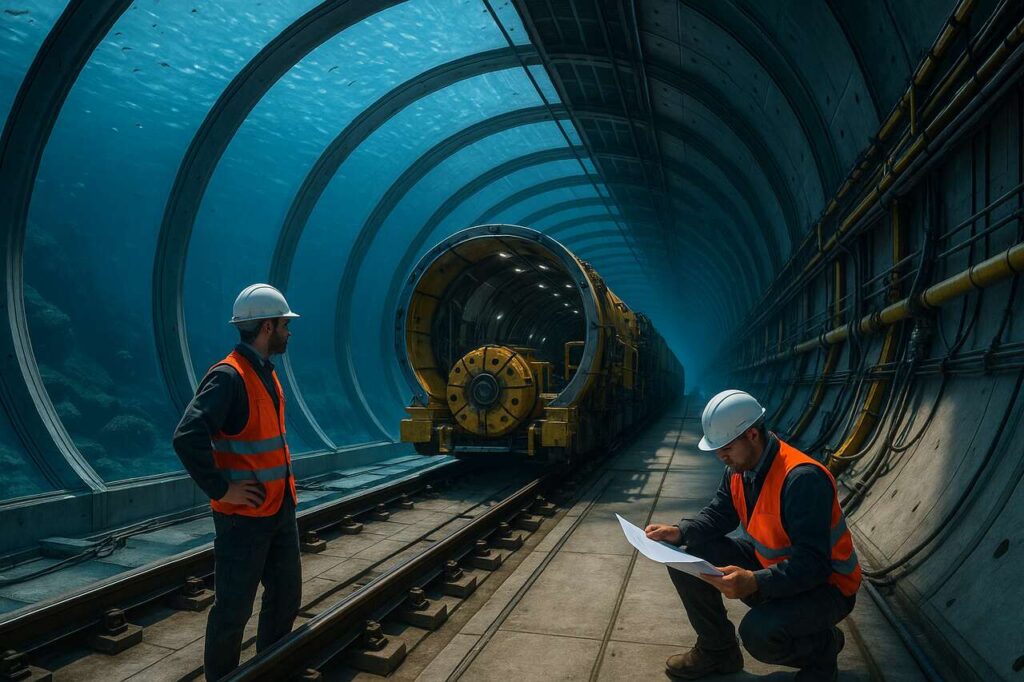
An unprecedented feat of engineering is taking shape deep beneath the waves, promising to physically connect two continents for the first time in modern history. A monumental project is underway to construct the world’s longest underwater high-speed railway, a venture that will redefine the boundaries of international travel and commerce. This submerged artery of steel and concrete aims to slice travel times from hours by sea and air to mere minutes by train, forging a powerful new link between cultures and economies that have been separated by water for millennia. The sheer scale of the ambition is matched only by the complexity of its execution, capturing the attention of engineers, economists, and governments worldwide.
Presentation of the underwater railway line project
A monumental engineering feat
At the heart of this endeavor is the Strait of Gibraltar Fixed Link, a project long dreamed of but only now becoming a technological reality. The plan involves boring a twin-rail tunnel beneath the strait, connecting Punta Paloma in Spain with Malabata in Morocco. Spanning a total length of approximately 23 miles (38 kilometers), with 17 miles (28 kilometers) directly under the sea, it will dwarf existing underwater tunnels like the Channel Tunnel. The trains are designed to reach speeds of over 100 mph (160 km/h), making the intercontinental journey a matter of just 30 minutes. This is not merely a tunnel; it is a permanent, weatherproof, high-capacity bridge between Europe and Africa.
The route and its strategic importance
The chosen route is the shortest distance between the two continents, but it presents significant geological challenges, including its depth and seismic activity. The tunnel will reach a maximum depth of 1,550 feet (475 meters) below sea level. Its strategic importance cannot be overstated. By creating a direct land route, the project aims to:
- Integrate North African economies more closely with the European Union.
- Establish a new, vital corridor for the flow of goods, bypassing maritime chokepoints.
- Create a resilient infrastructure link that is immune to weather disruptions affecting ferries and flights.
- Position Spain and Morocco as key logistical hubs in a new era of global trade.
This railway is envisioned as the backbone of a future Euro-African transport network, a critical piece of infrastructure for the 21st century.
Project stakeholders and funding
This binational project is spearheaded by government-backed companies from both Spain and Morocco: SECEGSA (Sociedad Española de Estudios para la Comunicación Fija a través del Estrecho de Gibraltar) and SNGED (Société Nationale d’Études du Détroit de Gibraltar). The colossal undertaking requires a consortium of international engineering firms, financial institutions, and public investment. The estimated cost is a moving target but is projected to be in the tens of billions of dollars, sourced from a mix of public funds, international development banks, and private investment, reflecting its global significance. It represents a massive financial and political commitment from both nations, underscoring their shared vision for a connected future.
Executing such a vision requires overcoming immense physical and technical hurdles that test the limits of modern engineering.
Technological challenges of construction
Tunneling beneath the seabed
The primary challenge lies in the geology of the strait. The tunnel must traverse a complex mix of hard rock and softer, unstable clay-like materials, all while under immense water pressure. This requires the use of several highly specialized, earth-pressure-balance Tunnel Boring Machines (TBMs), some of the largest ever built. These subterranean behemoths must be capable of adapting to changing ground conditions in real-time to prevent collapses and water ingress. Furthermore, the region is seismically active, meaning the tunnel’s lining must be designed with exceptional flexibility and strength to withstand potential earthquakes, a feat that pushes material science to its absolute limits.
Ensuring passenger safety
Safety is the paramount concern in a tunnel of this length and depth. The design incorporates a three-tunnel system: two main rail tunnels and a smaller central service tunnel. This service tunnel is a critical lifeline, providing a route for emergency services and an escape path for passengers in case of an incident. Advanced systems are being designed for:
- Ventilation and smoke extraction: High-powered fans can clear smoke and maintain breathable air throughout the entire length of the tunnel.
- Fire suppression: State-of-the-art misting systems and fire-resistant materials will be used to contain any potential fires.
- Pressurization: The tunnels will be pressurized to prevent smoke from spreading between them, ensuring the service tunnel remains a safe haven.
These measures are designed to make the tunnel one of the safest transportation infrastructures ever built.
Materials and longevity
Building a structure to last for over a century in a highly corrosive saltwater environment is a monumental task. The tunnel segments will be constructed from a specially formulated, high-performance concrete reinforced with corrosion-resistant steel alloys. Every component, from the rail fasteners to the electrical conduits, must be able to withstand the constant assault of salt and moisture. Cathodic protection systems, which use electrical currents to prevent corrosion, will be installed along the entire length of the tunnel. The goal is to create a structure that is not just functional but enduring for generations, a permanent link that requires minimal major maintenance for over 120 years.
While mastering these technological hurdles is critical, the project’s success also hinges on its ability to coexist with the delicate marine environment it will pass through.
Environmental impact and protection measures
Assessing marine ecosystem disruption
The Strait of Gibraltar is a critical biological corridor for numerous marine species, including whales, dolphins, and tuna. The construction phase, particularly the work at the tunnel portals and any necessary seabed preparation, poses potential risks. Key concerns include underwater noise from drilling, which can disrupt marine mammal communication and navigation, and the suspension of sediment, which can harm filter-feeding organisms and reduce water clarity. An exhaustive Environmental Impact Assessment (EIA) has been conducted to map sensitive habitats and migration routes, forming the basis for a robust mitigation plan.
Mitigation strategies
To minimize its ecological footprint, the project has committed to a series of stringent protection measures. These include the use of acoustic “bubble curtains” around construction sites to dampen underwater noise and sediment barriers to contain disturbed seabed material. Real-time monitoring by marine biologists will be in place to halt work if migratory species are detected nearby. Furthermore, the project includes a significant environmental offset program, which involves funding the restoration of coastal wetlands and the creation of new artificial reefs to actively enhance marine biodiversity in the region, aiming for a net positive environmental impact.
A greener alternative to air and sea travel
Despite the impacts of its construction, the tunnel’s long-term operational benefits present a compelling environmental case. By shifting a significant portion of passenger and freight traffic from ferries and short-haul flights to electric-powered high-speed rail, the project is expected to cause a dramatic reduction in carbon emissions. The comparison is stark.
| Transport Mode | CO2 Emissions (grams per p-km) |
|---|---|
| Short-haul flight | 255 |
| Ferry | 130 |
| High-Speed Rail (electric) | 14 |
This shift represents a substantial contribution to the climate goals of both continents, making the tunnel a key piece of sustainable transport infrastructure for the future.
This potential for a greener, more efficient transport system is directly tied to the profound economic transformations the project is expected to unleash.
Economic benefits for the linked continents
Boosting trade and commerce
The railway will be a game-changer for logistics, creating a seamless and rapid freight corridor between Africa and Europe. Currently, goods moving between the two continents face lengthy delays at ports and are subject to the vagaries of maritime weather. The tunnel will allow for the “just-in-time” delivery of goods, reducing inventory costs and spoilage for perishable products like fresh produce from Morocco. It is projected to handle over 13 million tons of cargo annually, integrating supply chains and making businesses on both sides of the strait more competitive on the global stage. This reliable, high-volume artery will fundamentally reshape trade flows.
Fostering tourism and cultural exchange
For tourism, the project is nothing short of revolutionary. The ability to travel from the heart of Andalusia to the markets of Tangier in under an hour will open up new possibilities for weekend trips and multi-country holidays. It will make the rich cultural heritage of both regions more accessible than ever before, encouraging deeper cultural understanding and exchange. The project is expected to attract an additional 10 million passengers per year, providing a massive stimulus to hotels, restaurants, and local businesses in the regions surrounding the tunnel portals, creating a vibrant, cross-continental tourism hub.
Job creation and regional development
The economic impact begins long before the first train runs. The construction phase alone is a massive engine for job creation, requiring thousands of skilled engineers, technicians, and laborers over more than a decade. But the long-term benefits are even greater. The improved connectivity will attract new investment to southern Spain and northern Morocco, historically less developed regions. New logistics centers, manufacturing plants, and service industries will emerge, creating sustainable, high-quality jobs and fostering balanced regional development for decades to come.
As the project redefines economic geography, it also presents a new set of challenges and opportunities for the broader landscape of global transportation.
Challenges and perspectives for international transport
Integration with existing rail networks
A tunnel is only as effective as the network it connects to. A primary challenge is ensuring seamless integration with the existing high-speed rail networks in Spain (and by extension, Europe) and the developing network in Morocco. This involves more than just physically connecting the tracks; it requires harmonizing technical standards, including track gauge, power supply, and particularly the complex signaling and traffic control systems. Successful integration of the European Rail Traffic Management System (ERTMS) with its Moroccan equivalent is crucial for ensuring smooth, uninterrupted cross-border services.
Security and border control
Creating a high-speed, high-volume border crossing in a subsea tunnel presents unique security challenges. The project requires an unprecedented level of cooperation between Spanish and Moroccan authorities to establish a joint security protocol. The solution being developed involves pre-travel clearance and juxtaposed controls, where passengers and freight clear customs and immigration for the destination country before boarding the train. This “one-stop” security model, similar to that used for the Channel Tunnel, is essential to maintain the speed and efficiency that is the railway’s main selling point while ensuring robust security and border integrity.
A new model for global connectivity
Beyond its regional impact, the Gibraltar project is being watched globally as a blueprint for future intercontinental infrastructure. Its success could inspire and inform other ambitious projects, such as a tunnel connecting Sicily and Tunisia or even the long-envisioned Bering Strait crossing between Asia and North America. It demonstrates that with sufficient political will and technological innovation, physical barriers that have defined global geography for eons can be overcome. It represents a paradigm shift, moving from a world connected primarily by sea and air to one linked by permanent, high-capacity land corridors.
This pioneering spirit is driving the project forward through its complex construction phases toward an eagerly anticipated completion.
Project progress and anticipated timeline
Current status of the project
After decades of feasibility studies and preliminary research, the project has officially moved into an active pre-construction phase. Recent bilateral agreements have revitalized the joint committees, and funding has been allocated for updated, in-depth geological surveys of the seabed using the latest seismic imaging technology. Engineering firms are finalizing the designs for the specialized TBMs, and land has been acquired for the construction of the portal areas and support infrastructure on both continents. While major tunneling has not yet begun, the groundwork—both literal and political—is being laid at an accelerated pace.
Key milestones and phases
The project is broken down into a series of carefully managed phases, each with its own set of objectives and timelines. The complexity of the undertaking requires a long-term perspective.
| Phase | Key Activities | Estimated Completion |
|---|---|---|
| Phase 1: Preparatory Works | Final geological surveys, TBM design, portal site construction | 2-3 years |
| Phase 2: Main Tunneling | Boring of the service and main rail tunnels | 6-8 years |
| Phase 3: Systems Installation | Track laying, installation of electrical, signaling, and safety systems | 3-4 years |
| Phase 4: Testing & Commissioning | System integration tests, trial runs, safety certifications | 1-2 years |
This phased approach allows for continuous assessment and adaptation, ensuring each stage is completed to the highest standard before the next begins.
Looking ahead: the final push
The most challenging and lengthy phase—the main tunneling operation—lies ahead. This will be a relentless, round-the-clock effort, with TBMs advancing slowly but surely from both ends to meet in the middle, deep beneath the strait. Once the physical connection is made, the focus will shift to the intricate task of transforming the raw concrete tube into a modern, high-speed railway. The final push will involve thousands of technicians installing the complex web of systems that will bring the tunnel to life. The anticipation is palpable; this is no longer a distant dream but a concrete project on a clear, albeit lengthy, path to completion.
This monumental undertaking, born from a vision to unite continents, is steadily moving from blueprint to reality. It stands as a powerful testament to human ingenuity, international cooperation, and a shared belief in a more connected world. The project’s success will not only revolutionize trade and travel between Europe and Africa but will also serve as an enduring symbol of what can be achieved when nations work together to overcome the most formidable of natural barriers.