

Prepare for an astronomical spectacle that commands attention. Witness the precise and unforgiving alignment of celestial bodies as the moon completely obscures the sun, casting a sudden, deep twilight upon the earth. This is not a gradual sunset but an abrupt interruption of daylight, a moment that has captivated and unnerved humanity for millennia. Understand the mechanics, the risks, and the profound effects of an event that transforms the familiar sky into an alien landscape. This is a call to observe, to learn, and to experience one of nature’s most awe-inspiring displays: a total solar eclipse.
Understanding the phenomenon of a total solar eclipse
The mechanics of a perfect alignment
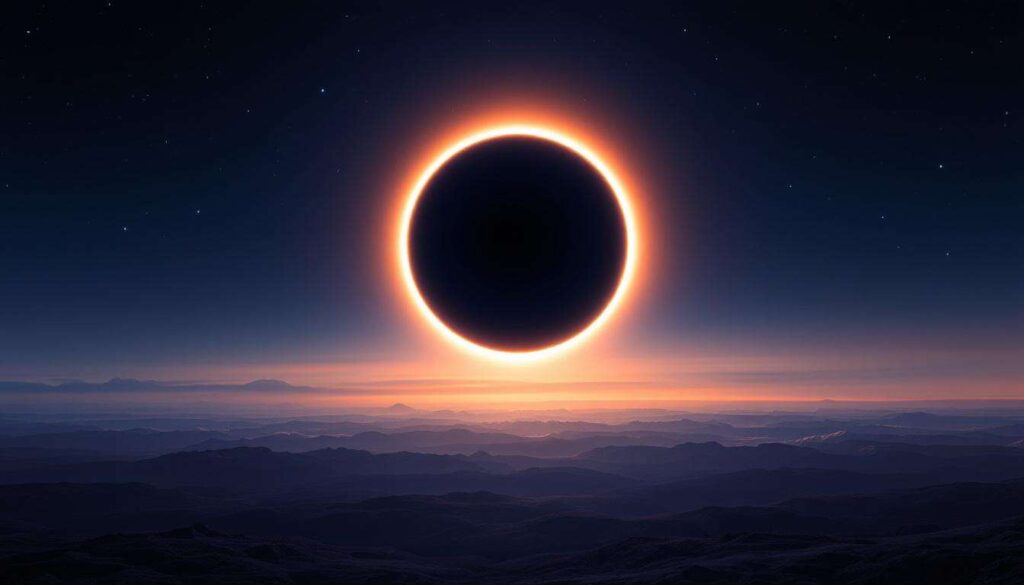
A total solar eclipse occurs during the new moon phase, when the moon passes directly between the sun and earth. This alignment, known as syzygy, casts the moon’s shadow onto our planet. The shadow is composed of two parts: the darker, central part called the umbra, and the lighter, outer part called the penumbra. To witness a total solar eclipse, an observer must be located within the path of the umbra. From this narrow track on the earth’s surface, the moon appears to be the exact same size as the sun, allowing it to completely block the sun’s brilliant face for a few precious minutes.
What makes a total eclipse rare ?
While a new moon occurs every month, several factors must converge to create a total solar eclipse. The moon’s orbit is tilted about five degrees relative to the earth’s orbit around the sun. Because of this tilt, the moon’s shadow usually passes above or below the earth. Furthermore, the moon’s orbit is elliptical, meaning its distance from earth varies. For a total eclipse to happen, the moon must be close enough in its orbit to appear large enough in the sky to fully cover the sun. When it is too far away, it appears smaller, resulting in an annular eclipse where a “ring of fire” remains visible. There are several types of solar eclipses, each defined by the degree of the sun’s obscuration:
- Total eclipse: The sun is completely hidden by the moon, revealing the sun’s faint outer atmosphere, the corona.
- Partial eclipse: Only part of the sun is obscured by the moon. Observers in the penumbra see a partial eclipse.
- Annular eclipse: The moon is too far from earth to completely cover the sun, leaving a bright ring of sunlight visible.
- Hybrid eclipse: A rare event that shifts between an annular and total eclipse along its path.
The precise geometry required for the umbra to touch the earth in a specific location makes totality a truly special event, often occurring in any given spot only once every several centuries. Now that the celestial mechanics are clear, the critical questions become when and where this century’s longest shadow will fall.
The eclipse of the century: dates and observation locations
The great North African eclipse of 2027
Mark your calendars for August 2, 2027. On this day, one of the longest total solar eclipses of the 21st century will occur, with a staggering maximum duration of totality lasting 6 minutes and 23 seconds. This duration is exceptionally long, approaching the theoretical maximum of just over seven and a half minutes. The path of this eclipse offers remarkable viewing opportunities, though it traverses some of the planet’s most remote and sun-drenched landscapes. The shadow will first make landfall on the Atlantic coast of Morocco, cross through northern Africa, and clip the southern tip of Spain before moving over the Middle East.
Key observation points and durations
The longest duration of totality will occur over a remote area of southern Egypt, but numerous accessible locations will provide spectacular views. The city of Luxor, Egypt, is a prime candidate, combining a very long duration of totality with a high probability of clear skies and the stunning backdrop of ancient temples. Other locations offer unique experiences, from the coasts of Spain and Morocco to the historical sites of Tunisia. Choosing a location involves balancing the length of totality with weather prospects and travel logistics.
| Location | Country | Duration of Totality | Local Time of Mid-Eclipse |
|---|---|---|---|
| Tangier | Morocco | 4 minutes, 51 seconds | 10:47 AM |
| Gibraltar | British Overseas Territory | 4 minutes, 28 seconds | 11:48 AM |
| Sfax | Tunisia | 5 minutes, 41 seconds | 11:13 AM |
| Luxor | Egypt | 6 minutes, 23 seconds | 1:02 PM |
| Jeddah | Saudi Arabia | 5 minutes, 55 seconds | 2:28 PM |
Knowing where to be is only the first step. The next, and arguably most critical, is understanding how to witness this celestial event without causing permanent harm to your vision.
Best practices for observing the eclipse safely
The irreversible danger of direct viewing
Looking directly at the sun, even for a few seconds, can cause severe and permanent eye damage. The sun’s intense visible light and invisible ultraviolet (UV) and infrared (IR) radiation can burn the retina, a condition known as solar retinopathy. This damage is often painless, so you may not realize it is happening until it is too late. Standard sunglasses, no matter how dark, are completely insufficient for solar viewing. They do not block the harmful IR and UV radiation that can cause blindness. The only moment it is safe to look at the eclipse without protection is during the brief period of totality, when the sun’s bright face is entirely covered. The instant the sun begins to reappear, you must look away or use proper protection again.
Certified eye protection and alternative methods
To safely watch the partial phases of the eclipse, you must use specialized solar filters. These filters are designed to block more than 99.99% of the sun’s light and all of its harmful radiation. Ensure your equipment meets the international safety standard, ISO 12312-2. Safe viewing methods include:
- Eclipse glasses or handheld solar viewers: These are inexpensive cardboard or plastic glasses with special-purpose solar filters. Always inspect them for scratches or damage before use.
- Solar filters for telescopes and binoculars: If you plan to use magnification, you must place a certified solar filter on the front of the instrument, covering the main lens or aperture. Never look through an unfiltered telescope or binoculars, even while wearing eclipse glasses.
- Pinhole projection: This is a simple, indirect method. Create a small hole in a piece of cardstock and let the sunlight pass through it onto another surface, like a second piece of cardstock or the ground. This projects a small image of the sun, allowing you to watch the moon’s progress safely.
As humans take these careful precautions to observe the event, the natural world around them will be reacting in a much more instinctual, and sometimes chaotic, way to the sudden onset of night.
Impact on fauna and flora: what happens during the eclipse ?
Sudden changes in animal behavior
The rapid fall of light and temperature during a total solar eclipse triggers profound and often confused reactions in animals. Their circadian rhythms, the internal clocks that govern their daily activities, are abruptly disrupted. Observers have reported a wide range of unusual behaviors. Birds, for instance, may become silent and return to their nests as if night has fallen. Conversely, nocturnal creatures like crickets and frogs may begin their evening chorus. Livestock have been known to head back to the barn, and bees, which navigate by polarized light from the sun, often become disoriented and stop flying, returning to their hives. The sudden darkness sends a false signal of nightfall, causing a brief but fascinating period of biological confusion.
The subtle response of plant life
The effects on flora are less dramatic but equally real. Plants that exhibit nyctinastic movements, meaning their leaves or flowers close at night, may begin to do so during totality. For example, the leaves of some legume species might droop, and certain flowers may start to close their petals. Photosynthesis, the process by which plants convert sunlight into energy, will temporarily cease in the umbra. While the short duration of an eclipse has no lasting impact on plant health, it serves as a powerful demonstration of their deep connection to the daily cycle of sunlight. These widespread biological responses, from the smallest insect to the largest tree, highlight the all-encompassing nature of the eclipse’s shadow.
Conclusion: why is this event so exceptional ?
A convergence of rarity and science
This event is exceptional due to the sheer improbability of its mechanics. The perfect cosmic coincidence of the sun being 400 times larger than the moon, but also 400 times farther away, allows for the stunning spectacle of totality. For scientists, an eclipse is a rare opportunity to study the sun’s corona, its wispy outer atmosphere, which is normally invisible due to the overwhelming brightness of the sun’s surface. During totality, this ethereal crown becomes visible, allowing for research into solar wind, temperature paradoxes, and the sun’s magnetic field. This brief window of darkness provides data that is otherwise impossible to gather from earth.
A unifying human experience
Beyond the science, the eclipse is a profound communal event. It connects us to a long history of human observation, from ancient cultures that saw eclipses as omens to modern-day eclipse chasers who travel the globe. For a few minutes, people from all walks of life will stand together, looking up at the same sky in shared wonder. The experience of seeing the sun disappear in the middle of the day, of feeling the temperature drop, and of witnessing the 360-degree sunset on the horizon is a powerful reminder of our place in the cosmos. It is a moment of perspective, beauty, and connection that transcends cultural and national boundaries.
Embrace this rare celestial alignment. Understand the science behind the spectacle, prepare to observe it with the utmost caution, and take a moment to appreciate the profound, fleeting impact it has on our planet and all its inhabitants. Do not miss this opportunity to witness the sky in a way you never have before.